Quick Answer
Idioms for “never going to happen” are colorful expressions used to describe events, situations, or outcomes that are impossible, highly unlikely, or purely imaginary. They add drama, humor, and emphasis to your statements.Examples: when pigs fly, not in a million years, a snowball’s chance in hell
We all face moments when we need to say “no” to an idea, dismiss a fantasy, or shut down an unrealistic hope. But repeating “that will never happen” can feel boring, flat, and uninspired. That’s where idioms come in.
Instead of sounding negative or repetitive, English offers a rich collection of imaginative idioms that bring personality, wit, and clarity to your refusal. When someone says “I’ll believe it when pigs fly” or “that has a snowball’s chance in hell,” you instantly understand the message with zero confusion.
These idioms are especially useful in everyday conversations, business negotiations, storytelling, and even persuasive writing. But to use them naturally, you need to understand their exact meaning, emotional weight, and appropriate setting.
In this guide, you’ll learn:
- Powerful idioms for impossibility
- Real meanings and situations for each
- Formal, casual, and creative examples
- Practical tips for natural usage in 2026
Let’s explore the most expressive idioms that tell the world: this is simply not going to happen.
Quick Summary Table
| SituationBest Idioms | |
|---|---|
| Humorous impossibility | When pigs fly, Pigs might fly |
| Absolute refusal | Not in a million years, Over my dead body |
| Extreme unlikeliness | A snowball’s chance in hell, Fat chance |
| Impossibility due to conditions | When Hell freezes over, On a cold day in Hell |
| Dismissing an idea | Not a chance in the world, Not on your life |
| Logically impossible | Square the circle, Bite the moon |
| Low probability events | Once in a blue moon, Don’t hold your breath |
🐷 Idioms for Humorous Impossibility
Sometimes the best way to say “never” is with a smile. These idioms use humor and absurd imagery to dismiss impossible ideas without sounding harsh or aggressive.
1. When Pigs Fly
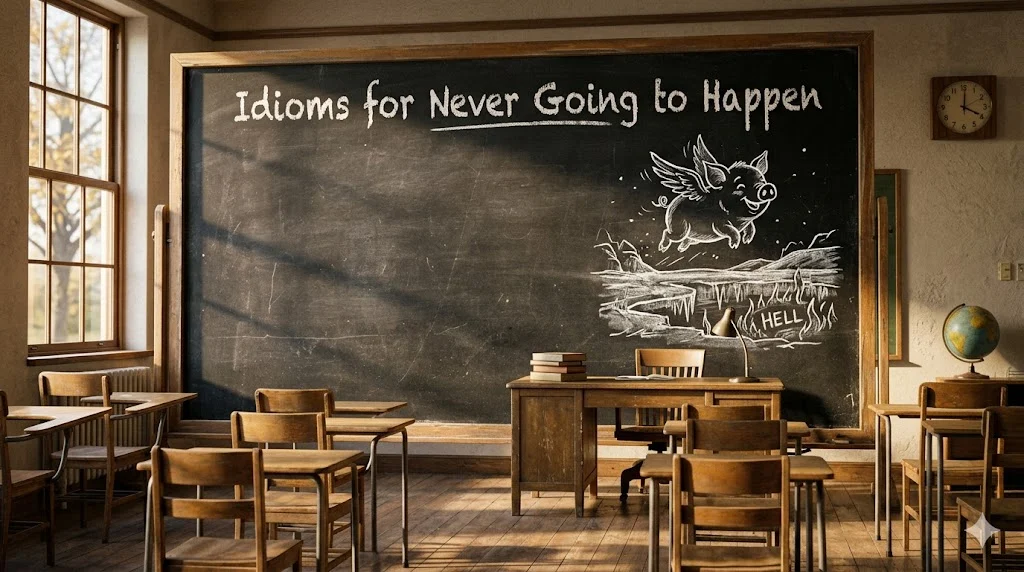
This is arguably the most famous idiom for impossibility in the English language. It creates an instantly recognizable mental image that makes people smile.
Meaning: Something will never happen because pigs don’t have wings
When People Use It: Responding to unrealistic requests, joking with friends, lighthearted disagreements
Alternative Expression: That will never happen
Examples:
- Formal: “The committee suggested we finish the project by tomorrow. I replied that would happen when pigs fly.”
- Casual: “You think he’ll apologize? Yeah, when pigs fly.”
- Creative: “Her promise floated away like a pig with paper wings doomed from the start.”
💡 Usage Insight: This idiom works best in friendly, informal settings. It softens rejection with humor.
2. Pigs Might Fly
A British variation of the classic idiom. While “when pigs fly” states a condition, “pigs might fly” expresses skeptical doubt about a specific suggestion.
Meaning: That is extremely unlikely to happen
When People Use It: British English conversations, expressing doubt politely
Alternative Expression: I doubt it very much
Examples:
- Formal: “He claims he’ll arrive on time. Pigs might fly.”
- Casual: “She said she’s quitting sugar. Pigs might fly, mate.”
- Creative: “Hope flapped awkwardly on unlikely wings, a pig dreaming of clouds.”
💡 Memory Tip: Think of this as the British cousin of “when pigs fly” slightly more understated but equally dismissive.
3. When Horses Fly
A lesser-known but equally effective variation. Some English speakers use this to avoid clichés while keeping the same humorous tone.
Meaning: Never, because horses cannot fly either
When People Use It: Creative writing, avoiding overused phrases
Alternative Expression: Impossible
Examples:
- Formal: “That merger will succeed when horses fly.”
- Casual: “Him remembering my birthday? When horses fly.”
- Creative: “Their agreement seemed as distant as galloping hoofbeats in empty clouds.”
❄️ Idioms Using Hell & Cold Imagery
These idioms draw on vivid, often dramatic imagery involving extreme cold or mythical scenarios. They pack emotional punch and are perfect for emphatic refusals.
4. When Hell Freezes Over
This idiom creates a powerful contrast hell, the hottest place imaginable, freezing solid. The impossibility is instant and obvious.
Meaning: Never, because hell freezing is impossible
When People Use It: Strong refusals, dramatic statements, expressing absolute certainty
Alternative Expression: Absolutely never
Examples:
- Formal: “The two parties will reach an agreement when hell freezes over.”
- Casual: “I’ll forgive him? When hell freezes over.”
- Creative: “Her patience would return only on the day ice claimed the underworld.”
5. On a Cold Day in Hell
A slightly longer variation that emphasizes the same impossible condition. It feels more conversational and less dramatic than “when hell freezes over.”
Meaning: Never, under any circumstances
When People Use It: Everyday conversations, expressing firm refusal
Alternative Expression: No chance at all
Examples:
- Formal: “He will admit his mistake on a cold day in hell.”
- Casual: “You’ll see me at that reunion on a cold day in hell.”
- Creative: “Forgiveness would arrive only when hell wore frost and shadows shivered.”
6. Not a Snowball’s Chance in Hell
This idiom combines two impossibilities: a snowball surviving in hell, plus the heat of hell. The imagery is vivid, almost comic, and instantly understood.
Meaning: Absolutely no possibility of success
When People Use It: Dismissing plans, describing doomed efforts, negative predictions
Alternative Expression: Zero chance
Examples:
- Formal: “The proposal has not a snowball’s chance in hell of passing.”
- Casual: “His startup has a snowball’s chance in hell.”
- Creative: “Her ambition melted faster than frost in a furnace.”
💡 Usage Insight: This is one of the most expressive idioms for impossibility. Use it when you want to be memorable and emphatic.
❌ Idioms for Absolute Refusal
These idioms go beyond stating impossibility they express personal refusal or strong resistance to an idea or request.
7. Over My Dead Body
This idiom creates a powerful condition: the requested action can only happen if the speaker dies first. It’s dramatic, personal, and leaves no room for negotiation.
Meaning: I will strongly resist or prevent this from happening
When People Use It: Protecting something valuable, refusing dangerous or unwanted requests
Alternative Expression: Absolutely not, I will stop you
Examples:
- Formal: “They wanted to sell the family business. I told them over my dead body.”
- Casual: “You’re borrowing my car? Over my dead body.”
- Creative: “Permission would be granted only when his heart stopped beating.”
8. Not in a Million Years
This idiom uses an exaggerated timeframe to emphasize impossibility. It feels less aggressive than “over my dead body” but equally final.
Meaning: That will never happen, even given unlimited time
When People Use It: Responding to unrealistic hopes, rejecting suggestions politely
Alternative Expression: Never ever
Examples:
- Formal: “She will apologize not in a million years.”
- Casual: “Me becoming a morning person? Not in a million years.”
- Creative: “His return felt as distant as a calendar counting infinity.”
9. Not on Your Life
A shorter, punchier version of “not in a million years.” It adds a sense of personal stake and strong emotion.
Meaning: Absolutely not, I refuse completely
When People Use It: Quick refusals, emotional responses
Alternative Expression: No way
Examples:
- Formal: “Would I invest in that scheme? Not on your life.”
- Casual: “You want me to sing? Not on your life.”
- Creative: “Her agreement would cost more than any soul would pay.”*
10. Not a Chance in the World
This idiom emphasizes that no possibility exists anywhere, not just in the current situation or location.
Meaning: Absolutely no possibility exists
When People Use It: Expressing certainty about impossibility
Alternative Expression: Completely impossible
Examples:
- Formal: “There is not a chance in the world they will accept those terms.”
- Casual: “Him winning? Not a chance in the world.”
- Creative: “Hope evaporated leaving no trace in any universe.”
🎲 Idioms for Low Probability (Almost Never)
Some events aren’t strictly impossible but are so unlikely that they might as well be. These idioms describe events that technically could happen but realistically won’t.
11. Once in a Blue Moon
A blue moon (the second full moon in a calendar month) happens approximately once every 2.5 years. It’s rare but possible. This idiom describes rare events without claiming absolute impossibility.
Meaning: Very rarely, almost never
When People Use It: Describing infrequent events, contrasting with “always” or “often”
Alternative Expression: Very rarely
Examples:
- Formal: “Such alignment of interests occurs once in a blue moon.”
- Casual: “He visits his parents once in a blue moon.”
- Creative: “Her laughter appeared as rarely as the calendar’s second full glow.”
💡 Usage Insight: This idiom is softer than others. Use it for rare events, not absolute impossibilities.
12. Don’t Hold Your Breath
This idiom advises someone not to wait because the expected event will take too long or never happen. It’s practical and slightly cynical.
Meaning: Don’t expect this to happen soon or at all
When People Use It: Advising patience, managing expectations
Alternative Expression: Don’t wait for it
Examples:
- Formal: “They promise changes, but don’t hold your breath.”
- Casual: “He said he’ll pay me back. Don’t hold your breath.”
- Creative: “Hope suffocated slowly as seconds stretched into silence.”*
13. Fat Chance
This sarcastic idiom uses “fat” (meaning large or abundant) to describe a chance that is actually zero. The sarcasm is deliberate and obvious.
Meaning: That is very unlikely (said sarcastically)
When People Use It: Responding to ridiculous requests, expressing disbelief
Alternative Expression: No way, in your dreams
Examples:
- Formal: “He expects a promotion after that performance? Fat chance.”
- Casual: “You think I’m lending you money? Fat chance.”
- Creative: “Opportunity stood heavy weight and empty, a joke wearing probability’s mask.”*
⚠️ Warning: This idiom can sound rude in formal settings. Use it only with people you know well.
14. When the Sun Sets in the East
This idiom uses a natural impossibility (the sun setting in the east instead of the west) to dismiss an idea. It’s slightly old-fashioned but still understood.
Meaning: Never, because this violates natural laws
When People Use It: Literary contexts, older speakers, creative writing
Alternative Expression: When impossible things happen
Examples:
- Formal: “His return to power would happen when the sun sets in the east.”
- Casual: “Her becoming humble? When the sun sets in the east.”
- Creative: “Justice would rise only from the wrong horizon.”*
🧠 Logical & Mathematical Impossibility Idioms
These idioms appeal to logic, mathematics, or physical laws. They feel intellectual and are perfect for more serious discussions.
15. Square the Circle
This refers to an ancient geometry problem: constructing a square with the same area as a given circle using only compass and straightedge. Mathematicians proved this impossible in 1882.
Meaning: Attempt the impossible, especially due to logical contradictions
When People Use It: Academic discussions, philosophical debates, describing futile efforts
Alternative Expression: Attempt the impossible
Examples:
- Formal: “The committee tried to square the circle by pleasing everyone.”
- Casual: “He’s trying to square the circle with that budget.”
- Creative: “Her plan folded angles into curves, seeking perfect lies.”*
💡 Memory Tip: Think of this as the intellectual’s “when pigs fly.” It carries more weight in formal writing.
16. Bite the Moon
A less common but beautifully visual idiom. Biting the moon is physically impossible, making it perfect for poetic or creative contexts.
Meaning: Attempt something completely impossible
When People Use It: Poetry, creative writing, artistic expression
Alternative Expression: Chase the impossible
Examples:
- Formal: “Demanding perfection on the first draft is like asking someone to bite the moon.”
- Casual: “You think you can finish that in an hour? Might as well bite the moon.”
- Creative: “He reached for glory knowing his teeth would find only light.”*
17. Get Blood from a Stone
This idiom describes trying to extract something (money, information, emotion) from someone who simply doesn’t have it to give.
Meaning: Try to obtain something from an uncooperative or unable source
When People Use It: Describing difficult people, impossible requests, frustration
Alternative Expression: Impossible extraction
Examples:
- Formal: “Getting a straight answer from him is like getting blood from a stone.”
- Casual: “Trying to get him to talk? Blood from a stone.”
- Creative: “Her secrets hardened into granite, yielding nothing to desperate hands.”*
🌊 Idioms for Futile or Hopeless Efforts
These idioms describe not just impossibility but the futility of even trying. They’re perfect for situations where effort is wasted.
18. Build Castles in the Air
This idiom describes planning or hoping for things that have no realistic foundation. The plans are beautiful but impossible to realize.
Meaning: Make impossible or unrealistic plans
When People Use It: Describing dreamers, criticizing impractical ideas
Alternative Expression: Daydream unrealistically
Examples:
- Formal: “He spends his time building castles in the air instead of working.”
- Casual: “Stop building castles in the air and get real.”
- Creative: “Her ambitions floated skyward on foundations made of mist.”*
19. Milk a Bull
A blunt and slightly humorous idiom. Male bulls do not produce milk, so this action is completely impossible.
Meaning: Attempt something completely futile or impossible
When People Use It: Informal settings, expressing frustration with wasted effort
Alternative Expression: Waste your time
Examples:
- Formal: “Trying to convince him is like milking a bull.”
- Casual: “You’re milking a bull with that approach.”
- Creative: “Effort drained into emptiness, fingers grasping at dry nothing.”*
20. Catch a Falling Star
Made famous by a popular song, this idiom describes attempting something rare, magical, and ultimately impossible.
Meaning: Attempt something extremely rare or impossible
When People Use It: Poetic contexts, romantic disappointments, creative writing
Alternative Expression: Chase the impossible
Examples:
- Formal: “Expecting perfection from humans is like trying to catch a falling star.”
- Casual: “Finding an honest politician? Might as well catch a falling star.”
- Creative: “He reached for brilliance knowing meteors burn before they land.”*
📚 Idioms for Impossible Conditions
These idioms state that an event will happen only if another impossible condition is met first. They’re structured as conditional statements.
21. When the Moon Turns to Blood
This idiom comes from religious and apocalyptic imagery. It describes an event so dramatic and unlikely that it signals the end of the world.
Meaning: Never, or only during a cataclysmic event
When People Use It: Dramatic statements, religious contexts, storytelling
Alternative Expression: At the end of the world
Examples:
- Formal: “Peace will come when the moon turns to blood.”
- Casual: “He’ll apologize when the moon turns to blood.”
- Creative: “Redemption awaited only unstable transformations.”*
22. When Fish Grow Legs
This idiom uses evolutionary impossibility as its condition. Fish evolved legs millions of years ago, but the idiom treats it as impossible in human timescales.
Meaning: Never, because evolution takes too long
When People Use It: Humorous refusals, casual conversations
Alternative Expression: Not in this lifetime
Examples:
- Formal: “That policy will change when fish grow legs.”
- Casual: “Her becoming organized? When fish grow legs.”
- Creative: “Progress walked on impossible limbs through evolutionary dreams.”*
23. When the Clock Strikes Thirteen
Clocks only strike twelve. A thirteenth strike would mean something is fundamentally wrong, making this a perfect impossibility condition.
Meaning: Never, because it violates basic systems
When People Use It: Literary contexts, dramatic refusals
Alternative Expression: When impossible things happen
Examples:
- Formal: “Trust will return when the clock strikes thirteen.”
- Casual: “I’ll believe his excuse when the clock strikes thirteen.”
- Creative: “Forgiveness waited beyond numbered hours in silence.”*
🎯 How to Use Idioms for “Never Going to Happen” Naturally
Using impossibility idioms can make your English more colorful, persuasive, and memorable. But only if you use them correctly. Here’s how to sound natural, confident, and appropriate.
Match the Situation’s Emotional Tone
Not all impossibility idioms carry the same emotional weight. Choosing the wrong one can make you sound rude, dramatic, or confused.
For humor and lighthearted refusal:
- When pigs fly
- Pigs might fly
- When horses fly
👉 “You think you can beat me at chess? When pigs fly.”
For strong, emotional refusal:
- Over my dead body
- Not in a million years
- When hell freezes over
👉 “You’re selling that heirloom over my dead body.”
For logical or analytical impossibility:
- Square the circle
- Get blood from a stone
👉 “Trying to satisfy both sides is squaring the circle.”
For describing rare events:
- Once in a blue moon
- Don’t hold your breath
👉 “He helps with chores once in a blue moon.”
Keep Your Audience in Mind
Some idioms sound fine between friends but strange or offensive in professional settings.
Avoid these in formal or professional writing:
- Fat chance (sarcastic, rude)
- Over my dead body (dramatic, emotional)
- A snowball’s chance in hell (vulgar reference to hell)
Use these in professional contexts:
- Not in a million years
- Not a chance in the world
- Square the circle
- Once in a blue moon
👉 “The board will approve that request? Not in a million years.”
Use these with friends and family:
- When pigs fly
- Fat chance
- When hell freezes over
👉 “You buying dinner? Fat chance, dude.”
Don’t Overuse Idioms
Idioms are like spices. A little adds flavor. Too much ruins the dish.
Bad example (too many idioms):
“When pigs fly and hell freezes over, not in a million years, fat chance, over my dead body will I agree to that.”
Good example (one strong idiom):
“I’ll agree to that when hell freezes over.”
💡 Golden Rule: Use one idiom per statement. Let it breathe. Let it land.
Consider Mental Health Sensitivity
Some impossibility idioms reference mental states or conditions. Use them carefully.
Avoid these in sensitive contexts:
- Any idiom suggesting mental instability
- Idioms that mock conditions or disabilities
Stick to neutral impossibility idioms:
- Not in a million years
- When pigs fly
- Once in a blue moon
If you’re unsure, choose a simpler expression like “that’s very unlikely” or “I don’t think that will happen.”
🚀 Common Mistakes to Avoid
Even advanced English speakers make mistakes with impossibility idioms. Here’s what to watch out for.
❌ Mixing Idioms Incorrectly
Wrong: “When pigs freeze over” (mixes “when pigs fly” and “when hell freezes over”)
Right: “When pigs fly” OR “When hell freezes over”
❌ Using Sarcastic Idioms in Serious Situations
Wrong (at a funeral): “Him coming back? Fat chance.”
Right: “That outcome is very unlikely.”
❌ Taking Idioms Literally
Foreign speakers sometimes misunderstand that idioms aren’t literal.
Literal misunderstanding: “When will pigs actually grow wings and fly?”
Understanding the idiom: “You mean it will never happen.”
❌ Using “Once in a Blue Moon” for Absolute Impossibility
Wrong: “Will the sun rise tomorrow? Once in a blue moon.”
Right: “Does he call his mother? Once in a blue moon.”
Remember: “Once in a blue moon” means very rare, not impossible.
📝 Practice Method That Actually Works
Learning idioms isn’t about memorization. It’s about usage, repetition, and real-world application. Here’s a simple system.
1. Learn Three Idioms Per Week
Don’t overload yourself. Choose three idioms from this guide. Understand their meaning, tone, and context.
Week 1 focus:
- When pigs fly (humorous)
- Not in a million years (emphatic refusal)
- Once in a blue moon (rare events)
2. Use Each Idiom in Five Real Sentences
Write or speak five original sentences for each idiom. Make them personal.
Example for “when pigs fly”:
- “My brother said he’ll clean his room when pigs fly.”
- “The government lowering taxes? When pigs fly.”
- “She promised to return my book. Yeah, when pigs fly.”
- “Him admitting he’s wrong? When pigs fly.”
- “My cat becoming friendly with the dog? When pigs fly.”
3. Create One Creative Story Using Multiple Idioms
Write a short paragraph (50-100 words) using several impossibility idioms naturally.
Example:
“My boss said we’d get bonuses this year. Not in a million years, I thought. He also promised less overtime when hell freezes over. And flexible hours? When pigs fly. I’m not holding my breath. I’ll believe any of it once in a blue moon.”
4. Practice with a Language Partner or Recording
Say your sentences out loud. Record yourself. Listen for unnatural phrasing or overuse.
💡 Memory Trick: Connect each idiom to a visual image in your mind.
- When pigs fly → Picture a pink pig with bird wings
- Over my dead body → Imagine a tombstone with “NO” written on it
- Snowball’s chance in hell → See a tiny snowball melting instantly in flames
🧠 Quick Reference: Idioms by Strength Level
| Strength Level | Idioms |
|---|---|
| Mild (rare but possible) | Once in a blue moon, Don’t hold your breath |
| Medium (very unlikely) | Not in a million years, Fat chance |
| Strong (practically impossible) | When pigs fly, A snowball’s chance in hell |
| Absolute (logically impossible) | Square the circle, When hell freezes over |
| Emotional refusal | Over my dead body, Not on your life |
❓ FAQs
1. What does “when pigs fly” mean in English?
“When pigs fly” means something will never happen. It’s a humorous way to say “impossible.” Example: “He’ll arrive on time when pigs fly.”
2. Is “a snowball’s chance in hell” offensive?
It can be mildly offensive in religious or very formal contexts because it mentions hell. In casual conversation, it’s generally acceptable.
3. Can I use these idioms in business writing?
Some work well. Use “not in a million years,” “once in a blue moon,” or “square the circle.” Avoid “over my dead body” and “fat chance” in professional settings.
4. What’s the difference between “once in a blue moon” and “when pigs fly”?
“Once in a blue moon” means very rare but possible (every 2.5 years). “When pigs fly” means absolutely impossible (never). Use them accordingly.
5. How do I remember all these idioms?
Start with the three most common: when pigs fly, not in a million years, once in a blue moon. Use them for one week. Add three more the next week. Practice consistently.
6. Are these idioms used in 2026?
Yes. All idioms in this guide remain current and understood by native English speakers in 2026. Some (like “square the circle”) are more formal, but all are active.
7. Can children understand these idioms?
Most children understand “when pigs fly” and “not in a million years” by age 8-10. “A snowball’s chance in hell” is not appropriate for children due to the reference to hell.
8. Do these idioms work in all English-speaking countries?
Most work universally across the US, UK, Canada, Australia, and New Zealand. “Pigs might fly” is more common in the UK. “Not a snowball’s chance in hell” is more common in North America.
✅ Conclusion
Idioms for “never going to happen” give you the power to say “no” with style, humor, clarity, and emotional precision. Instead of repeating dull phrases like “that’s impossible” or “never,” you can choose from dozens of colorful expressions that match your exact tone and situation.
Whether you’re joking with friends (when pigs fly), refusing a request at work (not in a million years), describing a rare event (once in a blue moon), or explaining a logical impossibility (square the circle), there’s an idiom that fits perfectly.
The key is simple:
- Match the idiom to the situation’s emotional tone
- Keep your audience in mind
- Don’t overuse idioms in one sentence
- Practice consistently with real examples
Once you start using these idioms in real conversations, your English will feel more alive, expressive, and naturally fluent. You’ll sound less like a textbook and more like a native speaker who understands the subtle art of saying “never” in a hundred different ways.
So next time someone asks if you’ll do something impossible, smile and say: “When pigs fly, my friend. When pigs fly.”
Read More Related Articles:
- Idioms for Hard Work | Expressing Dedication, Effort & Perseverance Naturally In 2026
- Idioms for Kids / Children | Fun & Easy English Expressions In 2026
- Idioms for Achieving Goals | Expressing Ambition & Determination In 2026

Urban Hunter is an American writer at IdiomCrafter.com, with a keen interest in how language shapes everyday conversations. She enjoys turning common expressions into engaging and easy-to-follow reads. Outside of writing, she spends time exploring new words and their hidden meanings.