Quick Answer
Idioms for love are expressive phrases used to describe romantic feelings, deep affection, attraction, and emotional connection in a more vivid and natural way.
Examples: fall head over heels, love at first sight, tied the knot
Love is one of the most powerful emotions humans experience and naturally, language has evolved countless ways to express it. Instead of simply saying “I love you,” English offers a wide range of idioms for love that capture everything from attraction and romance to heartbreak and deep emotional bonds.
Think about phrases like “fall head over heels” or “love at first sight.” These expressions don’t just describe love they bring it to life, making conversations more engaging, emotional, and relatable.
Whether you’re talking about relationships, storytelling, poetry, or even casual conversations, using idioms helps you sound more natural and expressive. But the key is knowing when and how to use them correctly.
In this guide, you’ll explore:
- 25+ powerful idioms for love
- Their meanings and real-life usage
- Formal, casual, and creative examples
- Practical tips to use them naturally
Let’s explore the most expressive idioms that bring language to life.
Quick Summary Table
| Situation | Idiom Examples |
|---|---|
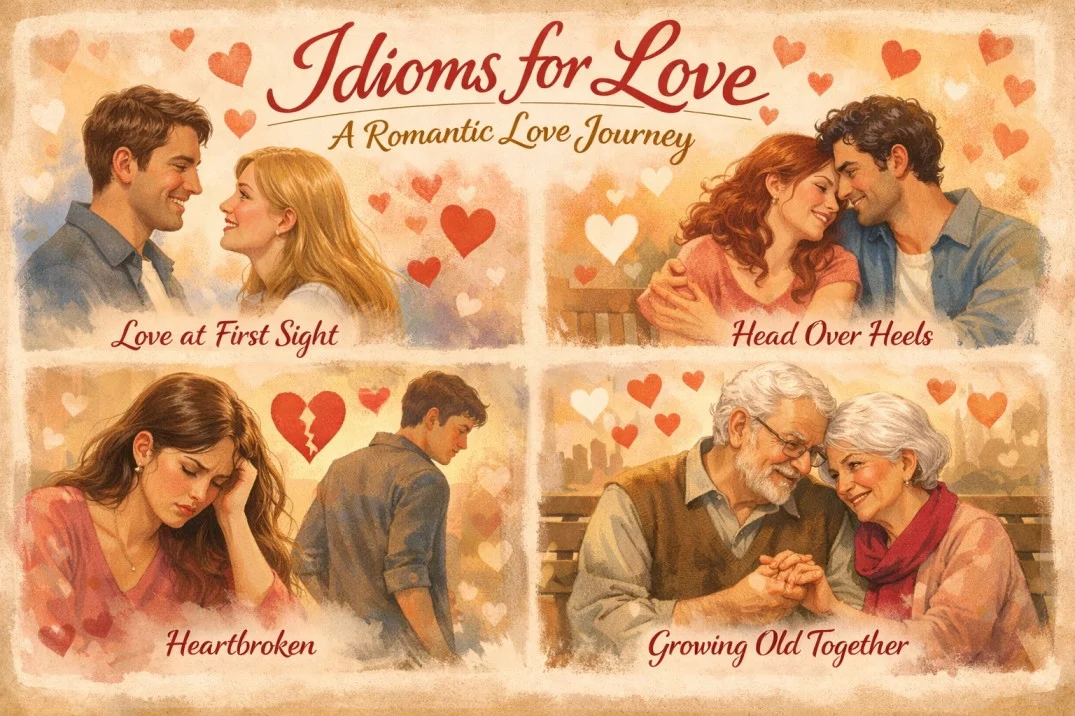
| Falling in love | Fall head over heels, Love at first sight |
| Deep affection | Apple of my eye, Carry a torch |
| Romantic relationships | Tie the knot, Better half |
| Heartbreak | Break someone’s heart, Love lost |
| Flirting & attraction | Have a crush, Sweep off feet |
💘 Idioms for Falling in Love
Love often begins suddenly unexpected, exciting, and impossible to ignore.
1. Fall Head Over Heels
This idiom describes a powerful and sudden feeling of deep love.
Meaning: Fall deeply and completely in love
When People Use It: At the beginning of intense romantic feelings
Alternative Expression: Deeply in love
Examples:
Formal: He fell head over heels in love with her.
Casual: I totally fell head over heels.
Creative: His heart flipped completely, surrendering to love.
2. Love at First Sight
Some connections feel instant, as if they were meant to happen.
Meaning: Falling in love immediately upon meeting
When People Use It: Romantic first encounters
Alternative Expression: Instant attraction
Examples:
Formal: It was love at first sight.
Casual: I knew right away.
Creative: Their eyes met, and everything changed in a moment.
3. Sweep Someone Off Their Feet
This expression reflects charm and romantic intensity.
Meaning: Impress someone romantically in a big way
When People Use It: When someone is deeply impressed
Alternative Expression: Charm completely
Examples:
Formal: He swept her off her feet with his kindness.
Casual: He totally swept her off her feet.
Creative: His presence lifted her into a world of romance.
💡 Usage Insight: These idioms are perfect for describing the beginning stage of love, where emotions are intense and exciting.
❤️ Idioms for Deep Love & Affection
As love grows, it becomes deeper, more meaningful, and emotionally rooted.
4. Apple of Someone’s Eye
This idiom expresses strong affection and importance.
Meaning: Someone very precious and loved
When People Use It: For partners, children, or loved ones
Alternative Expression: Beloved
Examples:
Formal: She is the apple of his eye.
Casual: She’s everything to him.
Creative: She held a special place in his world.
5. Carry a Torch for Someone
Love doesn’t always fade it sometimes lingers quietly.
Meaning: Have ongoing romantic feelings for someone
When People Use It: One-sided or lasting love
Alternative Expression: Still in love
Examples:
Formal: He still carries a torch for her.
Casual: He’s still into her.
Creative: His feelings glowed softly over time.
6. Head Over Heart
Sometimes love makes you choose emotion over logic.
Meaning: Follow emotions instead of reason
When People Use It: Emotional decisions in love
Alternative Expression: Act emotionally
Examples:
Formal: She chose head over heart.
Casual: I just followed my feelings.
Creative: Her heart led where logic hesitated.
💍 Idioms for Relationships & Commitment
Love often leads to commitment, partnership, and lifelong bonds.
7. Tie the Knot
Marriage is one of the most common expressions of commitment.
Meaning: Get married
When People Use It: Weddings and relationships
Alternative Expression: Get married
Examples:
Formal: They tied the knot last year.
Casual: They’re getting married.
Creative: Their lives intertwined forever.
8. Better Half
A loving way to refer to your partner.
Meaning: Your spouse or partner
When People Use It: Casual or affectionate speech
Alternative Expression: Partner
Examples:
Formal: He attended the event with his better half.
Casual: I’m going with my better half.
Creative: Together, they completed each other.
9. Match Made in Heaven
Some relationships feel perfectly destined.
Meaning: Perfectly suited couple
When People Use It: Ideal relationships
Alternative Expression: Perfect match
Examples:
Formal: They are a match made in heaven.
Casual: They’re perfect together.
Creative: Their bond felt written in the stars.
💡 Memory Tip: Think of weddings, destiny, and emotional connection to remember these idioms.
💔 Idioms for Heartbreak & Lost Love
Not all love stories last forever some end in pain and emotional struggle.
10. Break Someone’s Heart
One of the most common expressions of emotional pain.
Meaning: Cause deep emotional hurt
When People Use It: Relationship endings
Alternative Expression: Hurt deeply
Examples:
Formal: He broke her heart.
Casual: She really hurt me.
Creative: His words shattered her world.
11. Love Lost
Sometimes love fades over time.
Meaning: A relationship that has ended
When People Use It: Past relationships
Alternative Expression: Past love
Examples:
Formal: It was a case of love lost.
Casual: It’s over now.
Creative: Their love faded into memory.
12. Cry One’s Heart Out
Heartbreak often leads to intense emotional release.
Meaning: Cry intensely due to sadness
When People Use It: Emotional pain
Alternative Expression: Cry deeply
Examples:
Formal: She cried her heart out.
Casual: I cried so much.
Creative: Tears carried her pain away.
😍 Idioms for Attraction & Flirting
Before love fully develops, attraction and chemistry often take the lead.
13. Have a Crush on Someone
A light and common expression for early attraction.
Meaning: Feel romantic attraction
When People Use It: Early stages of liking someone
Alternative Expression: Be attracted
Examples:
Formal: He has a crush on her.
Casual: I like him.
Creative: His attention lingered on her quietly.
14. Love-Struck
When someone is overwhelmed by romantic feelings.
Meaning: Strongly affected by love
When People Use It: Early intense attraction
Alternative Expression: Infatuated
Examples:
Formal: He appeared love-struck.
Casual: He’s totally in love.
Creative: His world revolved around her.
15. Make Eyes at Someone
This playful idiom captures the subtle, often unspoken side of attraction where emotions are expressed through glances rather than words.
Meaning: Flirt using eye contact
When People Use It: Light, playful flirting situations
Alternative Expression: Flirt
Examples:
Formal: He was making eyes at her across the room.
Casual: He was totally checking her out.
Creative: Their glances spoke louder than words.
🔥 Idioms for Passion & Intense Love
Not all love is calm and quiet some love stories are filled with intensity, desire, and emotional fire. These idioms reflect deep passion and powerful romantic feelings.
16. Madly in Love
A classic expression used to describe love that is overwhelming, consuming, and deeply emotional.
Meaning: Deeply and passionately in love
When People Use It: Strong romantic relationships
Alternative Expression: Deep love
Examples:
Formal: They are madly in love with each other.
Casual: They’re chaotic about each other.
Creative: Their love burned bright and unstoppable.
17. Set One’s Heart on Someone
This idiom shows a strong emotional decision when someone chooses a person with complete certainty.
Meaning: Strongly desire someone romantically
When People Use It: Determined love or admiration
Alternative Expression: Be emotionally committed
Examples:
Formal: She set her heart on him from the beginning.
Casual: She really wants him.
Creative: Her heart chose him without hesitation.
18. Fall for Someone
A very common and natural idiom that describes the beginning of love, often unexpectedly.
Meaning: Begin to develop romantic feelings
When People Use It: Early stages of love
Alternative Expression: Develop feelings
Examples:
Formal: He fell for her quite quickly.
Casual: I fell for him.
Creative: Love quietly found its way into his heart.
🌹 Idioms for Long-Term Love & Loyalty
True love is not just about passion it’s about commitment, support, and staying together through life’s ups and downs.
19. Stand by Someone
This idiom reflects loyalty and emotional support, especially during difficult times.
Meaning: Support someone in all situations
When People Use It: Loyalty and commitment
Alternative Expression: Stay loyal
Examples:
Formal: She stood by him during challenging times.
Casual: I’ll always be there for you.
Creative: She remained his strength through every storm.
20. Through Thick and Thin
A powerful expression that emphasizes staying together no matter what challenges arise.
Meaning: Remain together in all circumstances
When People Use It: Strong, lasting relationships
Alternative Expression: Always together
Examples:
Formal: They stayed together through thick and thin.
Casual: We’ve been through everything together.
Creative: Their bond survived every rise and fall.
21. Old Flame
This idiom refers to a past love that still holds emotional significance.
Meaning: A past romantic partner
When People Use It: Talking about previous relationships
Alternative Expression: Ex-lover
Examples:
Formal: He unexpectedly met an old flame.
Casual: I ran into my ex.
Creative: Memories of a past love quietly returned.
💞 Idioms for Romantic Gestures & Expression
Love is often shown through actions and emotions rather than words. These idioms reflect how people express love openly and meaningfully.
22. Wear Your Heart on Your Sleeve
This idiom describes someone who expresses their emotions honestly and openly.
Meaning: Show emotions openly
When People Use It: Emotional transparency
Alternative Expression: Be expressive
Examples:
Formal: He wears his heart on his sleeve in relationships.
Casual: He shows his feelings openly.
Creative: His emotions were visible in every word and gesture.
23. Steal Someone’s Heart
A romantic and slightly poetic idiom that describes winning someone’s love effortlessly.
Meaning: Make someone fall in love
When People Use It: Attraction and affection
Alternative Expression: Win affection
Examples:
Formal: She stole his heart instantly.
Casual: He totally fell for her.
Creative: She captured his heart without trying.
24. Win Someone’s Heart
This idiom emphasizes earning love through actions, kindness, or personality.
Meaning: Gain someone’s love or affection
When People Use It: Romantic effort and connection
Alternative Expression: Impress romantically
Examples:
Formal: He won her heart through his sincerity.
Casual: He impressed her a lot.
Creative: His actions slowly opened the door to her heart.
25. Lovebirds
A warm and affectionate term used to describe couples who are clearly in love.
Meaning: A couple deeply in love
When People Use It: Happy, affectionate relationships
Alternative Expression: Romantic couple
Examples:
Formal: The lovebirds enjoyed a peaceful evening together.
Casual: They’re so in love.
Creative: Their world revolved entirely around each other.
💞 How to Use Idioms for Love Naturally
Using idioms for love is not just about sounding romantic it’s about expressing emotions in a way that feels real, relatable, and emotionally accurate. When used correctly, these idioms can make your language more engaging and human. But if used incorrectly, they can feel forced or even awkward.
Let’s break down how to use them naturally and effectively.
✔ Use Idioms in Real Conversations
Idioms are most powerful when they reflect how people actually speak in everyday life. Instead of using plain or overly direct sentences, idioms help you express feelings in a softer, more natural way.
Examples:
Instead of: I really like her
Say: I think I’m falling for her
Instead of: He likes her a lot
Say: He has a crush on her
Instead of: They love each other deeply
Say: They’re madly in love
Why this works:
These expressions sound more natural and emotionally expressive, which is exactly how people talk about love in real situations.
💡 Pro Tip:
Use idioms where they feel natural don’t force them into every sentence.
✔ Match the Context (Casual vs Formal)
Love can be expressed in different tones depending on the situation. Choosing the right idiom based on context is essential for sounding appropriate and fluent.
🔹 Casual Context
In everyday conversations, light and simple idioms feel more natural and relatable.
Examples:
- “I have a crush on him.”
- “I’m falling for her.”
- “They’re really into each other.”
These are perfect for friends, chats, and informal settings.
🔹 Formal Context
In more serious or respectful situations, idioms should be softer or slightly more neutral.
Examples:
- “He developed feelings for her.”
- “She has strong affection for him.”
- “They share a deep connection.”
These expressions maintain clarity and emotional balance without sounding overly casual.
💡 Key Insight:
Always ask yourself:
👉 Is this a casual conversation or a serious moment?
Your idiom choice should match that tone.
✔ Keep It Natural and Simple
One of the biggest mistakes learners make is trying to use too many idioms at once. This can make sentences feel unnatural and overly dramatic.
Example (Incorrect):
“I’m falling for her, head over heels, and she stole my heart completely.”
Better:
“I think I’m falling for her.”
Idioms are already expressive so keeping your sentence simple makes your communication clear and effective.
💡 Rule: One strong idiom is more powerful than many.
⚠️ Common Mistakes to Avoid
Understanding what not to do is just as important as learning how to use idioms.
❌ Using Idioms in Serious Formal Writing
Idioms are informal by nature. Avoid using them in:
- Academic essays
- Business reports
- Professional documents
Instead, use clear and direct language.
❌ Using the Wrong Tone
Not all idioms fit every emotional moment.
For example:
- Using a playful idiom during a serious emotional confession can feel inappropriate.
- Saying something too dramatic in a light situation can feel exaggerated.
💡 Always match the emotional depth of the situation.
❌ Overusing Clichés
Some love idioms are very common (like “head over heels”). While they’re useful, overusing them can make your language sound repetitive or less original.
Better approach:
Mix common idioms with natural expressions to keep your language fresh.
🧠 Practice Method
To truly master idioms, you need to move beyond memorization and focus on real usage.
📌 Learn 2–3 Idioms Daily
Don’t try to learn too many at once. Focus on a few idioms and understand:
- Their meaning
- When to use them
- Their emotional tone
This builds long-term retention.
📌 Use Them in Sentences
Practice writing short, natural sentences.
Examples:
- “I think I’m falling for her.”
- “He has a crush on her.”
This helps you internalize usage patterns.
📌 Try Them in Real Conversations
Start using idioms in low-pressure situations like:
- Chatting with friends
- Text messages
- Casual discussions
Over time, this will make your speech sound more fluent and natural.
FAQs
1. What are idioms for love?
They are expressions used to describe romantic feelings in a vivid and natural way.
2. Are these idioms formal?
Most are informal but can be used in semi-formal contexts.
3. Can I use them in writing?
Yes, especially in blogs, storytelling, and conversations.
4. How can I remember them?
By using them regularly and connecting them with emotions.
5. Why are they important?
They make your English more natural, expressive, and engaging.
Conclusion
Love is far more than just a feeling it’s an experience filled with excitement, passion, vulnerability, and connection. Using idioms for love allows you to express these emotions in a way that feels natural, vivid, and deeply human.
Instead of repeating simple phrases, you can describe your feelings with depth whether you’re falling head over heels, trying to win someone’s heart, or staying together through thick and thin.
The key is simple: practice and use them in real life. Start with a few idioms, use them in conversations, and gradually make them part of your natural expression.
Because in the end, language isn’t just about words it’s about emotion, connection, and meaning. ❤️
Read More Related Articles:
- Idioms for Snow | Adds Frosty Charm to Your Language In 2026
- Idioms for Anger | Powerful Expressions to Describe Anger Naturally In 2026
- Idioms for Scared | Express Fear Like a Native Speaker In 2026

Urban Hunter is an American writer at IdiomCrafter.com, with a keen interest in how language shapes everyday conversations. She enjoys turning common expressions into engaging and easy-to-follow reads. Outside of writing, she spends time exploring new words and their hidden meanings.