Quick Answer
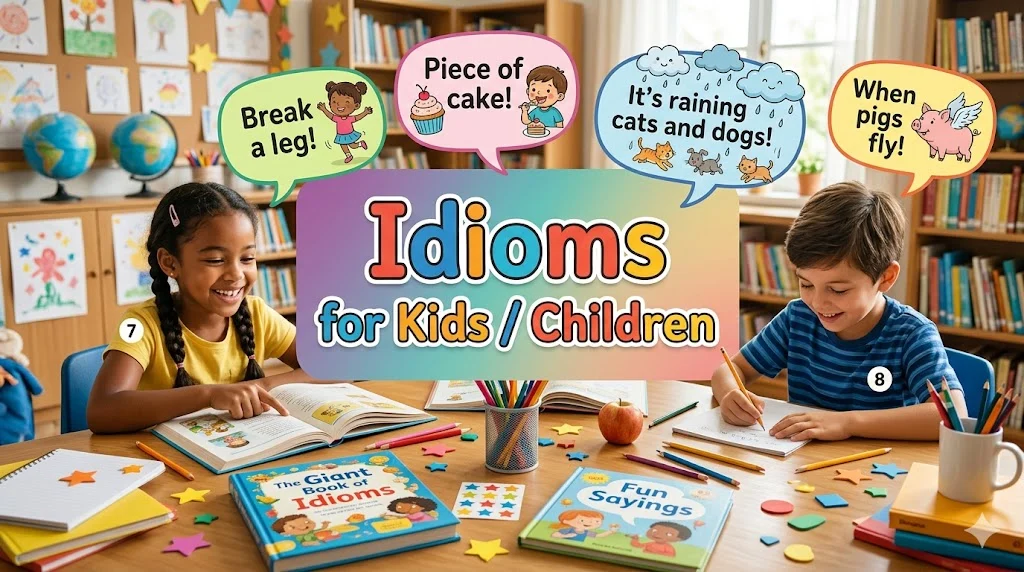
Idioms for kids are fun expressions that don’t mean exactly what they say they carry a special hidden meaning that makes English more colorful and exciting for young learners.Examples: break a leg, piece of cake, it’s raining cats and dogs
Have you ever told a child to “break a leg” before their school play and watched them stare at you in total confusion? That’s the magic and the mystery of idioms.
English is full of these colorful expressions, and children run into them every day in books, cartoons, conversations, and classrooms. But because idioms say one thing and mean another, they can be tricky for young learners to understand without a little help.
That’s exactly why this guide exists. Whether you’re a parent, a teacher, or a curious kid yourself, this article breaks down the most useful and fun idioms for children with simple meanings, real examples, and plenty of smiles along the way.
In this guide, you’ll learn:
- Playful idioms every child should know
- Simple meanings in kid-friendly language
- Fun examples for school, home, and play
- Easy tips to help children remember them
Let’s jump right in because learning idioms is more fun than a barrel of monkeys!
Quick Summary Table
| Situation | Idioms |
|---|---|
| Wishing good luck | Break a leg, Fingers crossed |
| Studying hard | Hit the books, Burn the midnight oil |
| Something very easy | Piece of cake, Easy as pie |
| Something very hard | Bite off more than you can chew |
| Revealing a secret | Spill the beans, Let the cat out of the bag |
| Bad weather | It’s raining cats and dogs |
| Working together | Many hands make light work, Lend a hand |
| Feeling very happy | Over the moon, On cloud nine |
| Trying your best | Give it your best shot, Go the extra mile |
| Making a mistake | Put your foot in your mouth |
🍀 Idioms for Good Luck and Encouragement
These are the idioms children hear most often before a big test, a sports game, or a school performance. Learning them early helps kids feel confident and supported.
1. Break a Leg
Meaning: Good luck!
When people use it: Before performances or exams
Alternative expression: Best of luck
This has nothing to do with actually breaking a leg. Actors started saying it because they believed wishing someone “good luck” directly was actually bad luck. So they said the opposite instead!
Examples:
- Formal: “Break a leg on your science presentation today, Sophie!”
- Casual: “You’ve practiced so much break a leg!”
- Creative: She whispered “break a leg” as her friend walked onto the stage.
2. Fingers Crossed
Meaning: Hoping for something good to happen
When people use it: While waiting for results or news
Alternative expression: I hope so
Kids actually do this literally crossing their fingers while hoping for something. The idiom simply means you’re wishing hard that things will go well.
Examples:
- Formal: “I have my fingers crossed that we get a snow day tomorrow!”
- Casual: “Fingers crossed I get picked for the team.”
- Creative: With fingers crossed tightly, she waited for the teacher to call her name.
💡 Teaching Tip: Ask kids to act these out! Let them cross their fingers or practice saying “break a leg” to each other before a class activity. Physical actions make idioms stick in memory far better than just reading them.
📚 Idioms for School and Studying
School is where children spend most of their time, so it’s no surprise that many everyday idioms are all about learning, working hard, and using your brain.
3. Hit the Books
Meaning: Start studying
When people use it: Before exams or homework time
Alternative expression: Study hard
No actual hitting involved! “Hit the books” simply means it’s time to open your textbooks and get to work. A great one for encouraging children before a big test.
Examples:
- Formal: “We have a big test on Friday, so let’s hit the books tonight.”
- Casual: “No more games I need to hit the books.”
- Creative: After dinner, Jamie hit the books for two whole hours.
4. Burn the Midnight Oil
Meaning: Stay up very late to study or work
When people use it: Before big projects or important tests
Alternative expression: Stay up late
Long ago, people used oil lamps to read at night. “Burning the midnight oil” meant you were up so late that you were still using that lamp. Kids love the historical image behind this one.
Examples:
- Formal: “I burned the midnight oil to finish my science project.”
- Casual: “She’s been burning the midnight oil all week.”
- Creative: The whole family burned the midnight oil the night before the competition.
5. Use Your Noodle
Meaning: Use your brain and think carefully
When people use it: During problem-solving moments
Alternative expression: Think it through
“Noodle” is a funny old word for your head or brain. Kids absolutely love this one because it sounds so silly and silly is memorable!
Examples:
- Formal: “This math puzzle is tough use your noodle!”
- Casual: “Come on, you know the answer. Use your noodle!”
- Creative: “Before you give up,” said the teacher with a smile, “try using your noodle first.”
💡 Memory Trick: Connect idioms to a funny picture in your mind. Imagine someone literally hitting a book with their fist, or a giant noodle sitting on top of your head thinking. Silly images are the best memory tools for young learners.
🌈 Idioms for Easy and Difficult Things
Children deal with challenges every single day from learning to ride a bike to finishing a tricky homework assignment. These idioms help them describe how easy or hard something feels.
6. Piece of Cake
Meaning: Very easy
When people use it: After completing something simple
Alternative expression: Super easy, a breeze
Eating a piece of cake is easy and enjoyable so when something feels that effortless, we call it a “piece of cake.” Children pick this one up almost immediately because the image is so relatable.
Examples:
- Formal: “The spelling test? Piece of cake!”
- Casual: “That level in the game was a piece of cake.”
- Creative: She finished the puzzle in five minutes an absolute piece of cake.
7. Bite Off More Than You Can Chew
Meaning: Take on more tasks or responsibilities than you can handle
When people use it: When someone overcommits to too many things
Alternative expression: Too much at once
Imagine stuffing too much food in your mouth at once uncomfortable and messy! This idiom describes exactly that feeling when we pile on too many responsibilities at the same time.
Examples:
- Formal: “Joining three clubs and the sports team might be biting off more than you can chew.”
- Casual: “I think I bit off more than I could chew with this project.”
- Creative: He bit off more than he could chew when he promised to clean the whole house all by himself.
8. Give It Your Best Shot
Meaning: Try your absolute hardest
When people use it: When encouraging someone to attempt something
Alternative expression: Do your best
Think of an archer carefully aiming at a target and releasing their very best arrow. “Giving it your best shot” means putting everything you have into one great attempt win or lose.
Examples:
- Formal: “You might not win, but give it your best shot!”
- Casual: “Just give it your best shot that’s all anyone can ask.”
- Creative: Even though she was nervous, Amara gave the audition her very best shot.
🌧️ Idioms for Weather and Everyday Life
Some of the most famous idioms in English come from the weather and daily situations. These are wonderful starter idioms because children encounter them so often in stories and conversations.
9. It’s Raining Cats and Dogs
Meaning: It’s raining very heavily
When people use it: During a big storm or heavy downpour
Alternative expression: Pouring rain
Don’t worry no animals are falling from the sky! This is one of the oldest and most entertaining idioms in the English language, and children always burst out laughing when they first hear it.
Examples:
- Formal: “We can’t go outside for recess it’s raining cats and dogs!”
- Casual: “Bring an umbrella; it’s really raining cats and dogs out there.”
- Creative: The picnic was completely ruined when it suddenly started raining cats and dogs.
10. Cat Got Your Tongue?
Meaning: Why aren’t you speaking?
When people use it: When someone is unusually quiet or shy
Alternative expression: Are you speechless?
No cat has your tongue, of course! This funny expression is used when someone is too shy, shocked, or embarrassed to say a single word.
Examples:
- Formal: “You’re so quiet today cat got your tongue?”
- Casual: “Come on, say something! Cat got your tongue?”
- Creative: When called on to answer, Liam froze. “Cat got your tongue?” the teacher asked with a warm smile.
11. Spill the Beans
Meaning: Accidentally or purposely reveal a secret
When people use it: When someone shares information that was supposed to be private
Alternative expression: Let the cat out of the bag
Imagine a bag of beans spilling everywhere once they’re scattered across the floor, you simply can’t put them all back. Once a secret is out, it’s out! This idiom is perfect for children who love drama and surprises.
Examples:
- Formal: “Who spilled the beans about the surprise party?”
- Casual: “Come on, spill the beans what’s the big news?”
- Creative: Before anyone could stop her, Emma spilled the beans about the entire birthday plan.
🎉 Idioms for Feelings and Emotions
Helping children name and express how they feel is incredibly important. These idioms give them colorful, expressive ways to describe their emotions in a way that feels natural and fun.
12. Over the Moon
Meaning: Extremely happy and excited
When people use it: When celebrating wonderful news or an achievement
Alternative expression: Thrilled, on cloud nine
So happy you’ve floated all the way up past the moon! Children love the visual image of being this joyful it turns a feeling into a whole adventure.
Examples:
- Formal: “I was over the moon when I got an A on my report.”
- Casual: “She was absolutely over the moon about her birthday present.”
- Creative: The whole class was over the moon when their teacher announced a field trip to the science museum.
13. Under the Weather
Meaning: Feeling sick or unwell
When people use it: When someone isn’t feeling their best
Alternative expression: Feeling poorly, not feeling well
This one is wonderfully practical for children. Instead of just saying “I feel bad,” they can express themselves with this gentle, descriptive idiom that sounds caring rather than dramatic.
Examples:
- Formal: “Tom won’t be in class today he’s a bit under the weather.”
- Casual: “I’m feeling under the weather, so I’ll skip the game.”
- Creative: Even though she was under the weather, Zara still tried to help with the bake sale.
14. On Cloud Nine
Meaning: Feeling wonderfully happy and content
When people use it: After receiving great news or experiencing something joyful
Alternative expression: Over the moon
Floating happily on a soft, fluffy cloud far above all worries that’s what being on cloud nine feels like. A beautiful idiom for pure, simple joy.
Examples:
- Formal: “After winning the spelling bee, Daniel was on cloud nine all day.”
- Casual: “Getting the puppy put the whole family on cloud nine.”
- Creative: On cloud nine after the match, she skipped all the way home.
🤝 Idioms for Teamwork and Helping Others
Teamwork is a huge part of childhood at school, in sports, and at home. These idioms teach children the value of working together in the most memorable and natural way possible.
15. Many Hands Make Light Work
Meaning: A job is much easier when lots of people help
When people use it: When encouraging a group to pitch in together
Alternative expression: Teamwork pays off
When everyone helps out, even big tasks feel manageable. This is the perfect classroom idiom for tidy-up time or group projects.
Examples:
- Formal: “Let’s all clean up together many hands make light work!”
- Casual: “Come help me with these boxes. Many hands make light work.”
- Creative: The garden was spotless in minutes because many hands made light work.
16. Go the Extra Mile
Meaning: Do more than what is expected
When people use it: When praising effort that goes above and beyond
Alternative expression: Give extra effort
Imagine finishing a race, then choosing to keep running a little further anyway just because you care. Going the extra mile means always giving a little more than the minimum.
Examples:
- Formal: “You added illustrations to your essay you really went the extra mile!”
- Casual: “She always goes the extra mile to help her friends.”
- Creative: Going the extra mile, the team stayed late to decorate the hall into something truly beautiful.
17. Lend a Hand
Meaning: Help someone with something
When people use it: When offering or asking for assistance
Alternative expression: Give a hand, chip in
You’re not actually handing someone your hand! It simply means offering your help freely and willingly. A kind, simple idiom that children can use every single day.
Examples:
- Formal: “Could you lend a hand setting up the art station?”
- Casual: “Sure, I’ll lend a hand with the dishes.”
- Creative: Without being asked, Mia lent a hand to the younger kids struggling with their backpacks.
😬 Idioms for Mistakes and Learning
Everyone makes mistakes and these idioms help children talk about them in a lighthearted, understanding way. They also carry an important message: mistakes are simply part of growing up.
18. Put Your Foot in Your Mouth
Meaning: Say something embarrassing or accidentally hurtful
When people use it: After saying exactly the wrong thing at the wrong moment
Alternative expression: Say the wrong thing
Imagine actually trying to put your foot in your mouth awkward, uncomfortable, and a little embarrassing! That’s exactly the feeling this idiom captures perfectly.
Examples:
- Formal: “I really put my foot in my mouth when I said that in front of everyone.”
- Casual: “Oops I put my foot in my mouth again.”
- Creative: As soon as the words came out, she knew she had put her foot in her mouth completely.
19. Back to the Drawing Board
Meaning: Start over from the very beginning
When people use it: When a plan fails and needs to be completely rethought
Alternative expression: Start fresh, try again
Architects and designers used large “drawing boards” to create their plans. When the plan didn’t work out, they wiped it clean and started again just like we do when things go wrong.
Examples:
- Formal: “Our experiment didn’t work it’s back to the drawing board.”
- Casual: “That idea flopped completely. Back to the drawing board!”
- Creative: The model bridge collapsed in testing, sending the entire team back to the drawing board.
20. Every Cloud Has a Silver Lining
Meaning: Something good can be found in every bad situation
When people use it: To encourage someone after a disappointment
Alternative expression: Look on the bright side
Dark storm clouds can have beautiful bright silver edges when sunlight shines behind them. This lovely idiom teaches children one of life’s most important lessons optimism, even in hard times.
Examples:
- Formal: “We lost the match, but we learned so much every cloud has a silver lining.”
- Casual: “It’s okay. Every cloud has a silver lining.”
- Creative: Staying home sick meant extra time to finish her painting a true silver lining indeed.
🐾 Animal Idioms Kids Absolutely Love
Animals appear in some of the most beloved English idioms of all time, and children are naturally drawn to them. These make language learning feel like storytelling, which is exactly what it should feel like.
21. Hold Your Horses
Meaning: Wait! Slow down!
When people use it: When someone is rushing ahead too quickly
Alternative expression: Be patient, slow down
Picture a rider pulling back the reins to stop a galloping horse that exciting visual image is exactly where this idiom comes from. Perfect for reminding excited children to pause and think before acting.
Examples:
- Formal: “Hold your horses let everyone finish reading before we discuss.”
- Casual: “Hold your horses! We’re not leaving yet.”
- Creative: “Hold your horses!” Mum called out as the kids raced toward the door.
22. Let the Cat Out of the Bag
Meaning: Accidentally reveal a secret
When people use it: When a surprise gets ruined by someone saying too much
Alternative expression: Spill the beans
Imagine trying to hide a lively cat inside a bag sooner or later, it pops out no matter what! This idiom is perfect for talking about secrets that escape before they’re supposed to.
Examples:
- Formal: “Please don’t let the cat out of the bag about the class party!”
- Casual: “Oops I let the cat out of the bag by accident.”
- Creative: With one careless sentence, Noah had let the cat out of the bag entirely.
23. The Elephant in the Room
Meaning: An obvious problem or issue that everyone notices but nobody wants to talk about
When people use it: When an uncomfortable topic is being avoided
Alternative expression: The big issue everyone ignores
Imagine a giant elephant sitting in the middle of a classroom everyone sees it clearly, but nobody mentions it. This idiom is wonderful for teaching children about emotional awareness and honest communication.
Examples:
- Formal: “Let’s talk about the elephant in the room who forgot to water the class plant for two weeks?”
- Casual: “We all know what happened. It’s the elephant in the room.”
- Creative: For days, the broken trophy sat on the shelf as the elephant in the room nobody dared mention.
24. A Bee in Your Bonnet
Meaning: Being obsessed with or worried about one particular idea
When people use it: When someone can’t stop thinking or talking about one thing
Alternative expression: Can’t get it out of your head
A bee trapped inside your hat would drive you absolutely impulsive! This charming old idiom describes someone who keeps buzzing around one single thought or worry without being able to let it go.
Examples:
- Formal: “She’s had a bee in her bonnet about the science fair all week.”
- Casual: “What’s up? You seem to have a bee in your bonnet about something.”
- Creative: With a bee in his bonnet about his missing pencil case, he couldn’t concentrate on anything else at all.
25. Wild Goose Chase
Meaning: A pointless, hopeless search that leads nowhere
When people use it: When someone searches endlessly for something that can’t be found
Alternative expression: Wasted effort, chasing shadows
Try catching a wild goose and you’ll understand this idiom in about thirty seconds! It describes chasing something that leads you further and further without ever arriving at a result.
Examples:
- Formal: “Looking for that library book in the lost-and-found was a complete wild goose chase.”
- Casual: “We looked everywhere it was a total wild goose chase.”
- Creative: The treasure hunt turned into a wild goose chase that covered the entire playground twice.
🎯 How to Teach Idioms to Kids Naturally
Knowing idioms is one thing using them naturally is something else entirely. Here are proven approaches that actually work with young learners.
Connect Idioms to Stories
Introduce new idioms through books, fairy tales, cartoons, or films the child already loves. When a child hears “it’s raining cats and dogs” in a story they’re enjoying, it lands differently than reading it off a list. Language learned through stories is language that sticks.
Draw the Literal Meaning
Ask children to draw what an idiom would look like if taken literally. Watching a child draw actual cats and dogs falling from the sky is hilarious and that laughter is one of the most powerful memory tools that exists. The sillier the drawing, the better they’ll remember the real meaning.
Use It in Real Conversation
Casually drop an idiom into a natural conversation at home or in class. When children hear idioms used authentically in context, they absorb them almost effortlessly. Don’t announce “today’s idiom is…” just use it and let curiosity do the rest.
One or Two Idioms at a Time
Don’t overwhelm young learners. Introduce one or two idioms per week, let them use those confidently in their own sentences, then move on. Depth always beats breadth when it comes to building a child’s language skills.
⚠️ Common Mistakes to Avoid
Taking idioms too literally. Young children may genuinely believe it’s raining actual cats and dogs. Always explain that idioms are like a “secret code” they say one thing but mean something completely different.
Teaching too many at once. A lesson full of twenty new idioms is overwhelming for any child. Choose two or three that connect to their current daily life, practice those thoroughly, and build from there.
Using advanced idioms too early. Expressions like “burning the midnight oil” make more sense for older children who already understand the concept of working late into the night. Always match the idiom to the child’s age and life experience.
Forgetting to revisit. Idioms learned once and never used again disappear quickly. Keep revisiting favorites in games, in stories, and in everyday conversation to keep them alive and natural.
🚀 Practice Method That Actually Works
Learn two new idioms per week.
Pick idioms connected to something the child is doing that week a school event, a sporting match, a rainy day. Relevance is everything for how well children retain new language.
Draw it, act it, say it.
Have the child draw the literal interpretation, then act out the real meaning, then use it in a sentence of their own. This three-step method engages visual, physical, and verbal learning all at once.
Create a funny sentence.
Ask the child to invent the silliest or most creative sentence they can using the new idiom. Humor is one of the most reliable memory tools for young learners a sentence that makes them laugh will be remembered for years.
Spot it in the wild.
Challenge children to find their new idiom in a book, cartoon, or conversation during the week. When they find it, celebrate the discovery enthusiastically. This turns passive learning into an exciting everyday game.
💡 Golden Rule for Parents and Teachers: The best idiom lesson isn’t a worksheet it’s a natural conversation where you use the idiom yourself. Children are expert imitators. Lead by example, and they’ll follow without even realizing they’re learning.
❓ FAQs
1. At what age should children start learning idioms?
Children as young as five or six can begin with simple, visual idioms like “raining cats and dogs” or “piece of cake.” More abstract idioms work better for children aged eight and above, as they develop stronger language comprehension and more life experience to connect the meaning.
2. Why are idioms so confusing for young children?
Young children think very literally, so expressions that say one thing but mean another can genuinely puzzle them. That’s exactly why explanations, visual drawings, and real-life examples are so important when first introducing idioms to kids.
3. Are these idioms suitable for children learning English as a second language?
Absolutely. Idioms are especially valuable for children learning English as a second language because they appear constantly in native speech, books, and television. Learning them early gives young learners a significant and natural advantage in understanding real-world English.
4. How do I decide which idioms to teach first?
Start with idioms the child will encounter most often. School idioms, animal idioms, and weather idioms are the ideal starting points. Always connect new idioms to familiar, real-life situations the child already understands well.
5. Can learning idioms improve a child’s reading comprehension?
Yes significantly. Idioms appear constantly in children’s books, stories, and poetry. Children who understand common idioms can better grasp the tone, humor, and deeper meaning of what they read, making them noticeably stronger and more confident readers over time.
Conclusion
Idioms for kids are far more than just fun expressions they are windows into the personality, creativity, and culture of the English language. When children learn idioms, they don’t just gain new vocabulary. They gain confidence, a sense of humor, and a deeper love for the language itself.
Start with the ones that make them laugh. Connect them to real moments in their day. Let the learning happen naturally one silly, colorful, unforgettable expression at a time.
Because language that comes alive in the imagination stays alive forever.
Read More Related Articles:
- Idioms for Happiness | Express Joy Like a Native Speaker In 2026
- Idioms for Scared | Express Fear Like a Native Speaker In 2026
- Idioms for Sadness | Expressing Deep Emotions Through Language In 2026

Tyler Zone is an American writer at IdiomCrafter.com, who enjoys exploring the meaning behind everyday phrases. He focuses on making idioms simple and relatable for readers of all backgrounds. In his free time, he likes discovering new expressions and how people use them in daily life.