We all face difficult situations. Sometimes life throws challenges that feel overwhelming, complex, or just plain hard. But instead of repeatedly saying “this is difficult,” English offers a rich collection of colorful idioms that express struggle, pressure, and hardship with creativity and emotion .
When someone says “I’m between a rock and a hard place” or “this project is an uphill battle,” you instantly understand the weight of their situation. These expressions don’t just describe difficulty they paint vivid pictures that make conversations more engaging and memorable .
Idioms are figurative phrases where the meaning isn’t obvious from the individual words . For example, “biting off more than you can chew” has nothing to do with food it means taking on too much responsibility. Understanding these expressions helps you communicate more naturally and understand native speakers better .
In this comprehensive guide, you’ll learn:
- Powerful idioms for different types of difficult situations
- Real meanings and contexts for each expression
- Practical examples showing how to use them naturally
- Tips for choosing the right idiom for the right moment
- Common mistakes to avoid when using these expressions
Let’s explore the most expressive idioms that bring your descriptions of challenges to life.
Quick Summary Table
| Situation | Idioms |
|---|---|
| Difficult decisions | Between a rock and a hard place, Tough call, In a cleft stick |
| Hard work & effort | Uphill battle, Blood, sweat, and tears, Burn the midnight oil |
| Frustrating situations | Like pulling teeth, At your wits’ end, Banging your head against a wall |
| Accepting hard truths | A hard pill to swallow, Bitter pill, Face the music |
| Giving up | Throw in the towel, Throw in the sponge |
| Overwhelming pressure | In over your head, Carrying the weight of the world, The heat is on |
| Surviving hardship | Weather the storm, Tough row to hoe, Trial by fire |
🤔 Idioms for Difficult Decisions & Dilemmas
Sometimes the hardest part isn’t the work itself it’s making the right choice when no option seems good.
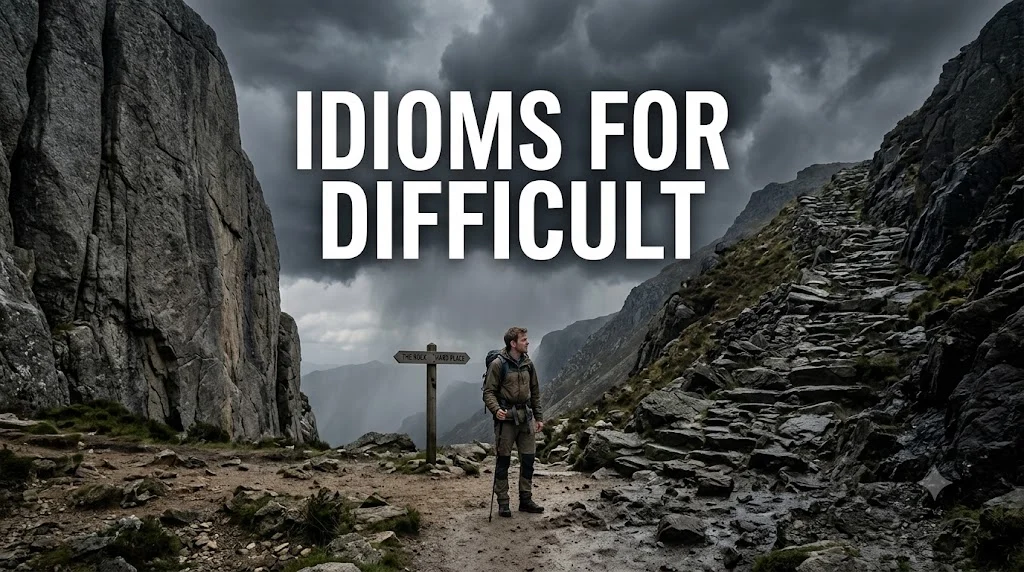
1. Between a Rock and a Hard Place
Meaning: Facing two equally difficult or unpleasant options with no easy way out .
When People Use It: When someone must choose between two bad alternatives, often in professional or personal dilemmas.
Examples:
- Formal: “The CEO was caught between a rock and a hard place, having to choose between laying off employees or cutting salaries.”
- Casual: “I’m between a rock and a hard place if I go to the party, I’ll fail my test, but if I study, I’ll miss my best friend’s birthday.”
- Creative: “She stood at the crossroads of impossible choices, trapped between a rock and a hard place with no clear path forward.”
2. A Tough Call
Meaning: A difficult decision that requires careful consideration .
When People Use It: When choosing between options that both have significant pros and cons.
Examples:
- Formal: “Deciding whether to expand internationally or consolidate domestic operations was a tough call for the board.”
- Casual: “It’s a tough call whether to accept the job offer or stay where I am.”
- Creative: “Each option whispered promises and warnings, making it the toughest call of his career.”
3. In a Cleft Stick
Meaning: In a difficult situation where every available option has negative consequences .
When People Use It: Formal or literary contexts describing dilemmas.
Examples:
- Formal: “The manager found himself in a cleft stick, knowing either decision would upset someone on the team.”
- Creative: “His loyalty pulled him in opposite directions, leaving him in a cleft stick of his own making.”
4. On the Horns of a Dilemma
Meaning: Forced to choose between two equally bad or undesirable options .
When People Use It: Formal discussions about complex choices.
Examples:
- Formal: “She found herself on the horns of a dilemma, unsure whether to follow her heart or her family’s wishes.”
- Creative: “The weight of indecision pressed upon him as he balanced on the horns of an impossible dilemma.”
5. Backed into a Corner
Meaning: Having no good choices left, feeling trapped .
When People Use It: When circumstances leave someone with no easy way out.
Examples:
- Formal: “The negotiations backed him into a corner with no acceptable compromise available.”
- Casual: “I felt backed into a corner when both friends wanted me to pick sides.”
💡 Usage Insight: These dilemma idioms are especially useful when you need to explain why a decision was so difficult they immediately convey the complexity and emotional weight of the situation.
😰 Idioms for Hard Work & Exhausting Effort
Some challenges require pushing beyond normal limits these idioms capture that struggle perfectly.
6. An Uphill Battle
Meaning: A task that is very difficult and requires constant, sustained effort .
When People Use It: Describing long-term struggles, whether personal, professional, or social.
Examples:
- Formal: “Fighting climate change is an uphill battle that requires global cooperation.
- Casual: “Getting my grades up this semester feels like an uphill battle.”
- Creative: “Each step forward demanded twice the effort, the journey an unrelenting uphill battle.”
7. Blood, Sweat, and Tears
Meaning: A tremendous amount of hard work and effort .
When People Use It: Emphasizing the sacrifice and dedication behind an achievement.
Examples:
- Formal: “The company’s success was built on blood, sweat, and tears from its founding team.”
- Casual: “The school play took blood, sweat, and tears to get right.”
- Creative: “Every brick of her success was laid with blood, sweat, and tears.”
8. Burning the Midnight Oil
Meaning: Staying up late working or studying, often under pressure .
When People Use It: Describing intense work sessions, especially before deadlines or exams.
Examples:
- Formal: “She burned the midnight oil to finish the financial report before the quarterly review.”
- Casual: “I had to burn the midnight oil before my big exam tomorrow.”
- Creative: “The lamp’s glow witnessed his dedication as he burned the midnight oil night after night.”
9. Break One’s Back
Meaning: To work extremely hard, often to the point of exhaustion .
When People Use It: Describing physical or mental effort that pushes someone to their limits.
Examples:
- Formal: “The team broke their backs to meet the impossible deadline.”
- Casual: “My mom breaks her back to provide for our family.”
- Creative: “He bent his back against the weight of expectation, refusing to break.”
10. Bend Over Backwards
Meaning: To try extremely hard to help someone or achieve something .
When People Use It: Describing extraordinary effort to accommodate others or complete a task.
Examples:
- Formal: “The customer service team bent over backwards to resolve the complaint.”
- Casual: “My teacher bends over backwards to help us understand difficult concepts.”
- Creative: “She contorted her schedule, bending over backwards to make everyone happy.”
11. Put One’s Shoulder to the Wheel
Meaning: To work hard to solve a problem or complete a task .
When People Use It: Encouraging teamwork and collective effort.
Examples:
- Formal: “We all need to put our shoulders to the wheel to complete this project on time.”
- Casual: “If you want to improve in basketball, you have to put your shoulder to the wheel.”
- Creative: “Together, they put their shoulders to the wheel and pushed progress forward.”
12. Go the Extra Mile
Meaning: To do more than what is expected or required .
When People Use It: Recognizing exceptional effort or encouraging excellence.
Examples:
- Formal: “The employee consistently goes the extra mile to exceed client expectations.”
- Casual: “Our teacher goes the extra mile to make sure everyone understands.”
- Creative: “She traveled beyond duty’s boundary, always ready to go the extra mile.”
13. Move Heaven and Earth
Meaning: To do everything possible to achieve a goal .
When People Use It: Describing extraordinary determination and effort.
Examples:
- Formal: “He moved heaven and earth to secure the funding for his research.”
- Casual: “My parents moved heaven and earth to give us a good education.”
- Creative: “She would move heaven and earth before letting her dream slip away.”
💡 Memory Tip: Think of these effort idioms as different levels of intensity “burning the midnight oil” is about long hours, while “moving heaven and earth” suggests almost superhuman determination.
😤 Idioms for Frustration & Struggle
Some difficulties aren’t just hard they’re frustrating enough to drive you wild.
14. Like Pulling Teeth
Meaning: Extremely difficult and frustrating, especially when trying to get someone to do something .
When People Use It: Describing stubborn resistance or uncooperative situations.
Examples:
- Formal: “Extracting useful information from the witness was like pulling teeth.”
- Casual: “Getting my little brother to clean his room is like pulling teeth.”
- Creative: “Every response emerged slowly, painfully, like pulling teeth from a reluctant source.”
15. At Your Wits’ End
Meaning: Completely frustrated and not knowing what to do next .
When People Use It: When all solutions have been tried and nothing works.
Examples:
- Formal: “After months of failing to resolve the issue, the team was at their wits’ end.”
- Casual: “The baby won’t stop crying, and I’m at my wits’ end.”
- Creative: “Exhausted of ideas and patience, he stood at his wits’ end, staring at the problem.
16. Banging Your Head Against a Wall
Meaning: Trying repeatedly to do something with no results, feeling futile .
When People Use It: Describing bureaucratic or systemic frustrations.
Examples:
- Formal: “Dealing with government bureaucracy often feels like banging your head against a wall.”
- Casual: “I’ve been trying to fix this computer for hours it’s like banging my head against a wall.”
- Creative: “He persisted despite the wall’s resistance, his efforts futile yet relentless.
17. A Sticky Wicket
Meaning: A difficult or awkward situation requiring careful handling .
When People Use It: Describing delicate interpersonal or professional scenarios.
Examples:
- Formal: “Mediating the dispute between the two departments was a sticky wicket.”
- Creative: “He stepped carefully through the sticky wicket of office politics.”
18. A Thorny Issue
Meaning: A complex or sensitive problem that is difficult to resolve .
When People Use It: Discussing controversial or multifaceted problems.
Examples:
- Formal: “Data privacy remains a thorny issue for technology companies.”
- Creative: “The committee wrestled with the thorny issue of budget allocation.”
19. In Deep Water
Meaning: In serious trouble or difficulty .
When People Use It: When someone has made a serious mistake or faces severe consequences.
Examples:
- Formal: “After mismanaging the budget, the treasurer found herself in deep water.”
- Casual: “I’ll be in deep water if I don’t pass this exam.”
- Creative: “He waded into waters deeper than he could handle.”
20. Up a Creek Without a Paddle
Meaning: In a difficult situation with no clear solution or resources .
When People Use It: Describing being stranded or helpless.
Examples:
- Formal: “Without the necessary data, the research team was up a creek without a paddle.”
- Casual: “My car broke down in the middle of nowhere I’m up a creek without a paddle.”
- Creative: “Lost and alone, he floated up a creek without a paddle.”
21. In a Tight Spot
Meaning: In a difficult or problematic situation .
When People Use It: Describing challenging circumstances generally.
Examples:
- Formal: “The company found itself in a tight spot when its main supplier went bankrupt.”
- Casual: “She was in a tight spot when her car broke down.”
- Creative: “Circumstances tightened around him, leaving him in a tight spot.”
22. The Last Straw
Meaning: The final problem in a series of difficulties that makes everything unbearable .
When People Use It: Describing the breaking point after accumulated frustrations.
Examples:
- Formal: “The third delay in production was the last straw for the client.”
- Casual: “Being late to work again was the last straw for my boss.”
- Creative: “The final annoyance, the last straw, shattered his remaining composure.”
💡 Usage Insight: Frustration idioms are perfect when you want to express emotional exhaustion or annoyance they convey not just difficulty but the emotional toll it takes.
😩 Idioms for Accepting Difficult Truths
Some challenges come from accepting reality, not just overcoming obstacles.
23. A Hard Pill to Swallow
Meaning: A difficult or unpleasant fact that one must accept .
When People Use It: When someone faces disappointing or painful news.
Examples:
- Formal: “The company’s bankruptcy was a hard pill to swallow for longtime employees.”
- Casual: “Failing the test was a hard pill to swallow.”
- Creative: “The bitter truth lodged in his throat, a hard pill to swallow.”
24. A Bitter Pill
Meaning: A difficult truth or situation that is unpleasant to accept .
Examples:
- Formal: “Realizing the project would never launch was a bitter pill.”
- Creative: “Defeat tasted like a bitter pill he couldn’t wash away.”
25. Face the Music
Meaning: To accept the bad consequences of one’s actions .
When People Use It: When someone must take responsibility for mistakes.
Examples:
- Formal: “The executive had to face the music after the financial scandal was revealed.”
- Casual: “I forgot my homework and had to face the music in class.”
- Creative: “The moment of reckoning arrived, and he had to face the music.”
26. The Crux of the Matter
Meaning: The central or most important point of an issue .
Examples:
- Formal: “The crux of the matter was whether the company could innovate quickly enough.”
- Creative: “Through layers of complexity, the crux of the matter emerged.”
27. The Tip of the Iceberg
Meaning: A small, visible part of a much larger problem .
Examples:
- Formal: “The recent scandal was just the tip of the iceberg of broader mismanagement.”
- Casual: “What we’ve seen so far is just the tip of the iceberg.”
- Creative: “Beneath the surface waited the true scale of the problem this was only the tip of the iceberg.”
💡 Memory Tip: These acceptance idioms help you describe not just challenges but the emotional process of coming to terms with them.
🏋️ Idioms for Being Overwhelmed
When challenges become too much to handle, these expressions capture that feeling perfectly.
28. In Over Your Head
Meaning: Involved in something too difficult to handle .
When People Use It: When someone lacks the skills or resources for a situation.
Examples:
- Formal: “The new manager realized he was in over his head with the complex project.”
- Casual: “I was in over my head trying to fix the computer myself.”
- Creative: “The situation rose like a wave above his head, and he was in over it.”
29. Out of One’s Depth
Meaning: Facing something too difficult or unfamiliar .
When People Use It: When someone lacks experience or knowledge.
Examples:
- Formal: “She felt out of her depth in the advanced mathematics seminar.”
- Casual: “I was completely out of my depth in that Spanish test.”
- Creative: “The conversation flowed around subjects far beyond his depth.”
30. Carrying the Weight of the World
Meaning: Feeling overwhelmed by many difficult responsibilities .
When People Use It: Describing extreme stress or pressure.
Examples:
- Formal: “The CEO walked in carrying the weight of the world after the quarterly losses.”
- Casual: “She looked like she was carrying the weight of the world on her shoulders.”
- Creative: “The burden pressed down on him as if he carried the weight of the world.”
31. The Heat Is On
Meaning: Under pressure in a difficult situation .
When People Use It: When deadlines or high-stakes situations create intense pressure.
Examples:
- Formal: “With the product launch approaching, the heat is on the marketing team.”
- Casual: “The heat is on with exams starting next week.”
- Creative: “The temperature of pressure rose, and the heat was on.”
32. Under Pressure
Meaning: Feeling stressed from too many demands or expectations .
Examples:
- Formal: “The team was under pressure to deliver results before the deadline.”
- Creative: “Under pressure’s weight, even the strongest can crack.”
33. Burn the Candle at Both Ends
Meaning: To work too much and become exhausted .
When People Use It: Describing unsustainable work habits.
Examples:
- Formal: “She’s been burning the candle at both ends to meet the project deadline.”
- Creative: “His energy flickered, burning the candle at both ends until nothing remained.”
34. A Steep Learning Curve
Meaning: A process that is difficult to learn quickly .
When People Use It: Describing challenging transitions to new skills or systems.
Examples:
- Formal: “The new software has a steep learning curve for inexperienced users.”
- Casual: “Learning to code has a really steep learning curve.”
- Creative: “Knowledge came slowly up the steep learning curve.
35. Hitting a Brick Wall
Meaning: Facing an obstacle that stops progress .
Examples:
- Formal: “The negotiations hit a brick wall over the budget dispute.”
- Creative: “Progress stopped abruptly, his momentum smashing against a brick wall.”
💡 Usage Insight: Use these idioms when you need to convey not just difficulty but the sense of being overwhelmed or outmatched by a challenge.
💪 Idioms for Facing & Overcoming Challenges
Not all difficult idioms are negative some describe courage, determination, and survival.
36. Bite the Bullet
Meaning: To face a difficult or unpleasant situation with courage .
When People Use It: When someone decides to do something hard that can’t be avoided.
Examples:
- Formal: “The company had to bite the bullet and accept the restructuring.”
- Casual: “I had to bite the bullet and tell my boss I was quitting.”
- Creative: “He closed his eyes and bit the bullet, knowing the pain would pass.”
37. Weather the Storm
Meaning: To survive a difficult period .
When People Use It: Describing getting through tough times successfully.
Examples:
- Formal: “The company weathered the storm during the economic recession.”
- Casual: “We weathered the storm during those tough months.”
- Creative: “They held fast together, weathering the storm until calm returned.”
38. Trial by Fire
Meaning: A very difficult first experience that tests a person’s ability .
When People Use It: Describing challenging introductions to new roles.
Examples:
- Formal: “His first month as manager was a trial by fire.”
- Creative: “The crucible tested her, a trial by fire that forged her strength.”
39. Take the Bull by the Horns
Meaning: Face a difficult situation with courage .
When People Use It: Encouraging proactive problem-solving.
Examples:
- Formal: “She took the bull by the horns and addressed the conflict directly.”
- Casual: “It’s time to take the bull by the horns and start that project.”
- Creative: “He seized the challenge, taking the bull by the horns without hesitation.”
40. Sink or Swim
Meaning: To succeed or fail in a difficult situation without help .
When People Use It: Describing situations where people must prove themselves.
Examples:
- Formal: “New recruits often have to sink or swim in fast-paced environments.”
- Creative: “The waters of challenge churned it was sink or swim.”
41. Hit the Ground Running
Meaning: To start something with energy and determination .
When People Use It: Describing quick adaptation to new challenges.
Examples:
- Formal: “The new hire hit the ground running and contributed immediately.”
- Creative: “She hit the ground running, refusing to fall behind.”
42. Come Hell or High Water
Meaning: No matter what happens, even in the face of extreme difficulty .
When People Use It: Expressing absolute commitment.
Examples:
- Formal: “We’ll complete this project come hell or high water.”
- Casual: “I’m leaving at 5 PM come hell or high water.”
- Creative: “Nothing would stop him come hell or high water, he would succeed.”
💡 Memory Tip: These action-oriented idioms help you describe not just the difficulty but the response to it they’re about determination and resilience.
🎯 How to Use Idioms for “Difficult” Naturally
Using idioms related to difficulty can instantly make your language more expressive but only if you use them with the right tone, timing, and intention.
✔ Match the Situation
Not all “difficult” idioms mean the same thing. Some describe struggle, others frustration, and some even determination. Choose the right one for the moment.
- For describing hard work:
→ “Blood, sweat, and tears,” “uphill battle,” “burning the midnight oil” - For expressing frustration:
→ “Like pulling teeth,” “at your wits’ end,” “banging your head against a wall” - For tough decisions:
→ “Between a rock and a hard place,” “tough call,” “backed into a corner” - For accepting hard truths:
→ “A hard pill to swallow,” “face the music,” “bitter pill” - For determination and resilience:
→ “Bite the bullet,” “weather the storm,” “take the bull by the horns”
💡 Insight: Think of these idioms as emotional shortcuts they instantly show how intense a situation feels .
✔ Keep Tone in Mind
Some idioms can sound:
- Too casual for professional settings
- Slightly dramatic if overused
- Inappropriate in formal or serious contexts
For example:
Saying “The CEO is at his wits’ end with the quarterly results” might feel too casual in a board meeting.
Instead, you can use a more formal option:
→ “The CEO is facing significant pressure regarding the quarterly results.”
💡 Pro Tip: If you’re unsure, switch to a neutral expression in formal settings and save idioms for casual conversations.
✔ Use Sparingly
Idioms are powerful, but too many can overwhelm your message.
Imagine someone saying:
→ “I felt between a rock and a hard place, at my wits’ end, and like I was banging my head against a wall…”
It starts to feel repetitive and unnatural.
Instead, use one strong idiom to carry the emotion:
→ “I was completely at my wits’ end.”
💡 Golden Rule: One well-placed idiom is more impactful than five forced ones.
✔ Practice with Real Context
Learning idioms isn’t about memorization it’s about usage.
Here’s a simple but powerful method:
- Learn 3 Idioms Daily
Focus on a few and understand their tone and context. - Use Them in Real Conversations
Even simple sentences help:
→ “This project is an uphill battle, but we’re making progress.” - Write One Creative Sentence for Each
Instead of basic sentences, try expressive ones:
→ “The silence after the argument was a bitter pill to swallow, heavier than any accusation.”
→ “Exhaustion came from all sides, but he resolved to weather the storm.”
💡 Memory Trick: The more visual and emotional your sentence is, the easier the idiom sticks in your mind.
⚠️ Common Mistakes to Avoid
Even advanced learners slip up when using idioms. Avoid these to sound more natural and confident.
❌ Using Offensive Idioms in Serious Contexts
Some idioms can unintentionally sound insensitive, especially when describing real struggles or hardships.
Instead of: “The team went wild trying to meet the deadline”
Try: “The team was under intense pressure to meet the deadline”
❌ Confusing Different Types of “Difficult”
→ “That party was an uphill battle” (wrong uphill battle is for serious struggles, not fun events)
→ “This math problem is like pulling teeth” (sometimes okay, but better for stubborn resistance)
Always consider the specific nature of the difficulty.
❌ Overusing Informal Expressions in Professional Writing
Idioms like “at your wits’ end” or “like pulling teeth” may weaken credibility in formal communication.
❌ Literal Translation from Your Native Language
Translating idioms word-for-word from your language often produces confusing or amusing results . Instead, learn English idioms as complete expressions.
📝 Practice Section
Test your understanding of these idioms with the following exercises.
Exercise 1: Fill in the Blank
Choose the correct idiom to complete each sentence.
- “Learning to play the violin has a ______________, but I’m determined to master it.”
(steep learning curve / burning the midnight oil / in over your head) - “When both job offers had serious drawbacks, he was ______________.”
(at his wits’ end / between a rock and a hard place / like pulling teeth) - “Trying to get my teenage son to do his homework is ______________.”
(a tough call / like pulling teeth / a hard pill to swallow) - “She’s been ______________ to prepare for the final exam she barely sleeps!”
(weathering the storm / burning the midnight oil / facing the music)
Exercise 2: Choose the Right Context
Match each idiom to the most appropriate situation.
| Idiom | Situation |
|---|---|
| A hard pill to swallow | A project you spent months on gets canceled |
| An uphill battle | Convincing your friend to eat vegetables |
| Like pulling teeth | Getting your child to do chores |
| Throw in the towel | After trying to fix your car for hours with no success |
Exercise 3: Creative Sentences
Write one creative sentence using each idiom:
- A tough nut to crack
- Weather the storm
- Carry the weight of the world
- Take the bull by the horns
- Bite off more than you can chew
📝 Quick Quiz
Check your understanding with this short quiz.
1. What does “between a rock and a hard place” mean?
a) Having an easy choice
b) Facing two difficult options
c) Being stuck in one place
d) Having a fun time
2. Which idiom means “to give up after trying hard”?
a) Weather the storm
b) Throw in the towel
c) Bite the bullet
d) Burn the midnight oil
3. Which idiom best describes working very hard for a long time?
a) Like pulling teeth
b) Blood, sweat, and tears
c) Between a rock and a hard place
d) A tough call
4. What does “a hard pill to swallow” describe?
a) An easy task
b) A difficult truth to accept
c) A fun activity
d) A simple decision
(Answers: 1-b, 2-b, 3-b, 4-b)
FAQs
1. What does “difficult” mean in idioms?
In idioms, “difficult” can mean challenging, frustrating, stressful, or requiring significant effort. Different idioms capture different aspects of difficulty .
2. Are these idioms formal or informal?
Most are informal, but some can be used in semi-formal writing. “Between a rock and a hard place” works in professional contexts, while “at your wits’ end” is more casual .
3. Can I use these idioms in daily conversations?
Yes, especially in casual conversations, storytelling, and informal writing. They make your language more vivid and engaging .
4. Are these idioms offensive?
Generally no, but always consider context. Some expressions about “wild” or “mental” states can be insensitive choose carefully .
5. How can I remember all these idioms?
Practice regularly, connect them with real situations, and use them in conversations. Focus on learning a few at a time rather than trying to memorize everything at once .
6. What’s the most common idiom for “difficult”?
“Between a rock and a hard place” and “uphill battle” are among the most commonly used .
🚀 Conclusion
Idioms for “difficult” add depth, emotion, and personality to your language. Instead of repeating simple words like “hard” or “tough,” you can express yourself in ways that feel more natural, engaging, and precise whether you’re describing overwhelming pressure, frustrating obstacles, or determined resilience .
The key is simple:
Understand the context – Different situations call for different idioms. What works for describing a tough decision won’t necessarily fit a frustrating task .
Choose wisely – Consider your audience and tone. Save casual idioms for conversations and use more formal expressions in professional writing .
Practice consistently – The more you use these idioms in real conversations, the more natural they become .
One well-placed idiom is more impactful than five forced ones.
Once you start using these expressions naturally, your English will feel more alive, expressive, and truly human. Whether you’re writing creatively, speaking professionally, or having casual conversations, these idioms will help you describe life’s challenges with the nuance and emotion they deserve.
Read More Related Articles:
- Idioms for Clear | Expressing Understanding, Transparency & Obviousness In 2026
- Idioms for Peace | Expressing Calm, Harmony & Resolution In 2026
- Idioms for Simple | Express Clarity & Ease In 2026

Loganx River is a passionate writer at IdiomCrafter.com, where he explores the meanings and stories behind everyday expressions. He enjoys breaking down complex phrases into simple, easy-to-understand ideas for readers. When he’s not writing, he spends his time reading and collecting interesting sayings from different cultures.