Quick Answer
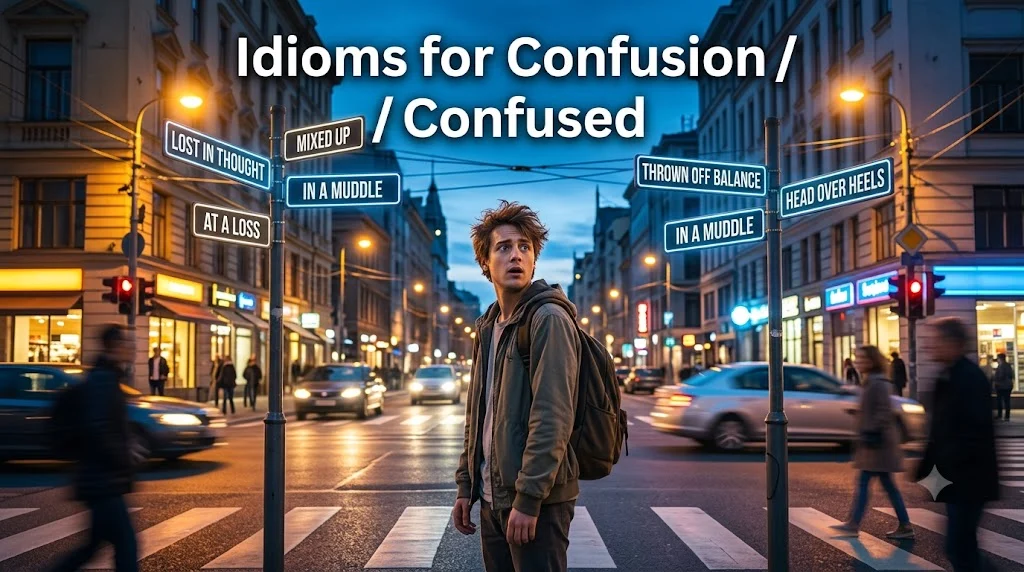
Idioms for “confusion” are expressive phrases used to describe the feeling of being lost, overwhelmed, disoriented, or mentally unclear often in a vivid and relatable way.Examples: at a loss, in a fog, go around in circles
We all experience confusion at some point during a difficult conversation, a confusing situation, or when life feels too overwhelming to process. But how often do we find the right words to describe that feeling?
In English, simply saying “I’m confused” gets the job done, but it lacks personality, emotion, and depth. That’s why idioms exist. When someone says “I was in a complete fog” or “my head was spinning,” you instantly feel the experience not just understand it.
Idioms for confusion are especially powerful in storytelling, casual conversations, writing, and even professional communication. They paint a picture. They make your English feel natural, expressive, and alive.
In this guide, you’ll learn:
Powerful idioms for “confusion” and feeling confused Real meanings and situations where they apply Formal, casual, and creative examples for each Practical tips for using them naturally without sounding forced
Let’s dive into the most expressive idioms that bring the feeling of confusion to life.
Quick Summary Table
| Situation | Idioms |
|---|---|
| Mental blankness | At a loss, Draw a blank |
| Overwhelming confusion | Head is spinning, In a fog |
| Going in circles | Go around in circles, Chase your tail |
| Total disorder | All at sea, Mixed up |
| Deep bewilderment | Can’t make head or tail of it, Lost the plot |
| Sudden confusion | Thrown off, Catch someone off guard |
🤯 Idioms for Mental Blankness and Disorientation
Sometimes confusion hits so hard that your mind goes completely blank you can’t think, respond, or even process what’s happening.
1. At a Loss
This is one of the most widely used idioms for confusion and not knowing what to do or say.
Meaning: Completely uncertain or confused about what to do next When People Use It: Moments of indecision, surprise, or emotional overwhelm Alternative Expression: Clueless, stuck
Examples: Formal: The committee was at a loss for how to proceed after the data was found to be inaccurate. Casual: I was completely at a loss when she asked me that question out of nowhere. Creative: Words abandoned him entirely, leaving only silence where answers should have been.
2. Draw a Blank
This idiom perfectly captures the moment when your mind simply refuses to produce information or a response.
Meaning: Fail to remember something or come up with an answer When People Use It: Memory lapses, unexpected questions, moments of mental freeze Alternative Expression: Forget, come up empty
Examples: Formal: When asked for the exact figures during the presentation, she drew a complete blank. Casual: I drew a total blank when they asked me her name. Creative: His mind reached for the answer and found nothing but empty space.
3. In a Fog
This idiom creates a vivid image just like driving through thick fog, you can’t see where you’re going or what’s around you.
Meaning: In a state of mental confusion or unclear thinking When People Use It: After bad news, lack of sleep, shock, or overwhelming stress Alternative Expression: Dazed, unclear-headed
Examples: Formal: The team appeared to be in a fog following the sudden change in leadership. Casual: I’ve been in a fog all morning I can’t focus on anything. Creative: She moved through the day as if the world were wrapped in thick, grey uncertainty.
Usage Insight: These idioms describe confusion that settles in quietly the kind that clouds your ability to think or respond clearly.
😵 Idioms for Overwhelming Confusion
Some confusion isn’t subtle it hits like a wave and leaves you completely overwhelmed and unable to process what’s going on.
4. Head Is Spinning
This idiom captures the sensation of being so overwhelmed that your thoughts feel physically out of control.
Meaning: Feel extremely confused or overwhelmed by too much information When People Use It: Information overload, shocking news, fast-moving events Alternative Expression: Overwhelmed, overloaded
Examples: Formal: After reviewing the lengthy proposal, her head was spinning with conflicting data. Casual: My head is spinning there’s just too much going on right now. Creative: His thoughts raced so fast that the room itself seemed to tilt and blur.
5. All Over the Shop (or All Over the Place)
This idiom describes a state where thoughts, ideas, or a situation are wildly disorganized and scattered in every direction.
Meaning: Completely disorganized, scattered, or confused When People Use It: Chaotic thinking, messy situations, lack of focus Alternative Expression: Scattered, chaotic
Examples: Formal: His argument was all over the place, making it difficult for the panel to follow his reasoning. Casual: I don’t know what happened my thoughts are all over the shop today. Creative: Ideas scattered like papers caught in a sudden gust of wind.
6. Can’t Make Head or Tail of It
A classic and very expressive idiom that means something is completely impossible to understand.
Meaning: Unable to understand something at all When People Use It: Confusing instructions, complicated problems, unclear communication Alternative Expression: Can’t figure it out, baffled
Examples: Formal: The legal document was written in such dense language that most readers couldn’t make head or tail of it. Casual: I’ve read this three times and I still can’t make head or tail of it. Creative: The message lay before him like a puzzle with no edges, no center, no solution.
Memory Tip: Think of these idioms as describing confusion caused by too much coming at you too fast your brain simply can’t keep up.
😤 Idioms for Going in Circles Without Getting Anywhere
Sometimes confusion isn’t about a single moment it’s about being stuck in a loop where nothing makes progress or sense.
7. Go Around in Circles
This idiom describes the frustrating experience of working hard on something but getting nowhere because the process keeps repeating.
Meaning: Keep dealing with the same problem or ideas without making progress When People Use It: Unproductive discussions, repetitive problems, endless debate Alternative Expression: Spinning wheels, going nowhere
Examples: Formal: The negotiations had been going around in circles for weeks with no resolution in sight. Casual: We’ve been going around in circles on this can we just make a decision? Creative: Every path curved back to where it began, as if progress itself had forgotten how to move forward.
8. Chase Your Tail
A vivid image of a dog chasing its own tail expending enormous energy on something that never leads anywhere useful.
Meaning: Be busy doing things that lead to no useful result When People Use It: Wasted effort, repetitive tasks, unproductive busyness Alternative Expression: Running in place, getting nowhere
Examples: Formal: Without a clear strategy, the team spent months chasing its tail on unrelated projects. Casual: I feel like I’ve been chasing my tail all week with zero results to show for it. Creative: He worked relentlessly, yet each step circled back to the same empty starting point.
9. Lost in Translation
Originally referring to meaning being lost when something is translated between languages, this idiom is now used broadly for any communication breakdown or misunderstanding.
Meaning: Meaning or intent gets confused or misunderstood in communication When People Use It: Cultural misunderstandings, unclear communication, context gaps Alternative Expression: Misunderstood, miscommunicated
Examples: Formal: A great deal of the original report’s nuance appeared to have been lost in translation during the summary. Casual: I think what I was trying to say got completely lost in translation. Creative: The truth traveled between them and arrived as something unrecognizable.
Usage Insight: These idioms work best when confusion comes from a cycle when someone is trying but not succeeding because the situation itself has no clear exit.
🤪 Idioms for Being Caught Off Guard and Suddenly Confused
Not all confusion builds slowly sometimes it hits instantly when something unexpected throws you completely off balance.
10. Caught Off Guard
This idiom describes the moment when something happens so unexpectedly that you have no time to prepare or respond.
Meaning: Surprised in a way that leaves you unprepared or confused When People Use It: Sudden news, unexpected questions, surprise events Alternative Expression: Blindsided, taken by surprise
Examples: Formal: The sudden policy change caught even senior management completely off guard. Casual: His question caught me so off guard that I didn’t know what to say. Creative: The news arrived without warning, like a door swinging open into an empty room.
11. Thrown Off
Similar to being caught off guard, this idiom suggests that something disrupted your mental balance or focus.
Meaning: Confused or distracted by something unexpected When People Use It: Disruptions, unexpected changes, surprising behavior Alternative Expression: Rattled, flustered
Examples: Formal: The last-minute changes to the agenda threw off the entire team’s preparation. Casual: That weird comment totally threw me off I couldn’t concentrate after that. Creative: One sentence was enough to unsettle everything she thought she understood.
12. Left Scratching Your Head
A wonderfully visual idiom it captures that moment when something is so puzzling that you literally pause and wonder what just happened.
Meaning: Confused and unable to understand or explain something When People Use It: Baffling situations, strange behavior, unexplained events Alternative Expression: Baffled, puzzled
Examples: Formal: The findings left even the most experienced researchers scratching their heads. Casual: That movie ending left me scratching my head for days. Creative: He stood with questions piling up inside him like unopened letters with no return address.
😵💫 Idioms for Deep or Prolonged Confusion
Some confusion isn’t a passing moment it’s a sustained state of disorientation that makes everything feel uncertain.
13. All at Sea
This idiom conjures the image of being out on the open ocean with no compass, no landmark, and no direction completely lost.
Meaning: Confused and not knowing what to do in a situation When People Use It: New experiences, overwhelming responsibilities, unfamiliar territory Alternative Expression: Lost, out of your depth
Examples: Formal: As a new hire, she felt completely all at sea during the first week of orientation. Casual: I’m totally all at sea with this new software nothing makes sense yet. Creative: She navigated the unknown with no map, no anchor, and no visible shore.
14. Lost the Plot
A British expression that describes someone who has completely lost track of what is happening or who is behaving in a bewildering, irrational way.
Meaning: Become very confused, or lose control of a situation or one’s behavior When People Use It: Extreme confusion, erratic behavior, losing track of facts Alternative Expression: Lost track, lost control
Examples: Formal: The director seemed to have lost the plot entirely by the final quarter of the project. Casual: I’ve completely lost the plot remind me what we’re even trying to do here. Creative: Somewhere between the beginning and now, the story had slipped entirely out of his hands.
15. In Over Your Head
This idiom describes the feeling of being involved in something far too difficult or complex so much so that confusion takes over completely.
Meaning: Involved in something too difficult to handle or understand When People Use It: Overwhelming tasks, situations beyond one’s ability, complex problems Alternative Expression: Out of your depth, overwhelmed
Examples: Formal: She quickly realized she was in over her head after being assigned the advanced financial audit. Casual: I took on too many projects at once and now I’m totally in over my head. Creative: The deeper he went, the less certain he became that any of it made sense at all.
💥 Idioms for Describing a Confusing Situation or Place
Confusion doesn’t only happen inside a person’s mind sometimes an entire situation or environment creates chaos and disorder.
16. Like a Maze
This idiom is self-explanatory and yet incredibly vivid navigating something confusing feels like being trapped in an endless maze with no exit.
Meaning: A situation so complex or confusing that it is hard to navigate When People Use It: Bureaucracy, complicated systems, confusing environments Alternative Expression: Complicated, labyrinthine
Examples: Formal: The healthcare system can feel like a maze to patients unfamiliar with its processes. Casual: Trying to get a refund from this company is like a maze I keep hitting dead ends. Creative: Every corridor opened onto another question, and every door led deeper into uncertainty.
17. A Tangled Web
This idiom suggests that a situation has become so complicated and knotted that it is almost impossible to understand or sort out.
Meaning: A complicated, confusing, or deceptive situation When People Use It: Complex lies, complicated relationships, confusing events Alternative Expression: Mess, complicated situation
Examples: Formal: Years of undisclosed agreements had woven a tangled web that investigators struggled to unravel. Casual: One small lie turned into such a tangled web now nobody knows what’s true. Creative: What began as a simple misunderstanding had grown into something no single person could fully see.
18. Muddied the Waters
This idiom describes a situation where something has been made more confusing or unclear often intentionally.
Meaning: Make something more confused or harder to understand When People Use It: Misleading information, overcomplicated explanations, deliberate confusion Alternative Expression: Complicated, obscured
Examples: Formal: The contradictory statements from both parties only muddied the waters of the investigation. Casual: Instead of helping clarify things, his explanation just muddied the waters even more. Creative: Where clarity once lived, there was now only grey.
😶 Idioms for Quiet or Subtle Confusion
Not every confused person is loudly struggling. Sometimes confusion is silent a quiet sense of being lost or uncertain.
19. Not Sure Which Way to Turn
This idiom reflects the internal experience of confusion standing at a crossroads and genuinely not knowing which direction to go.
Meaning: Confused about what decision to make or what direction to take When People Use It: Life decisions, difficult choices, overwhelming options Alternative Expression: Uncertain, undecided
Examples: Formal: After receiving two conflicting pieces of advice, she was no longer sure which way to turn. Casual: I’ve had so many options thrown at me I honestly don’t know which way to turn. Creative: She stood at the center of too many paths and could not feel the pull of any single one.
20. Out of the Loop
This idiom describes confusion that comes from not having the information or context that others already have.
Meaning: Uninformed or not updated about something important When People Use It: Being left out, missing information, not being informed Alternative Expression: Uninformed, behind
Examples: Formal: Several team members felt out of the loop regarding the new company direction. Casual: I’ve been out of the loop all week what did I miss? Creative: Everyone else seemed to carry a piece of a story he had never been handed.
21. Flying Blind
This idiom captures the danger and disorientation of moving forward without the information or guidance you need.
Meaning: Acting without necessary information or guidance When People Use It: Lack of data, insufficient preparation, unclear instructions Alternative Expression: Guessing, operating without information
Examples: Formal: Without access to the latest reports, the team was essentially flying blind during the launch. Casual: I had no idea what the meeting was about I was completely flying blind. Creative: He moved forward with certainty only in the absence of information to contradict him.
🚨 Idioms for Confusion Caused by Complexity or Contradiction
Sometimes confusion comes from the situation itself not from emotions, but from genuinely contradictory or overly complex information.
22. Apples and Oranges
This idiom describes the confusion that comes from comparing or mixing two completely different things as if they were the same.
Meaning: Two things that are so different they cannot be meaningfully compared When People Use It: Misleading comparisons, mismatched discussions, mixed expectations Alternative Expression: Incomparable, mismatched
Examples: Formal: Comparing last year’s revenue to this quarter’s is like comparing apples and oranges given the market conditions. Casual: You can’t compare those two situations it’s apples and oranges. Creative: She tried to place them side by side, but they belonged to entirely different worlds.
23. Wires Got Crossed
This idiom suggests that two people misunderstood each other their communication lines became mixed up, resulting in confusion.
Meaning: A misunderstanding between two or more people When People Use It: Miscommunication, conflicting plans, misunderstood messages Alternative Expression: Misunderstood, got confused
Examples: Formal: It appears the wires got crossed somewhere in the email chain, resulting in duplicate submissions. Casual: I think our wires got crossed I thought you said Tuesday, not Thursday. Creative: Somewhere between what was said and what was heard, the meaning had taken a wrong turn.
24. Mixed Signals
This idiom is extremely common in everyday English and describes the confusion of receiving contradictory messages from someone or a situation.
Meaning: Receiving contradictory messages that create confusion When People Use It: Relationships, unclear communication, inconsistent behavior Alternative Expression: Contradictory messages, inconsistent behavior
Examples: Formal: The department received mixed signals from upper management regarding the timeline for implementation. Casual: I’m getting such mixed signals from him I genuinely don’t know what he wants. Creative: She collected his contradictions like puzzle pieces that refused to form any coherent image.
25. Six of One, Half a Dozen of the Other
A wonderfully quirky idiom that captures the confusion of two options appearing so similar that it becomes impossible to choose between them.
Meaning: Two situations or choices that are essentially the same When People Use It: Indecision, confusion between similar options, circular arguments Alternative Expression: Same difference, no real choice
Examples: Formal: Whether we restructure the team now or after the audit is really six of one, half a dozen of the other. Casual: I can’t decide between these two options it’s six of one, half a dozen of the other. Creative: Both paths led to the same place by routes so similar they might as well have been one.
🎯 How to Use Idioms for “Confusion” Naturally
Using these idioms will make your English richer and more expressive but only when they’re used with the right timing, tone, and understanding. The goal is always to sound natural, not like you’re reading from a vocabulary list.
Here’s how to make sure these idioms land perfectly every time:
✔ Match the Situation
Not all confusion idioms carry the same weight or tone. Some describe a light, passing moment of puzzlement. Others describe deep disorientation or total overwhelm.
- For gentle, passing confusion → left scratching your head, draw a blank “I drew a blank when she asked me for the date I had to check my phone.”
- For deep or sustained confusion → all at sea, in a fog, flying blind “She was completely all at sea during her first week managing the team alone.”
- For situational chaos or complexity → muddied the waters, tangled web, like a maze “The policy changes only muddied the waters further nobody knew what applied anymore.”
Insight: Think about whether the confusion is internal (in someone’s mind) or external (in a situation or environment). Different idioms suit different sources.
✔ Keep Tone in Mind
The same idiom can feel playful in casual conversation and inappropriately light in a serious context. Always calibrate to your audience.
Too casual for formal writing: “She was completely flying blind during the merger talks.” Better in professional writing: “The team lacked sufficient data to make informed decisions during the negotiations.”
Meanwhile in a friendly story or conversation, “flying blind” adds personality and energy without sounding forced.
Pro Tip: If you’re ever unsure, test the sentence in your head without the idiom. If the plain version sounds too dry, the idiom probably belongs. If the plain version already sounds right, the idiom might just be noise.
✔ Use Sparingly
Idioms are seasoning they add flavor, but too much ruins the dish. If every sentence contains an idiom, the impact disappears and the writing starts to feel artificial.
Instead of: “I was in a fog, flying blind, with my head spinning and totally at a loss…” Try: “I was in a complete fog nothing around me made sense.”
One strong, well-chosen idiom does more work than five stacked together.
Golden Rule: Let the idiom carry the emotional weight. One is enough.
⚠️ Common Mistakes to Avoid
Even fluent English speakers make these errors. Avoiding them will instantly make your idiom use sound more polished and natural:
❌ Using the wrong idiom for the wrong type of confusion
“I drew a blank about the traffic situation” this doesn’t quite fit because “draw a blank” is about memory or finding answers, not navigating situations. Better: “I was completely lost in all the confusion.”
❌ Mixing idioms in a way that loses clarity
Stacking too many together creates confusion ironically. Keep it clean and choose the one that fits best.
❌ Using casual idioms in professional or formal contexts
“My head was spinning during the board presentation” can sound unprofessional in certain settings. In formal writing, it’s often better to save idioms for emphasis rather than routine use.
❌ Forgetting that some idioms can sound outdated
Expressions like “wild as a March hare” or “not all there” feel more old-fashioned. Know your audience younger readers may prefer fresher idioms like “flying blind” or “mixed signals.
🚀 Practice Method (That Actually Works)
Learning idioms is not about memorizing definitions it’s about feeling comfortable using them in the moment. Here’s a method that builds that natural fluency step by step:
1. Learn 3 Idioms Daily
Don’t overwhelm yourself. Pick three, understand their tone, and focus on the situations where they naturally fit. Depth beats quantity when it comes to idioms.
2. Use Them in Real Conversations
The moment you use an idiom in a real conversation, it moves from your passive memory to your active vocabulary. Even a text message works:
“I’ve been completely in a fog today didn’t sleep well.”
The more times you use it naturally, the more automatic it becomes.
3. Write One Creative Sentence for Each
This is where real improvement happens. Instead of writing basic example sentences, try ones that carry emotion and imagery:
“The moment they asked her to explain the report, her mind drew a complete blank every word she’d memorized dissolved quietly away.”
“His instructions were so contradictory it felt like the wires had gotten crossed in a system no one had ever properly built.”
Memory Trick: The more vivid and personal your sentence is, the more the idiom sticks. Connect it to a real experience you’ve had, even loosely.
FAQs
1. What does “confusion” mean in idioms?
In idioms, confusion refers to a wide range of experiences from mental blankness and disorientation to overwhelming chaos and miscommunication. Each idiom captures a slightly different emotional flavor of being confused.
2. Are these idioms formal or informal?
Most are informal and best suited for conversations, storytelling, and casual writing. Some (like “at a loss,” “out of the loop,” or “can’t make head or tail of it”) work in semi-formal and professional contexts as well.
3. Can I use them in essays or academic writing?
Generally, idioms are avoided in strict academic writing. However, in creative essays, personal narratives, or opinion pieces, they can add powerful expressive color when used selectively.
4. Are any of these idioms culturally specific?
Yes expressions like “all over the shop” and “lost the plot” are more common in British English. “Six of one, half a dozen of the other” is widely understood but sounds more traditional. Always consider your audience’s background.
5. How do I remember all of these idioms?
Don’t try to memorize them all at once. Learn them in groups by situation or emotion, use them in sentences that matter to you personally, and revisit them regularly in context. Practice through use, not through rote repetition.
Conclusion
Idioms for confusion and feeling confused give your English an emotional depth and personality that single words simply can’t match. Whether you’re trying to describe a foggy Monday morning, a baffling conversation, or a situation that feels completely beyond understanding, these expressions carry the weight of the experience with them.
The key is always the same understand the context, choose the right idiom for the right moment, and use it naturally rather than forcefully. When an idiom feels effortless, it lands perfectly. When it feels forced, it distracts.
Start with three that resonate with you. Work them into real conversations. Write them into sentences that feel personal and vivid. Before long, they’ll stop feeling like vocabulary and start feeling like your own words because in a very real sense, they will be.
Read More Related Articles:
- Idioms for Happiness | Express Joy Like a Native Speaker In 2026
- Idioms for Scared | Express Fear Like a Native Speaker In 2026
- Idioms for Sadness | Expressing Deep Emotions Through Language In 2026

Tyler Zone is an American writer at IdiomCrafter.com, who enjoys exploring the meaning behind everyday phrases. He focuses on making idioms simple and relatable for readers of all backgrounds. In his free time, he likes discovering new expressions and how people use them in daily life.