Quick Answer
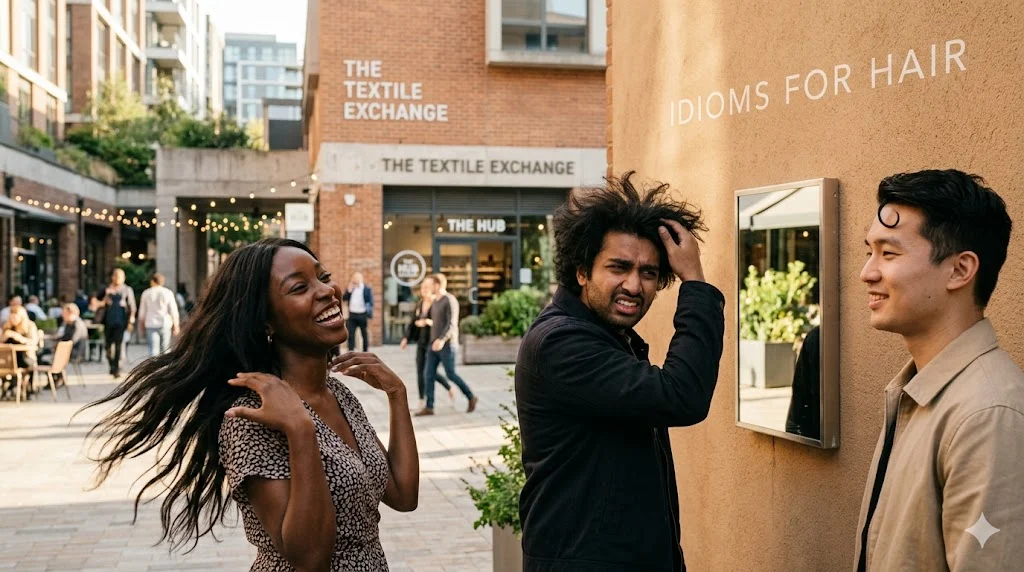
Idioms for “hair” are vivid expressions used to describe emotional states (calm, anger, stress), appearance (smoothness, messiness), and behavior (relaxation, panic) often in a relatable, dramatic, or humorous way.Examples: let your hair down, make your hair stand on end, bad hair day, keep your hair on.
Hair is more than just the strands on your head. In English, hair has become a powerful symbol for emotions, control, stress, and freedom. Think about it: when you are relaxed, your hair might be down. When you are terrified, your hair stands up. When you are frustrated, you might tear your hair out.
We use the word “hair” in daily idioms, but rarely do we mean actual hair. Instead, these expressions bring color, emotion, and personality to your speech. Saying “I’m stressed” is fine. But saying “I’ve been tearing my hair out all day” creates a vivid image that everyone understands instantly.
These idioms are especially useful in conversations, storytelling, creative writing, and even professional emails when used carefully. But to use them naturally, you need to understand context, tone, and intention.
In this guide, you’ll learn:
- Powerful idioms for hair across different emotions
- Real meanings and situational examples
- Formal, casual, and creative usage tips
- Practical strategies for natural application
Let’s explore the most expressive hair-related idioms that bring language to life.
Quick Summary Table
| Situation | Idioms |
|---|---|
| Relaxation & freedom | Let your hair down, Let loose |
| Fear & shock | Make your hair stand on end, Hair-raising |
| Frustration & stress | Tear your hair out, Bad hair day |
| Anger & irritation | Get in someone’s hair, Keep your hair on |
| Calmness & control | Not turn a hair, By a hair’s breadth |
| Appearance & detail | Split hairs, Let a hair grow on your head |
🧘 Idioms for Relaxation & Freedom
Sometimes “hair” represents letting go of control, rules, and stress. These idioms are perfect for describing moments of true relaxation or celebration.
1. Let Your Hair Down
This is one of the most common and beloved hair idioms. The image is simple: when you come home after a long day, you might take out hairpins and let your hair fall freely.
Meaning: To relax and enjoy yourself without worrying about what others think.
When People Use It: Parties, vacations, weekends, informal gatherings.
Alternative Expression: Unwind, be yourself.
Examples:
- Formal: After the quarterly reports were submitted, the team finally had a chance to let their hair down at the annual dinner.
- Casual: It’s Friday night! Time to let your hair down and forget about work.
- Creative: She laughed so hard that her worries dissolved into the music, finally letting her hair down after years of silence.
💡 Usage Insight: This idiom is always positive. It encourages freedom and authenticity.
2. Let Loose (Hair-related origin)
While not exclusively about hair, this idiom shares the same visual idea of releasing tied or束缚 hair.
Meaning: To act freely and without restraint.
When People Use It: Concerts, festivals, celebrations.
Alternative Expression: Go wild, be carefree.
Examples:
- Formal: The otherwise reserved professor let loose during the cultural festival.
- Casual: Come on, let loose and dance!
- Creative: His spirit, like unbound hair, floated into the night air.
😨 Idioms for Fear & Shock
When you are truly terrified, your body reacts physically. One ancient反应 is the raising of hair follicles goosebumps on your scalp. These idioms capture that primal response.
3. Make Your Hair Stand on End
This dramatic idiom describes something so frightening or shocking that it causes a physical reaction.
Meaning: To cause extreme fear, horror, or shock.
When People Use It: Horror stories, shocking news, suspenseful moments.
Alternative Expression: Terrify, horrify.
Examples:
- Formal: The documentary about the war was so graphic it made my hair stand on end.
- Casual: That ghost story made my hair stand on end!
- Creative: The silence in the abandoned house was so deep it made his hair stand on end, each strand whispering warnings.
4. Hair-Raising
A shorter, adjective form of the previous idiom. This is extremely common in reviews and descriptions.
Meaning: Extremely frightening or exciting.
When People Use It: Movies, roller coasters, adventures.
Alternative Expression: Thrilling, scary.
Examples:
- Formal: The stunt performer executed a hair-raising jump between two buildings.
- Casual: We watched a hair-raising horror movie last night.
- Creative: The road twisted along the cliff edge in a hair-raising dance with gravity.
5. Not a Hair Out of Place (for fear/control – opposite)
While this often means perfection, in fearful contexts it can describe someone who remains unnaturally still due to terror.
Meaning: Perfectly neat, but also can mean frozen in fear.
When People Use It: Describing someone who is either very organized or suddenly paralyzed by shock.
Alternative Expression: Perfect composure.
Examples:
- Formal: Despite the chaos, the butler stood with not a hair out of place.
- Casual: Even after the roller coaster, she had not a hair out of place.
🤯 Idioms for Frustration & Stress
These are your go-to expressions when you want to complain about a difficult situation, a tedious task, or a bad day.
6. Tear Your Hair Out
This is a very visual idiom. It describes the frustrated动作 of pulling your own hair in distress.
Meaning: To be extremely frustrated, worried, or annoyed.
When People Use It: Difficult problems, unsolvable puzzles, noisy environments.
Alternative Expression: Be extremely stressed, pull your hair out.
Examples:
- Formal: The software developers were tearing their hair out trying to fix the bug before the deadline.
- Casual: I’ve been tearing my hair out over this math homework for two hours.
- Creative: The endless beeping of the machine drove him to tear his hair out, strand by metaphorical strand.
7. Bad Hair Day
This idiom started literally (a day when your hair looks messy) but has expanded to mean any day where everything goes wrong.
Meaning: A day when everything seems to go wrong; a frustrating day.
When People Use It: Morning rushes, work problems, minor disasters.
Alternative Expression: Off day, frustrating day.
Examples:
- Formal: The presenter apologized for being unprepared, blaming a bad hair day that threw off her entire morning.
- Casual: I’m having such a bad hair day. First I spilled coffee, then I missed the bus.
- Creative: Tuesday arrived like a bad hair day for the universe tangled, messy, and impossible to style.
8. Keep Your Hair On (British English)
This is the opposite of tearing your hair out. It’s a命令 to stay calm.
Meaning: Stay calm; don’t get angry.
When People Use It: To calm someone down who is overreacting.
Alternative Expression: Relax, chill out, stay calm.
Examples:
- Formal: Keep your hair on, sir. The doctor will see you in five minutes.
- Casual: Keep your hair on! It’s just a small scratch on the car.
- Creative: She told herself to keep her hair on as the deadline approached, breathing in slow rhythm.
🔥 Idioms for Anger & Irritation
These idioms focus on the annoying, nagging feeling that someone or something is bothering you.
9. Get in Someone’s Hair
This is a gentle but clear way to say someone is annoying you by being too close or too involved.
Meaning: To annoy or bother someone by being too present or intrusive.
When People Use It: Children playing near a parent, coworkers interrupting, pets.
Alternative Expression: Bother, annoy, get on nerves.
Examples:
- Formal: The constant questions from the junior staff began to get in the manager’s hair.
- Casual: Mom, my little brother keeps getting in my hair while I’m trying to study.
- Creative: Worry got in her hair like tiny insects, buzzing and impossible to swat away.
10. Make Someone’s Hair Curl (British)
This can mean two things: extreme fear (similar to stand on end) or extreme disgust/anger. Context matters.
Meaning: To shock, horrify, or anger someone.
When People Use It: Stories of bad behavior, shocking revelations.
Alternative Expression: Shock, horrify.
Examples:
- Formal: The stories of corruption would make your hair curl.
- Casual: Did you hear what he said? That would make anyone’s hair curl.
11. Not Turn a Hair (Opposite of anger)
This describes someone who remains completely calm when others are angry or upset.
Meaning: To show no emotion or reaction.
When People Use It: Describing stoic people, professionals under pressure.
Alternative Expression: Stay calm, remain unruffled.
Examples:
- Formal: Despite the intense cross-examination, the witness did not turn a hair.
- Casual: Everyone was panicking, but she didn’t turn a hair.
🎯 Idioms for Calmness & Control
Hair can represent extreme precision, small margins, and perfect control.
12. By a Hair’s Breadth / By a Hair
This idiom describes a very small distance or margin. It comes from the idea that a single hair is extremely thin.
Meaning: By an extremely small margin; very narrowly.
When People Use It: Near misses, close competitions, almost accidents.
Alternative Expression: Narrowly, barely, by an inch.
Examples:
- Formal: The car missed the pedestrian by a hair’s breadth.
- Casual: I won the race by a hair.
- Creative: Success brushed past him by a hair’s breadth, leaving only the whisper of what could have been.
13. Not a Hair Out of Place
This is the ultimate compliment for neatness and control.
Meaning: Perfectly tidy, neat, and organized.
When People Use It: Describing professional appearance, meticulous people.
Alternative Expression: Immaculate, perfect.
Examples:
- Formal: The soldier stood at attention with not a hair out of place.
- Casual: Even after the long flight, she didn’t have a hair out of place.
- Creative: His lies were arranged like a wig not a hair out of place on the surface, but nothing real underneath.
14. Let a Hair Grow on Your Head
A very old, less common idiom meaning to wait or be patient.
Meaning: To wait for a very long time.
When People Use It: Literary or formal contexts.
Alternative Expression: Wait ages.
Examples:
- Formal: He vowed that he would not let another hair grow on his head before seeking revenge.
- Creative: Time stood still; she wouldn’t let a hair grow on her head until she heard his voice again.
🔬 Idioms for Appearance & Detail (Splitting Hairs)
These idioms focus on obsession with small details and precision.
15. Split Hairs
This is perhaps the most famous intellectual hair idiom. It has a negative connotation.
Meaning: To make unnecessary, fine distinctions; to argue about tiny, irrelevant details.
When People Use It: Arguments, legal discussions, nitpicking.
Alternative Expression: Nitpick, be overly precise.
Examples:
- Formal: Instead of solving the problem, the committee spent an hour splitting hairs over the wording.
- Casual: Stop splitting hairs! You know what I meant.
- Creative: They split hairs until nothing remained but dust and disappointment.
16. Hair-Splitter (Noun)
A person who splits hairs.
Meaning: Someone who argues about trivial details.
When People Use It: Describing pedantic people.
Examples:
- Formal: The professor was known as a hair-splitter, deducting points for missing commas.
- Casual: Don’t be such a hair-splitter.
17. Turn a Hair (in negative form)
We saw “not turn a hair” for calmness. Using it in positive form is rare.
Meaning: To change slightly.
Examples:
- He didn’t turn a hair when accused. (He stayed calm.)
💇 Idioms for Changing Appearance & Identity
Hair is often connected to identity, transformation, and major life changes.
18. Let Your Hair Down (Also freedom – see #1)
This idiom also implies showing your true self, not just relaxing.
Examples:
- She finally let her hair down and told everyone her real opinion.
19. Hair of the Dog (That Bit You)
This is a drinking idiom with a hair origin. The old belief was that putting the hair of a rabid dog on the wound would cure rabies. Now, it means drinking alcohol to cure a hangover.
Meaning: A small amount of alcohol taken to cure a hangover.
When People Use It: Morning after drinking.
Alternative Expression: Hangover cure.
Examples:
- Casual: I feel terrible. Time for a bit of hair of the dog.
- Formal: Some cultures believe in a “hair of the dog” approach to hangovers.
20. Keep Your Shirt On (Not hair, but often confused with “Keep your hair on”)
Just for clarity: “Keep your shirt on” means calm down (American). “Keep your hair on” is British for the same thing.
💥 Idioms for Extreme or Dangerous Situations
These idioms use hair to describe life-or-death moments.
21. Hang by a Hair
Similar to “by a hair’s breadth.” Something is very close to breaking or failing.
Meaning: To be in a very precarious position.
When People Use It: Health scares, business survival.
Alternative Expression: Hang by a thread.
Examples:
- Formal: The company’s future hung by a hair after the scandal.
- Creative: His patience hung by a hair, swaying in the wind of her excuses.
22. Escape by a Hair
Very similar to “by a hair’s breadth.”
Meaning: To barely escape danger.
Examples:
- He escaped the collapsing building by a hair.
😤 Idioms for Control & Obedience (Horse-related)
Horses have manes (long hair on their necks). Some idioms come from horse riding and控制.
23. Get (or Take) the Bit Between Your Teeth (Mane context)
While not directly “hair,” this involves the horse’s head and mane. But there is a direct one:
24. Make Someone’s Hair Stand on End (already covered)
25. Against the Hair (Very Old)
This means to do something the wrong way, against the natural grain. Like petting a cat backwards.
Meaning: To do something in a way that causes irritation or difficulty.
When People Use It: Rare, literary.
Alternative Expression: Against the grain (more common).
Examples:
- You are rubbing him against the hair by asking that question.
🎯 How to Use Hair Idioms Naturally
Using hair idioms can instantly make your English more colorful and relatable. However, like all figurative language, timing and context matter greatly. Here’s how to sound natural, not forced.
✔ Match the Emotion to the Idiom
Not all hair idioms express the same feeling. Using the wrong one can confuse your listener.
Fear:
- ✅ “That movie made my hair stand on end.”
- ❌ “That movie made me tear my hair out.” (That means frustration, not fear)
Frustration:
- ✅ “This traffic is making me tear my hair out.”
- ❌ “This traffic is making my hair stand on end.” (Sounds strange)
Relaxation:
- ✅ “I can’t wait to let my hair down this weekend.”
- ❌ “I can’t wait to split hairs this weekend.” (That means argue about details – very different!)
Anger/annoyance:
- ✅ “My little brother keeps getting in my hair.”
- ❌ “My little brother keeps letting his hair down.” (That would mean he’s relaxing – opposite meaning)
✔ Keep Tone in Mind
Some hair idioms are perfectly fine in casual conversation but might sound odd or inappropriate in professional or serious settings.
Casual/Informal (Friends, family, social media):
- Tear your hair out
- Bad hair day
- Get in someone’s hair
- Let your hair down
Neutral (Can be used in most situations):
- By a hair’s breadth
- Not a hair out of place
- Make your hair stand on end (acceptable in storytelling)
Formal/Literary (Use carefully):
- Hair-raising (acceptable in reviews)
- Split hairs (acceptable but slightly negative)
💡 Pro Tip: In a job interview, avoid saying “I’ve been tearing my hair out.” Instead, say “I’ve been working diligently to solve this challenge.” Save the dramatic idioms for casual settings.
✔ Use Sparingly for Maximum Impact
Idioms are like spices. A little adds flavor. Too much ruins the dish.
Bad example (overloaded):
“I was tearing my hair out and letting my hair down while splitting hairs about my bad hair day, which made my hair stand on end.”
Good example (balanced):
“It was a bad hair day from the start. By noon, I was tearing my hair out over a simple email. But after work, I met my friends and finally let my hair down.”
Golden Rule: One strong, well-placed hair idiom per paragraph (or per conversation turn) is enough. Let the rest of your sentence be clear and direct.
⚠️ Common Mistakes to Avoid
Even fluent English speakers can misuse hair idioms. Here are the most common pitfalls and how to avoid them.
❌ Mixing Up “Tear Your Hair Out” and “Let Your Hair Down”
These are opposites. One expresses extreme stress. The other expresses joyful relaxation.
Mistake: “I’m so happy, I’m tearing my hair out!”
Correction: “I’m so happy, I could let my hair down!”
Mistake: “This puzzle is so easy, I’m letting my hair down.”
Correction: “This puzzle is so hard, I’m tearing my hair out.”
❌ Using “Split Hairs” When You Mean “Let Your Hair Down”
These are unrelated. Splitting hairs is negative (nitpicking). Letting your hair down is positive (relaxing).
Mistake: “After work, I love to split hairs with my friends.”
Correction: “After work, I love to let my hair down with my friends.”
❌ Overusing “Bad Hair Day” for Serious Problems
“Bad hair day” is for minor frustrations (spilled coffee, missed bus, messy hair). Do not use it for serious problems (job loss, illness, accident).
Mistake: “My grandmother passed away. It’s such a bad hair day.”
Problem: This sounds insensitive and trivializes a serious event.
Better: “I’m having a really difficult day today.”
❌ Assuming “Hair” Idioms Are Universal
Many other languages have different hair-related expressions. Do not directly translate your native language’s hair idioms into English. Use the standard English idioms listed in this guide.
🚀 Practice Method
Memorizing a list is useless if you never use the idioms. Here is a 3-step practice method that builds real, natural fluency.
Step 1: Learn 3 Idioms Per Day
Don’t try to memorize all 25+ idioms at once. Focus on small groups based on emotion.
Day 1 (Relaxation): Let your hair down, not a hair out of place
Day 2 (Frustration): Tear your hair out, bad hair day, keep your hair on
Day 3 (Fear): Make your hair stand on end, hair-raising
Day 4 (Details): Split hairs, by a hair’s breadth
Step 2: Use Them in Real Sentences (Write or Speak)
Create one original sentence for each idiom. Do not copy the examples. Make them personal.
Let your hair down
- “After finals week, my friends and I are going to the beach to let our hair down.”
Tear your hair out
- “My little sister was tearing her hair out over her broken phone.”
By a hair’s breadth
- “I caught the train by a hair’s breadth. The doors closed right behind me.”
Step 3: Create a Short Story Using 5 Idioms
This is where real learning happens. A story forces you to use idioms in context.
Practice story example:
Monday was a total bad hair day. I woke up late, spilled coffee on my shirt, and missed the bus. At work, my computer crashed, and I started tearing my hair out. My coworker wouldn’t stop asking questions, getting in my hair the entire morning. But by 5 PM, everything was fixed. I met my friends for dinner, and we let our hair down until midnight.
💡 Memory Trick
Visualize the literal meaning: The best way to remember hair idioms is to picture the literal image.
- Let your hair down: Picture a woman removing pins, hair falling over her shoulders, smiling.
- Tear your hair out: Picture a cartoon character pulling clumps of hair in frustration.
- Hair stand on end: Picture a scared cat with fur standing up, but on a human head.
- Split hairs: Picture someone taking a single strand of hair and trying to split it with a razor blade – pointless and too detailed.
The more vivid the image, the easier the idiom sticks.
25+ Hair Idioms with Meanings
| # | Idiom | Meaning | Emotion |
|---|---|---|---|
| 1 | Let your hair down | Relax, be yourself | Relaxation |
| 2 | Make your hair stand on end | Terrify | Fear |
| 3 | Hair-raising | Very frightening | Fear |
| 4 | Tear your hair out | Be extremely frustrated | Frustration |
| 5 | Bad hair day | Everything goes wrong | Frustration |
| 6 | Keep your hair on | Stay calm | Calmness |
| 7 | Get in someone’s hair | Annoy someone | Anger |
| 8 | By a hair’s breadth | Very narrow margin | Precision |
| 9 | Not a hair out of place | Perfectly neat | Control |
| 10 | Split hairs | Argue about details | Negativity |
| 11 | Not turn a hair | Show no emotion | Calmness |
| 12 | Make someone’s hair curl | Shock or horrify | Shock |
| 13 | Hair of the dog | Hangover cure | Drinking |
| 14 | Hang by a hair | Precarious situation | Danger |
| 15 | Escape by a hair | Barely escape | Danger |
| 16 | Against the hair | Wrong direction | Old idiom |
| 17 | Let a hair grow | Wait a long time | Patience |
| 18 | Turn a hair | Change slightly | Change |
| 19 | Hair-splitter | Nitpicker | Negative |
| 20 | Let loose | Be free | Relaxation |
| 21 | In someone’s hair | Bothering someone | Annoyance |
| 22 | Get your hair off (rare) | Calm down (UK) | Calmness |
| 23 | Without turning a hair | Without reaction | Control |
| 24 | Hair trigger | Very sensitive | Reaction |
| 25 | Curl your hair | Shock (UK) | Shock |
🧠 Advanced Tips: Mixing Hair Idioms with Other Expressions
Once you are comfortable with individual hair idioms, try combining them with other figures of speech for advanced, natural-sounding English.
Combine with Similes
- “He was tearing his hair out like a man trying to solve an unsolvable riddle. ”
- “Her hair stood on end like porcupine quills ready for battle. ”
Combine with Metaphors
- “Frustration was a pair of hands, tearing his hair out strand by strand.”
- “The narrow escape was a hair’s breadth bridge over a canyon of disaster.”
Use in Dialogue (Natural conversation examples)
Friends chatting
A: You look exhausted. What happened?
B: Oh, I’ve been tearing my hair out over this freelance project. The client keeps changing everything.
A: That sounds awful. You need to let your hair down this weekend.
B: Absolutely. I’m going to do nothing but watch movies.
Family conversation
Mom: Stop getting in your sister’s hair!
Little brother: I’m just asking one question!
Mom: You’ve asked twenty. Keep your hair on and go play outside.
Work conversation
Manager: The report is due tomorrow, and the data is still incorrect.
Employee: I know. I’ve been tearing my hair out over it. We missed the error by a hair’s breadth yesterday.
Manager: Let’s not split hairs about who made the mistake. Just fix it.
❓ FAQs
1. What does “let your hair down” really mean?
It means to relax and act freely, without worrying about social rules or being judged. It comes from the old practice of women pinning up their hair in public and only letting it down in private.
2. Is “bad hair day” only about literal hair?
No. While it started literally (messy hair), it now means any day where small things keep going wrong. You can say “I’m having a bad hair day” even if your hair looks perfect.
3. Are these idioms offensive or insensitive?
Most hair idioms are not offensive. However, avoid saying someone is “tearing their hair out” if they have a serious mental health condition. Also avoid mocking someone’s actual hair loss or medical condition with these idioms.
4. Can I use “split hairs” in a positive way?
Usually, no. “Splitting hairs” has a negative meaning (being annoyingly precise about irrelevant details). It is not a compliment.
5. Which hair idiom is most common in daily conversation?
“Let your hair down” and “bad hair day” are extremely common in casual American and British English. “Tear your hair out” is also very frequent. Start with these three.
6. Do these idioms work in professional writing?
Some do, some don’t. “By a hair’s breadth” can work in formal reports. “Split hairs” is acceptable but slightly negative. Avoid “tear your hair out” and “let your hair down” in formal business writing. Use neutral language instead.
7. How is “hair of the dog” related to hair?
An old folk remedy suggested that putting the hair of a rabid dog into the wound would prevent rabies. The “hair” is literal dog hair. Now, it humorously refers to drinking more alcohol to cure a hangover.
8. What’s the difference between “not turn a hair” and “not a hair out of place”?
- Not turn a hair: Emotional control (staying calm when others panic).
- Not a hair out of place: Physical neatness (looking perfect).
✅ Conclusion
Idioms for hair are some of the most expressive, visual, and emotionally rich phrases in the English language. They allow you to move beyond simple words like “scared,” “frustrated,” or “relaxed” and paint a picture that listeners and readers will instantly understand.
From letting your hair down on a fun Friday night to tearing your hair out over a difficult problem, these idioms cover the full spectrum of human emotion. They capture fear (hair-raising), precision (by a hair’s breadth), irritation (getting in someone’s hair), and even the minor disasters of daily life (bad hair day).
The key to using them naturally is simple:
- Understand the core emotion of each idiom (fear, frustration, relaxation, anger, precision).
- Match the idiom to the situation (casual vs. formal, serious vs. lighthearted).
- Practice consistently using the 3-idiom daily method and short story technique.
- Visualize the literal image to lock the meaning in your memory.
Once you start weaving these hair idioms into your daily conversations, emails to friends, and even creative writing, your English will feel more alive, more human, and infinitely more expressive. You won’t just be speaking English – you’ll be painting with words.
So go ahead. Let your hair down, stop splitting hairs over perfect grammar, and start using these powerful expressions. Your next conversation will thank you.
Read More Related Articles:
- Idioms for Snow | Adds Frosty Charm to Your Language In 2026
- Idioms for Anger | Powerful Expressions to Describe Anger Naturally In 2026
- Idioms for Scared | Express Fear Like a Native Speaker In 2026

Loganx River is a passionate writer at IdiomCrafter.com, where he explores the meanings and stories behind everyday expressions. He enjoys breaking down complex phrases into simple, easy-to-understand ideas for readers. When he’s not writing, he spends his time reading and collecting interesting sayings from different cultures.