Quick Answer
Every teen should know common English idioms to communicate more naturally and confidently. These expressions make everyday conversations, school discussions, and social interactions more engaging and fluent.
Let’s be real. Nobody wants to sound like a robot when they talk. Using idioms makes your language come alive. When you say something “drives you wild” instead of just “annoys you,” people actually feel what you mean .
Think about it this way. Your favorite influencers, the songs you love, the shows you indulge-watch… they’re all packed with idioms. Understanding them means you never miss the joke. Using them means you fit right in.
Here’s something most people don’t realize. Idioms aren’t just about sounding cool. They actually help you connect with others. When you use an expression that everyone knows, you’re speaking the same language… literally and figuratively.
The best part? Teens pick up idioms faster than anyone. Your brain is wired for language learning right now. So why not take advantage of it?
The Ultimate Idiom Collection for Teens
1. Go Wild
Meaning: Get extremely excited or angry
Example: “The crowd went nuts when the band came on stage.”
When to use it: Parties, concerts, sports games… anytime excitement goes through the roof .
Why teens love it: It’s quick, punchy, and instantly communicates intensity. Plus, it works for both good wild and bad wild.
Try this: “My parents are going to go wild when they see my report card!”
2. Drive Someone Wild
Meaning: Annoy or frustrate someone greatly
Example: “This constant buzzing sound is driving me wild.”
When to use it: Whenever something or someone is testing your patience .
Why teens use it constantly: Because let’s face it, a lot of things drive teens wild. Homework, siblings, bad Wi-Fi… the list never ends.
Try this: “My little brother keeps asking the same question. He’s driving me wild!”
3. Lose It
Meaning: Lose emotional control
Example: “I totally lost it when I saw the surprise party.”
When to use it: Overwhelming moments, both good and bad .
Why it’s useful: It covers everything from laughing uncontrollably to getting really angry. One phrase, many situations.
Try this: “She lost it when she found out she got the lead role in the play.”
4. Off Your Rocker
Meaning: Acting strangely or foolishly
Example: “You must be off your rocker to wear shorts in the snow.”
When to use it: Questioning someone’s judgment or actions .
Why it’s a classic: It’s been around forever but still sounds fresh. Plus, it’s more playful than just calling someone “wild.”
Try this: “He’s off his rocker if he thinks he can finish that project in one night.”
5. Bounce Off the Walls
Meaning: Have extreme energy, usually from excitement or sugar
Example: “The kids were bouncing off the walls after the birthday party.”
When to use it: When someone has way too much energy .
Why it’s perfect for teens: Let’s be honest… this happens a lot. Caffeine, sugar, good news… teens bounce.
Try this: “I had so much coffee this morning, I’m bouncing off the walls.”
6. Spill the Tea
Meaning: Share gossip or reveal secrets
Example: “Okay, spill the tea! What happened at the party?”
When to use it: Whenever there’s juicy gossip to share .
Why this one’s huge right now: It’s modern, it’s fun, and every teen knows what it means. Plus, it sounds way cooler than “tell me the gossip.”
Try this: “I know something you don’t know. Should I spill the tea?”
7. Go Viral
Meaning: Become extremely popular online in a short time
Example: “Her TikTok video went viral overnight.”
When to use it: Talking about online content that blows up .
Why it’s essential: This is the language of your generation. If you don’t know this one, you’re missing out.
Try this: “That meme is going to go viral for sure.”
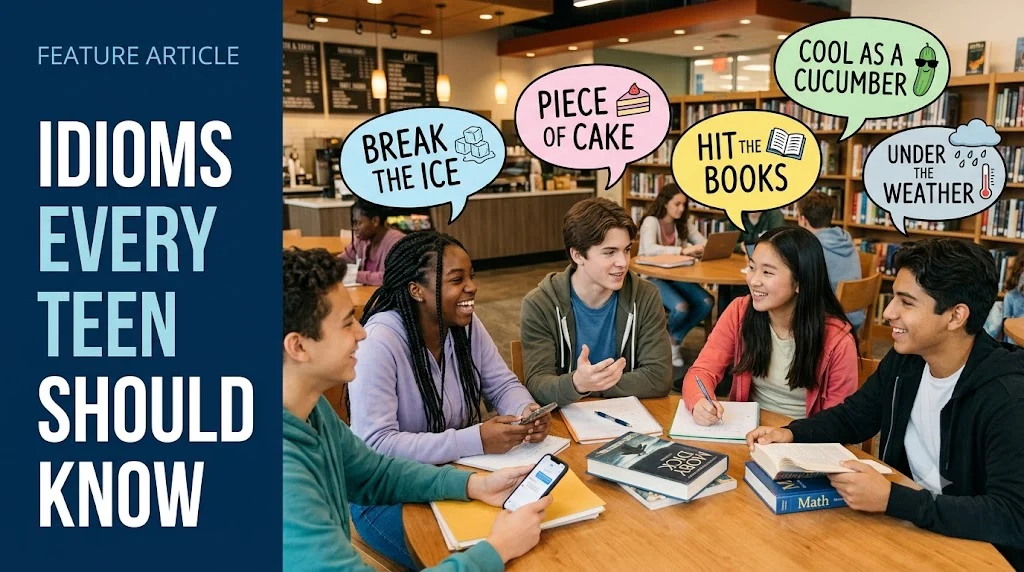
8. Hit the Books
Meaning: Study seriously
Example: “I need to hit the books before the history exam.”
When to use it: Before tests, during finals week, anytime studying is involved .
Why it works: It makes studying sound more active and less boring. Way better than saying “I need to study.”
Try this: “Sorry, can’t hang out tonight. Got to hit the books.”
9. Piece of Cake
Meaning: Something very easy to do
Example: “The math quiz was a piece of cake.”
When to use it: After completing something with ease .
Why it’s a favorite: It’s simple, everyone understands it, and it just sounds so casual and confident.
Try this: “Don’t worry about the presentation. It’ll be a piece of cake.”
10. Break the Ice
Meaning: Start a conversation in a friendly way
Example: “I told a joke to break the ice at the party.”
When to use it: Awkward situations, first meetings, group activities .
Why it matters: This one’s a lifesaver. It helps you connect with new people and feel less awkward.
Try this: “The game we played really helped break the ice with the new students.”
11. Under the Weather
Meaning: Feeling slightly sick
Example: “I’m feeling a bit under the weather today.”
When to use it: When you’re not feeling your best .
Why it’s useful: It’s a polite way to say you’re sick without being too dramatic or sharing too many details.
Try this: “I think I’ll skip practice. Feeling under the weather.”
12. Beat Around the Bush
Meaning: Avoid talking about something directly
Example: “Stop beating around the bush and just tell me.”
When to use it: When someone’s being vague or avoiding the point .
Why it’s good to know: Sometimes people are frustratingly indirect. This phrase calls them out in a playful way.
Try this: “My teacher kept beating around the bush instead of telling us about the test.”
13. No Cap
Meaning: No lie, honestly
Example: “No cap, that was the best movie I’ve ever seen.”
When to use it: When you want to emphasize you’re telling the truth .
Why it’s huge right now: This is modern teen slang. It’s everywhere on social media and in conversations.
Try this: “No cap, I actually finished all my homework.”
14. Low-Key
Meaning: Somewhat, quietly, secretly
Example: “I’m low-key excited for the school trip.”
When to use it: When you feel something but don’t want to make a big deal about it .
Why you need this: Sometimes you don’t want to admit how much you care. Low-key is perfect for that.
Try this: “I’m low-key worried about the test tomorrow.”
15. High-Key
Meaning: Openly, strongly, without hiding
Example: “I’m high-key obsessed with this new song.”
When to use it: When you want everyone to know exactly how you feel .
Why it’s the opposite of low-key: Sometimes you’re not hiding anything. High-key is for those moments.
Try this: “I’m high-key nervous about my college applications.”
16. Catch These Hands
Meaning: Threaten to fight someone (usually playful)
Example: “Keep teasing me and you’ll catch these hands.”
When to use it: Playful banter with friends .
Why it’s fun: It sounds aggressive but is usually used as a joke. That’s what makes it great for teen humor.
Try this: “If you eat my last slice of pizza, you’re going to catch these hands.”
17. Add Fuel to the Fire
Meaning: Make a bad situation worse
Example: “Stop arguing. You’re just adding fuel to the fire.”
When to use it: When someone’s making things worse instead of better .
Why it’s useful: Sometimes you need to call someone out. This phrase does it without being too harsh.
Try this: “Don’t bring that up now. You’ll just add fuel to the fire.”
18. Throw Shade
Meaning: Insult or disrespect someone indirectly
Example: “Did you see how she threw shade at him in the group chat?”
When to use it: When someone’s being subtly rude .
Why it’s popular: It’s the polite way to talk about drama. Everyone knows what it means, but it sounds less gossipy.
Try this: “I’m not throwing shade, but that outfit is… interesting.”
19. Living Rent-Free
Meaning: Something that’s stuck in your mind
Example: “That song has been living rent-free in my head all day.”
When to use it: When you can’t stop thinking about something .
Why it’s so relatable: We’ve all been there. Something just won’t leave your brain.
Try this: “His comment is living rent-free in my head. I can’t stop thinking about it.”
20. Go Off
Meaning: Express yourself passionately
Example: “She went off about how unfair the dress code is.”
When to use it: When someone’s ranting, performing, or sharing strong opinions .
Why it’s empowering: It celebrates people speaking their mind. No more holding back.
Try this: “I love when she goes off about social issues. She’s so passionate.”
21. Shoot Your Shot
Meaning: Take a chance or try for something
Example: “Just shoot your shot and ask her to the dance.”
When to use it: Before taking a risk or making a move .
Why it’s life-changing: This idiom actually pushes people to be brave. That’s pretty powerful for one phrase.
Try this: “I decided to shoot my shot and apply for the internship.”
22. It’s Giving
Meaning: It has the vibe of
Example: “This outfit is giving main character energy.”
When to use it: Describing the feeling or vibe of something .
Why it’s huge: This is how teens talk now. It’s short, it’s vague, and it lets you be creative.
Try this: “This room is giving cozy library vibes.”
23. I Can’t Even
Meaning: I’m too overwhelmed to continue
Example: “The test was so hard, I can’t even.”
When to use it: When you’re so shocked, excited, or frustrated that words fail you .
Why it’s a mood: Sometimes, you really can’t even. It says everything without saying anything.
Try this: “Did you hear what she said? I can’t even!”
24. Main Character Energy
Meaning: Acting like the star of your own life
Example: “She walked into the room with main character energy.”
When to use it: Describing confident, bold, or impressive people .
Why it’s inspiring: It reminds you to own your story and be confident.
Try this: “You need to have main character energy at the interview.”
25. Plot Twist
Meaning: An unexpected turn of events
Example: “Plot twist: I actually liked the movie everyone hates.”
When to use it: When something surprising happens .
Why it’s fun: It turns everyday moments into dramatic stories.
Try this: “Plot twist: the quiet kid is actually the class clown.”
26. Out of Pocket
Meaning: Wild, inappropriate, or unexpected
Example: “That comment was so out of pocket.”
When to use it: When someone says something that catches you off guard .
Why it’s useful: It covers a lot of territory. Something can be funny-out-of-pocket or offensive-out-of-pocket.
Try this: “His joke was so out of pocket, but I couldn’t stop laughing.”
27. No Shot
Meaning: No way, impossible
Example: “There’s no shot we finish this project tonight.”
When to use it: When something seems unlikely or impossible .
Why it’s casual: It’s the laid-back way to say something’s not happening.
Try this: “You’re telling me you’ve never seen that movie? No shot!”
28. Down Bad
Meaning: Desperate, lovesick, or in a bad situation
Example: “He’s so down bad for her. He wrote her a whole song.”
When to use it: When someone’s hopelessly into someone or something .
Why it’s perfect: We’ve all been down bad. It’s a relatable teen experience.
Try this: “I was so down bad after my favorite show ended.”
29. Glow Up
Meaning: A major positive transformation
Example: “Have you seen his glow up? He looks completely different.”
When to use it: When someone improves themselves significantly .
Why it’s inspiring: It reminds you that change is possible. Everyone can have a glow up.
Try this: “New year, new me. Time for a glow up.”
30. Touch Grass
Meaning: Go outside, be more realistic, stop obsessing online
Example: “You need to touch grass and get off social media.”
When to use it: When someone’s too caught up in online drama .
Why it’s real talk: Sometimes you need to be reminded that the internet isn’t everything.
Try this: “I’ve been studying for hours. I need to touch grass.”
How to Use Idioms Naturally
Match Your Tone
Some idioms are playful, others are serious. Use “go wild” for excitement and “lose it” for losing control. Context matters .
Don’t Overdo It
One or two idioms per conversation is plenty. Too many sounds forced and unnatural. Less is more .
Practice Out Loud
Say them. Record yourself. Use them with friends. The more you use them, the more natural they feel.
Learn from Native Speakers
Watch shows, follow influencers, listen to music. Pay attention to how native speakers use idioms .
Embrace Mistakes
You’ll mess up sometimes. That’s okay. Native speakers mess up too. Just keep practicing.
Common Mistakes to Avoid
Using old-fashioned idioms: Some expressions just sound outdated. Stick with what’s current .
Being too formal: Idioms are casual. Using them in formal writing can feel out of place.
Getting meanings wrong: Make sure you know what an idiom means before using it. Some are tricky.
Forcing it: Don’t cram idioms where they don’t belong. Let them come naturally.
Quick Reference Chart
| SituationBest Idioms | |
|---|---|
| Excitement | Go wild, bounce off the walls, go wild |
| Annoyance | Drive wild, do my head in, get on nerves |
| Fear/Nerves | Cold feet, losing it, in hot water |
| Studying | Hit the books, burn the midnight oil |
| Easy tasks | Piece of cake, no sweat |
| Gossip | Spill the tea, let the cat out of the bag |
| Surprise | Plot twist, out of nowhere |
| Failure/Setbacks | Take the L, throw in the towel |
| Romance | Head over heels, down bad |
| Online life | Go viral, no cap, touch grass |
Why This Matters for Your Future
Here’s something most teens don’t think about. Idioms aren’t just for casual conversations. They show up everywhere.
College essays. Job interviews. Professional emails. Social media posts. Everywhere.
Employers notice candidates who communicate well. Idioms show you understand nuance and cultural context. It makes you sound more fluent and confident .
Plus, connecting with people is a superpower. Idioms help you do that. They make conversations warmer, more engaging, and more human.
So don’t just memorize these idioms. Make them yours. Use them daily. Have fun with them.
Your language is your identity. Make it colorful.
FAQs
1. Why should teenagers learn English idioms?
Learning idioms helps teenagers speak more naturally, understand native English speakers better, and improve their communication skills in school, exams, and everyday conversations.
2. Which idioms should every teen know?
Teens should start with common idioms such as break the ice, hit the books, piece of cake, under the weather, and once in a blue moon because they are widely used in daily English.
3. Are English idioms useful for school and exams?
Yes. Many English proficiency tests, classroom discussions, and writing assignments include idiomatic expressions. Knowing common idioms can improve both comprehension and vocabulary.
4. How can teens remember idioms more easily?
The best way is to learn one idiom at a time, understand its meaning, read example sentences, and use it in everyday conversations or writing until it becomes natural.
5. Can teenagers use idioms in everyday conversations?
Absolutely. Using common idioms appropriately makes conversations sound more fluent, engaging, and natural, as long as they fit the context and are not overused.
Conclusion:
You’ve got 30 powerful idioms in your toolkit now. That’s enough to transform how you speak and write.
Remember the golden rule: context is everything. Choose the right idiom for the right moment, and don’t force it. One well-placed expression makes more impact than five that feel forced.
Start small. Pick your favorite three idioms from this list and use them this week. Then add more as you get comfortable.
Before you know it, these phrases will feel like second nature. You’ll sound more confident, more natural, and more connected to the people around you.
Now go out there and use them. Your conversations are about to get a whole lot more interesting.
Read More Related Articles:
- Idioms for Amazing | Expressions to Describe Something Incredible In 2026
- Idioms for Personality | Expressing Character Traits Naturally In English In 2026
- Idioms for Family | Expressing Love, Loyalty & Belonging Naturally In 2026

Loganx River is a passionate writer at IdiomCrafter.com, where he explores the meanings and stories behind everyday expressions. He enjoys breaking down complex phrases into simple, easy-to-understand ideas for readers. When he’s not writing, he spends his time reading and collecting interesting sayings from different cultures.