Quick Answer
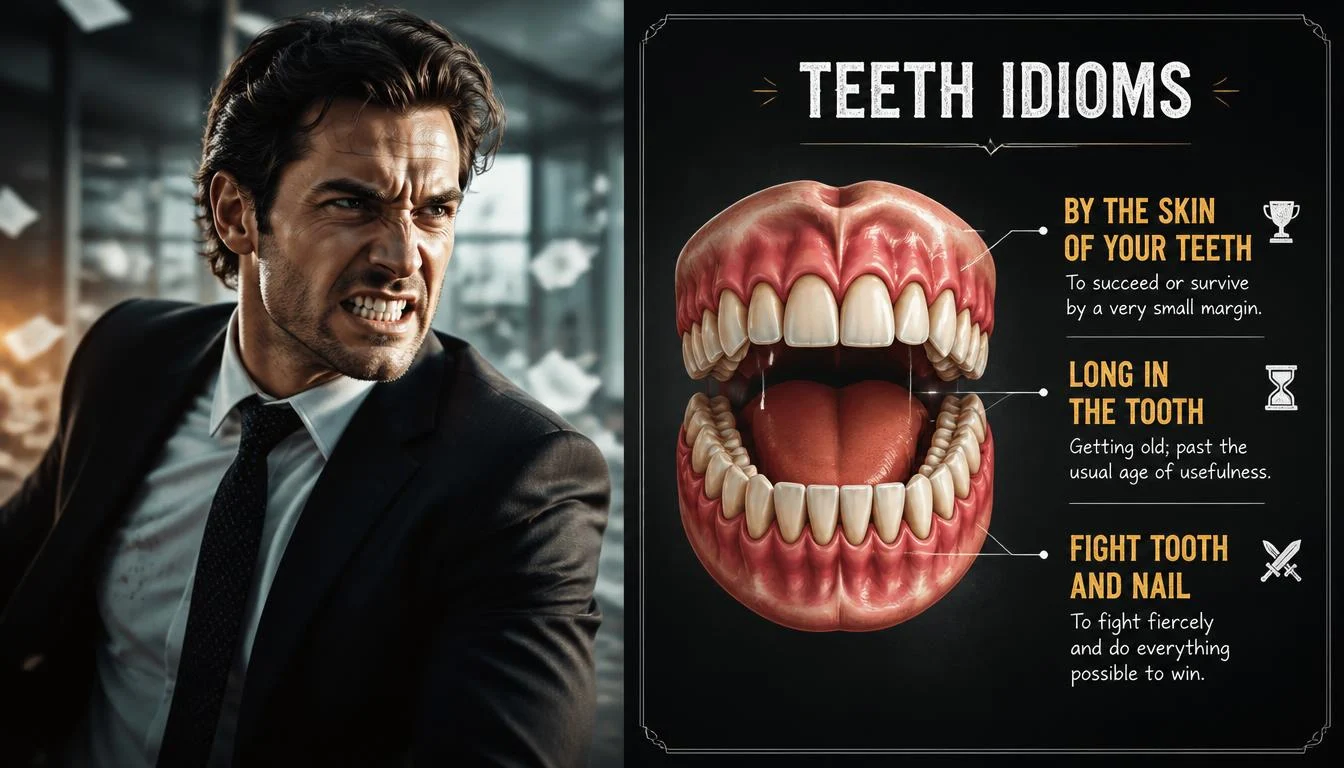
Teeth idioms are colorful expressions used to describe determination, narrow escapes, aging, irritation, honesty, and effort. They are commonly used in both casual conversations and formal writing.Examples: fight tooth and nail, by the skin of your teeth, long in the tooth, lie through your teeth, grit your teeth
We all use the word “teeth” in daily life, but rarely do we realize how many idioms revolve around this single body part. From expressing determination to describing a near-miss experience, teeth-related idioms add flavor, emotion, and personality to our language.
Instead of saying “I tried hard,” you can say “I fought tooth and nail.” Instead of “I barely passed,” you can say “I passed by the skin of my teeth.” That is the power of idioms they transform simple statements into vivid expressions that paint a picture in the listener’s mind.
These idioms are especially useful in conversations, storytelling, and even professional writing. But to use them naturally, you need to understand their meanings, contexts, and tones.
In this guide, you will learn:
- Powerful idioms featuring “teeth”
- Real meanings and everyday situations
- Formal, casual, and creative examples
- Practical tips for natural usage
- Origins and history behind these expressions
Let us explore the most expressive teeth idioms that bring language to life.
Quick Summary Table
| Situation | Idioms |
|---|---|
| Narrow escape or barely succeeding | By the skin of your teeth |
| Fierce determination and effort | Fight tooth and nail, Get your teeth into, Sink your teeth into |
| Age or getting older | Long in the tooth |
| Annoyance or irritation | Set your teeth on edge, Like pulling teeth, Grit your teeth |
| Bold dishonesty | Lie through your teeth |
| Disappointment or setback | A kick in the teeth |
| Being well-prepared | Armed to the teeth |
| First experience in a field | Cut your teeth on something |
| Determination to endure | Grit your teeth, Clench your teeth |
🦷 Idioms for Determination & Effort
1. Fight Tooth and Nail
Meaning: To fight with great determination, using all your strength and resources.
When People Use It: When describing fierce competition, struggles, or arguments.
Alternative Expressions: Give it your all, Leave no stone unturned, Go all out.
Examples:
- Formal: The legal team fought tooth and nail to protect their client’s rights.
- Casual: She fought tooth and nail to get that promotion.
- Creative: His ambition fought tooth and nail against every obstacle in his path.
Origin: This idiom dates back more than five centuries and refers to vicious animal fights where creatures literally used their teeth and claws. Today, it is used for any struggle whether figurative or literal not necessarily involving fighting to the death.
2. Get Your Teeth Into Something
Meaning: To start working on something with energy, enthusiasm, and full focus. This expression indicates you have found a task that truly engages you.
When People Use It: When you are excited about a new project, challenge, or assignment.
Alternative Expressions: Throw yourself into, Dive into, Immerse yourself in.
Examples:
- Formal: I cannot wait to get my teeth into this new research project.
- Casual: He loves to get his teeth into a good book.
- Creative: The challenge was exactly what she needed something she could truly get her teeth into.
Pro Tip: This idiom works well in professional contexts when you want to express enthusiasm for a new opportunity. It suggests you are ready to invest your skills and energy into something meaningful.
3. Sink Your Teeth Into Something
Meaning: To attack or engage with something vigorously. This can refer to food, work, or even a problem that demands your full attention.
When People Use It: When you are tackling something substantial, whether a meal, a project, or a complex issue.
Alternative Expressions: Dig in, Jump into, Take a bite out of.
Examples:
- Formal: The team was finally able to sink their teeth into the core problem and find a solution.
- Casual: I sank my teeth into that steak like I had not eaten in days.
- Creative: The melody sank its teeth into her mind and refused to let go.
Key Difference: While get your teeth into focuses on energetic engagement, sink your teeth into emphasizes a more aggressive, immersive approach like taking a literal bite that you do not want to release.
4. Dig Your Teeth In
Meaning: To start working very hard, often in a determined manner.
When People Use It: When you are ready to commit fully to a task or challenge.
Alternative Expressions: Hunker down, Focus hard, Put your back into it.
Examples:
- Formal: They dug their teeth in and finished ahead of schedule.
- Casual: I am ready to dig my teeth into this art project.
- Creative: He dug his teeth into the assignment and emerged victorious.
5. Sink Its Fangs Into
Meaning: This is a more intense version of “sink your teeth into.” It refers to something that grabs hold strongly and does not let go like a compelling book or addictive game.
When People Use It: When something has captured your complete attention or had a powerful effect on you.
Alternative Expressions: Pull you in, Hook you, Take hold of.
Examples:
- Formal: The new strategy has sunk its fangs into every aspect of operations.
- Casual: That book sank its fangs into me I could not stop reading.
- Creative: The fear sank its fangs into his heart and refused to leave.
😬 Idioms for Narrow Escape & Barely Succeeding
6. By the Skin of Your Teeth
Meaning: To succeed or survive by only the smallest margin; barely managing to do something.
When People Use It: When someone narrowly avoids failure, danger, or an unpleasant outcome.
Alternative Expressions: Just barely, By a whisker, In the nick of time.
Examples:
- Formal: The company passed the audit by the skin of its teeth.
- Casual: I passed the exam by the skin of my teeth.
- Creative: He escaped the disaster by the skin of his teeth, leaving only his shadow behind.
Origin: This phrase first appeared in the Bible, specifically in the Book of Job (Job 19:20), which reads: “My bone cleaveth to my skin and to my flesh, and I am escaped with the skin of my teeth.” Since teeth do not actually have skin, the phrase emphasizes how impossibly narrow the escape was.
Usage Tip: This idiom is perfect for telling stories where you almost failed but somehow succeeded against the odds. It adds drama and relief to your narrative.
7. By the Skin of Your Teeth Variations
| Variation | Meaning | Example |
|---|---|---|
| Just by the skin of my teeth | Slightly stronger emphasis on the narrow margin | He caught the train just by the skin of his teeth. |
| Only by the skin of my teeth | Emphasizes how close it was | She only passed the test by the skin of her teeth. |
🦴 Idioms for Age & Growing Older
8. Long in the Tooth
Meaning: Old or getting older, often said in a lighthearted or joking way.
When People Use It: When referring to someone or something that is showing signs of age.
Alternative Expressions: Getting on in years, Past one’s prime, Over the hill.
Examples:
- Formal: He is a bit long in the tooth for that demanding role.
- Casual: My car is long in the tooth, but it still runs well.
- Creative: The old house stood long in the tooth, its wooden bones creaking with every memory.
Origin: This expression comes from horse trading. You can estimate a horse’s age by examining its teeth as horses age, their gums recede, making their teeth appear longer. The same principle can apply to humans, as gums also recede with age.
Usage Note: This idiom is generally used humorously rather than offensively. However, be mindful of the context and your relationship with the person you are describing.
9. Cut Your Teeth On Something
Meaning: To get your first experience in a particular job, activity, or field.
When People Use It: When describing where someone gained their initial skills or knowledge.
Alternative Expressions: Learn the ropes, Gain experience in, Start out in.
Examples:
- Formal: Having cut his journalistic teeth on local newspapers, he moved on to a national paper.
- Casual: I cut my teeth on stage acting in school plays.
- Creative: She cut her teeth on small-town politics before conquering the national stage.
Origin: “Cutting teeth” refers to babies growing their first teeth. Just as babies “cut” their teeth when they are young, you “cut your teeth” on something when you are learning and developing new skills.
Variation: “Cut your eyeteeth” means the same thing. “Eyeteeth” are your canine teeth, which align roughly below your eyes.
10. Like Baby Teeth
Meaning: Something that is small, weak, or just starting out still in the early stages of development.
When People Use It: When describing ideas, skills, or projects that are not yet fully developed.
Alternative Expressions: In its infancy, Just getting started, Still developing.
Examples:
- Formal: This initiative is still like baby teeth, but it shows promise.
- Casual: His skills are like baby teeth, but he will get better.
- Creative: Their love was like baby teeth new, fragile, and growing slowly.
😤 Idioms for Annoyance & Irritation
11. Set Your Teeth on Edge
Meaning: To annoy you intensely or make you feel uncomfortable. This is often used for sounds, behaviors, or situations that grate on your nerves.
When People Use It: When something is irritating, unpleasant, or grating.
Alternative Expressions: Get on your nerves, Make your skin crawl, Put your teeth on edge.
Examples:
- Formal: It was his patronizing tone that set my teeth on edge.
- Casual: That screeching sound sets my teeth on edge.
- Creative: The silence between them set her teeth on edge louder than any argument.
Origin: This phrase dates back to 1382, appearing in Wyclif’s Bible to describe teeth sensitivity. Originally, it referred to the tingling sensation you feel in your teeth when eating something sour. Today, it has expanded to describe anything generally annoying. Both Shakespeare and the Bible reference this phrase.
12. Like Pulling Teeth
Meaning: Extremely difficult, tedious, or frustrating to do. It describes a task that requires excessive effort.
When People Use It: When you are struggling to get someone to do something or extract information from them.
Alternative Expressions: Painful struggle, Like herding cats, Dragging your feet.
Examples:
- Formal: Getting him to complete his report was like pulling teeth.
- Casual: It was like pulling teeth to get a straight answer.
- Creative: Every conversation with him felt like pulling teeth slow, painful, and exhausting.
Origin: This phrase dates back to the 19th century when tooth extraction was incredibly painful. Before modern dental advancements, having a tooth pulled was a dreaded experience making it the perfect metaphor for any difficult, reluctant process.
13. Grit Your Teeth
Meaning: To grind your teeth together in determination, anger, or to endure something unpleasant.
When People Use It: When you need to show determination or patience in a difficult situation.
Alternative Expressions: Bear it, Grin and bear it, Tough it out.
Examples:
- Formal: I am not wild about some aspects of the job, but I grit my teeth and get on with them.
- Casual: I grit my teeth and began to clean up after the party.
- Creative: She gritted her teeth through the pain, refusing to show weakness.
Origin: This expression dates back to the 16th century and symbolically represents alleviating anger and pain through physical restraint.
14. Gnash Your Teeth
Meaning: To grind your teeth together in anger, frustration, or sadness.
When People Use It: When someone is visibly upset, frustrated, or angry.
Alternative Expressions: Grind your teeth, Show anger, Clench your jaw.
Examples:
- Formal: He gnashed his teeth when he received the devastating news.
- Casual: She gnashed her teeth at the bad news.
- Creative: He gnashed his teeth in the darkness, cursing his own misfortune.
Key Difference:
- Grit your teeth = Endure something difficult (determination)
- Gnash your teeth = Express anger or frustration (emotion)
15. Fed Up to the Back Teeth
Meaning: Extremely annoyed or bored because a bad situation has continued for too long.
When People Use It: When you have reached your limit with a frustrating situation or person.
Alternative Expressions: Sick and tired, Had it up to here, Had enough.
Examples:
- Formal: Residents are fed up to the back teeth with the constant noise.
- Casual: He never does any housework I am fed up to the back teeth with it.
- Creative: She was fed up to the back teeth with promises that never materialized.
Usage Tip: This idiom is informal and commonly used in British English. It emphasizes that you have completely run out of patience.
16. Clench Your Teeth
Meaning: To hold back pain, emotion, or anger by clenching your teeth together.
When People Use It: When you are trying to stay composed during an emotionally challenging moment.
Alternative Expressions: Bite your tongue, Hold back, Restrain yourself.
Examples:
- Formal: He clenched his teeth to hide his disappointment.
- Casual: I clenched my teeth and stayed calm.
- Creative: He spoke with teeth clenched, trying not to explode in anger.
🦷 Idioms for Honesty & Dishonesty
17. Lie Through Your Teeth
Meaning: To tell a bold, obvious lie without shame.
When People Use It: When someone is caught lying or when you want to emphasize that someone is not telling the truth.
Alternative Expressions: Tell a blatant lie, Lie brazenly, Tell a whopper.
Examples:
- Formal: The witness was caught lying through his teeth during cross-examination.
- Casual: He was lying through his teeth I could tell.
- Creative: If I said it was a good talk, I would be lying through my teeth.
Origin: This phrase has evolved significantly over time. Originally (in the 14th century), the expression was “to lie in your teeth,” referring both to the liar’s teeth and the teeth of the person being lied to. The meaning was similar to the modern phrase “lying in your face.” Today, it has come to mean lying through a smile easily and unashamedly.
18. Toothless Smile
Meaning: A soft, gentle, or harmless smile often with a sense of innocence or vulnerability.
When People Use It: Describing babies, shy people, or situations where someone seems harmless.
Alternative Expressions: Gentle grin, Soft smile, Innocent look.
Examples:
- Formal: The baby gave a toothless smile that melted everyone’s hearts.
- Casual: He gave a toothless smile when he felt shy.
- Creative: Her toothless smile disarmed every argument he had prepared.
19. A Sharp Tongue
Meaning: The ability to speak in a critical, witty, or not-so-nice way.
When People Use It: When describing someone who is harsh or clever in their criticism.
Alternative Expressions: Witty, Sarcastic, Cutting.
Examples:
- Formal: She has a sharp tongue when it comes to her in-laws.
- Casual: Watch out for his sharp tongue it cuts deep.
- Creative: Her sharp tongue could cut through any pretense in seconds.
💥 Idioms for Failure, Disappointment & Setbacks
20. A Kick in the Teeth
Meaning: A humiliating, disappointing, or unfair setback, especially when you are already in a difficult situation.
When People Use It: When someone experiences an unexpected disappointment or betrayal.
Alternative Expressions: A slap in the face, A bitter blow, A letdown.
Examples:
- Formal: The closure of the factory was a real kick in the teeth for an area already suffering.
- Casual: Not making the team was a kick in the teeth.
- Creative: His rejection felt like a kick in the teeth sharp, brutal, and uninvited.
Usage Tip: This idiom conveys a strong sense of injustice. Use it when someone has been treated poorly, especially when they expected better treatment or support.
21. Toothless Threat
Meaning: A warning or threat that has no real power or effect.
When People Use It: When someone’s warnings are hollow or not backed by action.
Alternative Expressions: Empty threat, Weak warning, Hollow promise.
Examples:
- Formal: The rules are a toothless threat if no one follows them.
- Casual: That teacher gives toothless threats but never acts.
- Creative: His ultimatum was a toothless threat, spoken without conviction or follow-through.
Related Idiom: “All teeth and no bite” means the same thing looking scary or tough but actually being harmless.
22. No Teeth Left in It
Meaning: Something has lost all its power, effectiveness, or authority.
When People Use It: When rules, warnings, or policies are no longer enforceable or respected.
Alternative Expressions: Weak, Ineffective, Powerless.
Examples:
- Formal: That regulation has no teeth left in it.
- Casual: His warning had no teeth left in it after he was caught doing the same thing.
- Creative: The law stood like a statue, with no teeth left to bite.
🗡️ Idioms for Being Prepared & Dangerous
23. Armed to the Teeth
Meaning: Very well-prepared or heavily equipped with weapons, tools, or resources.
When People Use It: When someone is extremely well-prepared for a challenge, task, or confrontation.
Alternative Expressions: Fully equipped, Heavily armed, Well-stocked.
Examples:
- Formal: The soldiers were armed to the teeth with the latest technology.
- Casual: She came armed to the teeth with facts for the debate.
- Creative: He entered the negotiation armed to the teeth with arguments and evidence.
Origin: This saying dates back to the 16th century and pirates. In those days, firearms took a significant amount of time to reload. To avoid being vulnerable, pirates would carry one gun in each hand and hold their knife in their mouth literally being “armed to the teeth.” Over time, it has broadened to mean being prepared with any type of weapon or resource.
Variation: “Tooth and claw” is a similar idiom, used to describe a fierce, all-out effort: “They fought with tooth and claw.”
24. Show Your Fangs
Meaning: To act mean, sneaky, or reveal your aggressive side.
When People Use It: When someone shows hostility or reveals their true, threatening nature.
Alternative Expressions: Bare your teeth, Show your true colors, Reveal your claws.
Examples:
- Formal: The villain showed his fangs in the final act.
- Casual: The bully showed his fangs again.
- Creative: The corporate shark showed his fangs during the hostile takeover.
😋 Idioms for Food & Pleasure
25. Sweet Tooth
Meaning: A strong liking for sweet foods and sugary treats.
When People Use It: When describing someone who loves desserts, candy, or anything sweet.
Alternative Expressions: Lover of sweets, Sugar sugar, Dessert lover.
Examples:
- Formal: The girl has a sweet tooth and loves chocolate.
- Casual: I definitely have a sweet tooth I cannot resist cake.
- Creative: Her sweet tooth was legendary; she dreamed in chocolate and spoke in caramel.
Usage Note: This is one of the most common teeth idioms and can be used in almost any context from casual conversation to professional settings.
🦷 Advanced & Creative Idioms
26. Cut Like Teeth
Meaning: Harsh, sharp, or piercing often used to describe words, wind, or criticism.
When People Use It: When describing something that hurts deeply or has a sharp sensation.
Alternative Expressions: Cut deep, Bite sharply, Hurt badly.
Examples:
- Formal: Her words cut like teeth through his defenses.
- Casual: That cold wind cut like teeth through my jacket.
- Creative: The truth cut like teeth sharp, painful, and necessary.
27. Smile with All Your Teeth
Meaning: A big, genuine, full smile showing complete happiness.
When People Use It: When describing someone’s pure joy or genuine happiness.
Alternative Expressions: Beaming, Grinning from ear to ear, Radiant smile.
Examples:
- Formal: She smiled with all her teeth when she saw the puppy.
- Casual: He smiled with all his teeth at the good news.
- Creative: The victory made him smile with all his teeth a rare, unfiltered moment of joy.
Opposite: “A smile with no teeth” means a fake, weak, or forced effort to appear happy.
28. With a Fine-Toothed Comb
Meaning: To go through something with great attention to detail, performing a very thorough search.
When People Use It: When you are carefully examining something for mistakes, details, or hidden information.
Alternative Expressions: Scrutinize, Examine closely, Leave no stone unturned.
Examples:
- Formal: The investigators went through every document with a fine-toothed comb.
- Casual: I went through my notes with a fine-toothed comb before the test.
- Creative: He searched every memory with a fine-toothed comb, looking for answers.
Origin: This idiom originated in the early 1800s. Fine-toothed combs were originally designed to remove head lice. Investigators began using them metaphorically to describe probing crime scenes with extreme attention to detail.
29. Rarer Than a Hen’s Teeth
Meaning: Extremely rare so rare it does not exist. Hens do not have teeth.
When People Use It: When something is incredibly scarce or impossible to find.
Alternative Expressions: As rare as rocking horse manure, One in a million, Scarce as gold dust.
Examples:
- Formal: Opportunities like this are rarer than a hen’s teeth.
- Casual: A honest politician is rarer than a hen’s teeth.
- Creative: True love in that city was rarer than a hen’s teeth almost mythical.
30. Give Your Eyeteeth
Meaning: To want something so much that you would give up something very valuable.
When People Use It: When describing a strong desire for something.
Alternative Expressions: Be willing to give your right arm for, Desperately want, Covet.
Examples:
- Formal: Most actors would give their eyeteeth to work with her.
- Casual: I would give my eyeteeth for a job like that.
- Creative: He would have given his eyeteeth for one more chance.
31. No Skin Off My Teeth
Meaning: Something that does not concern you or affect you personally.
When People Use It: When you want to say that a situation does not matter to you.
Alternative Expressions: No skin off my nose, Does not bother me, Not my concern.
Examples:
- Formal: It is no skin off my teeth whether my friend comes with us or not.
- Casual: If you want to come late, it is no skin off my teeth.
- Creative: The drama unfolding around her was no skin off her teeth she had her own battles to fight.
🎯 How to Use Teeth Idioms Naturally
Using teeth-related idioms can instantly make your language more expressive but only if you use them with the right tone, timing, and intention. The goal is not just to sound interesting, but to sound natural, relatable, and appropriate.
Let us break it down in a way that actually helps you use these idioms in real life.
✔ Match the Situation
Not all teeth idioms mean the same thing. Some express determination, others express frustration, and some even express dishonesty. The key is choosing the right one for the moment.
| Situation | Recommended Idioms |
|---|---|
| Showing determination | Fight tooth and nail, Grit your teeth |
| Describing a near miss | By the skin of your teeth |
| Expressing annoyance | Set your teeth on edge, Like pulling teeth |
| Talking about aging | Long in the tooth |
| Admitting a lie | Lie through your teeth |
| Describing disappointment | A kick in the teeth |
| Showing preparedness | Armed to the teeth |
| Starting something new | Cut your teeth on something |
| Liking sweets | Sweet tooth |
✔ Keep Tone in Mind
Here is where most learners go wrong: not every idiom fits every situation.
Some teeth idioms can sound:
- Too casual for professional settings
- Too aggressive for sensitive conversations
- Outdated in modern contexts
For example: Saying “He’s long in the tooth” about a colleague could be disrespectful in a formal meeting. Instead, you might soften it with humor or avoid mentioning age altogether.
Pro Tip: If you are unsure, switch to a neutral expression in formal settings and save idioms for casual conversations.
✔ Use Sparingly
Idioms are powerful, but too many can overwhelm your message.
Imagine someone saying:
“I fought tooth and nail, gritted my teeth, and barely passed by the skin of my teeth.”
It starts to feel repetitive and unnatural, right?
Instead, use one strong idiom to carry the emotion:
“I fought tooth and nail for that opportunity.”
Golden Rule: One well-placed idiom is more impactful than five forced ones.
✔ Use Idioms with Cultural Awareness
Some teeth idioms are more common in certain varieties of English:
- “Fed up to the back teeth” is more British English
- “No skin off my teeth” is more common in the southern United States
- “By the skin of your teeth” is universally understood and used
⚠️ Common Mistakes to Avoid
Even advanced learners slip up when using idioms. Avoid these to sound more natural and confident:
❌ Using Offensive Idioms in Serious Contexts
Some phrases can unintentionally sound insensitive, especially when referring to age or appearance.
- “Long in the tooth” can be seen as rude if used directly about someone
- “Toothless smile” could be patronizing if used about an adult
Better Approach: Use these idioms to describe yourself, objects, or third parties never directly to someone’s face unless you are being playful.
❌ Confusing Similar Idioms
- “Grit your teeth” = endure something with determination
- “Gnash your teeth” = express anger or frustration
These are not interchangeable.
❌ Overusing Informal Expressions in Professional Writing
Idioms like “lie through your teeth” or “kick in the teeth” may weaken credibility in formal communication.
In professional writing, use idioms sparingly or choose more neutral alternatives.
❌ Using “Armed to the Teeth” Literally
This idiom can be misunderstood if used in a non-weapon context but used well, it adds creativity.
Creative Example: “She walked into the meeting armed to the teeth with data, ready for any challenge.”
🚀 Practice Method (That Actually Works)
Learning idioms is not just about memorization it is about usage.
1. Learn 3 Idioms Daily
Do not overload yourself. Focus on a few and understand their tone and context.
Sample Batch:
- Day 1: Fight tooth and nail, By the skin of your teeth, Grit your teeth
- Day 2: Long in the tooth, Cut your teeth on, Sweet tooth
- Day 3: Set your teeth on edge, Like pulling teeth, Lie through your teeth
2. Use Them in Real Conversations
Even simple sentences help:
- “This traffic is like pulling teeth.”
- “I just passed that test by the skin of my teeth.”
The more you use them, the more natural they feel.
3. Write One Creative Sentence for Each
This is where real improvement happens. Instead of basic sentences, try expressive ones:
- “His patience held by the skin of his teeth fragile but unbroken.”
- “Excitement sank its teeth into the room and refused to let go.”
- “The truth cut like teeth through every lie she had told.”
4. Create Mental Images
The more visual and emotional your sentence is, the easier the idiom sticks in your mind:
- Fight tooth and nail → Two animals fighting viciously
- By the skin of your teeth → An impossibly thin margin of safety
- Long in the tooth → An old horse with receding gums
- Like pulling teeth → The pain and effort of 19th-century dentistry
📝 Teeth Idioms Cheat Sheet
🦷 Metaphors & Extended Uses
33. All Teeth and No Bite
Meaning: Looks scary or threatening but is actually harmless.
When People Use It: Describing someone who talks tough but does not follow through.
Alternative Expressions: All bark and no bite, Paper tiger, Empty threat.
Examples:
- Formal: The political candidate was all teeth and no bite.
- Casual: He talks tough but is all teeth and no bite.
- Creative: His threats were all teeth and no bite sharp words with no substance.
34. Tooth and Claw
Meaning: A fierce, all-out effort involving great struggle.
When People Use It: Describing competitive environments or intense struggles.
Alternative Expressions: Dog-eat-dog, Cutthroat, Fierce competition.
Examples:
- Formal: The business world is a tooth-and-claw environment.
- Casual: It was tooth and claw in that race.
- Creative: The corporate jungle was a tooth-and-claw world where only the strongest survived.
35. All Gums and No Teeth
Meaning: All talk with no action or substance.
When People Use It: Describing someone whose promises are empty.
Alternative Expressions: All talk, Empty words, Empty promise.
Examples:
- Formal: That promise was all gums and no teeth in practice.
- Casual: He is all gums and no teeth never follows through.
- Creative: His ambition was all gums and no teeth a smile without power.
📜 Origins & History of Teeth Idioms
Many teeth idioms have fascinating historical origins:
Biblical References
- “By the skin of your teeth” : Appears in the Book of Job (Job 19:20)
- “Set your teeth on edge” : Appears in Wyclif’s Bible (1382)
Shakespearean Contributions
Medieval Origins
- “Armed to the teeth” : Dates back to 16th-century pirates
- “Lie through your teeth” : Originated in the 14th century as “lie in your teeth”
- “Grit your teeth” : Dates back to the 16th century
Horse Trading Background
- “Long in the tooth” : Comes from evaluating a horse’s age by examining its teeth
- “Don’t look a gift horse in the mouth” : Also related to horse teeth and age assessment
🧠 Memory Tricks for Teeth Idioms
Visual Associations
- Fight tooth and nail → Picture two animals fighting with teeth and claws
- By the skin of your teeth → Imagine teeth with an impossibly thin layer of skin
- Long in the tooth → Picture an old horse with long-looking teeth
- Like pulling teeth → Imagine someone struggling to extract a tooth without modern tools
- Armed to the teeth → Picture a pirate with guns in both hands and a knife in their mouth
Rhymes & Mnemonics
- “Passing by the skin of your teeth” rhymes with “relief” you feel relief when you barely pass
- “Fight tooth and nail” can be remembered as “never fail” when you fight hard enough, you do not fail
- “Long in the tooth” rhymes with “youth” you are no longer youthful
❓ FAQs
1. What does “by the skin of your teeth” mean?
It means barely succeeding or just narrowly escaping a difficult situation. Teeth do not have skin, which makes this idiom a metaphor for an impossibly narrow margin.
2. Are teeth idioms formal or informal?
Most teeth idioms are informal and commonly used in everyday conversations. Some, like “fight tooth and nail” or “cut your teeth on,” can be used in professional contexts depending on the situation.
3. What does “long in the tooth” mean?
It means old or getting older. The phrase comes from horse trading you can tell a horse’s age by its teeth.
4. Is “armed to the teeth” only about weapons?
No, it can also mean being well-prepared with facts, arguments, or any resources. For example: “She was armed to the teeth with evidence.”
5. What does “set your teeth on edge” mean?
It means to annoy someone or make them feel uncomfortable. Originally, it described the tingling sensation in teeth from eating something sour.
6. Can I use “fight tooth and nail” in a formal report?
Yes, but sparingly. It works well in persuasive essays, reports about competition, or motivational content but avoid overusing it.
7. What does “cut your teeth on” mean?
It means to gain your first experience in a particular job, activity, or field.
8. Where does “lie through your teeth” come from?
It originated in the 14th century as “lie in your teeth” and evolved to mean lying shamelessly while smiling.
9. What is “like pulling teeth” used for?
It describes something that is extremely difficult, tedious, or frustrating to do.
10. How many teeth idioms are there in English?
There are dozens of teeth idioms, with new variations emerging over time. This guide covers over 40 of the most common and useful ones.
Conclusion
Teeth idioms add energy, emotion, and personality to your language. Instead of repeating simple words, you can express yourself in a way that feels more natural and engaging whether you are describing determination, frustration, a narrow escape, or growing older.
The key is simple: understand the context, choose wisely, and practice consistently.
Once you start using these idioms in real conversations, your English will feel more alive, expressive, and truly human. From the Bible to Shakespeare to modern everyday speech, teeth idioms have stood the test of time and they will serve you well in your own linguistic journey.
Remember:
- Fight tooth and nail when you need to show determination
- Know when you have passed by the skin of your teeth
- Avoid lying through your teeth
- Grit your teeth when things get tough
- Cut your teeth on new experiences
Now, go forth and use these idioms with confidence armed to the teeth with knowledge, ready to sink your teeth into any conversation.
Read More Related Articles:
- Idioms for Heart | Express Love, Courage, Sadness & Emotion In 2026
- Idioms for Nature | Expressing the Natural World Beautifully In 2026
- Idioms for Green | Expressing Growth, Envy & Inexperience In 2026

Tyler Zone is an American writer at IdiomCrafter.com, who enjoys exploring the meaning behind everyday phrases. He focuses on making idioms simple and relatable for readers of all backgrounds. In his free time, he likes discovering new expressions and how people use them in daily life.