Quick Answer
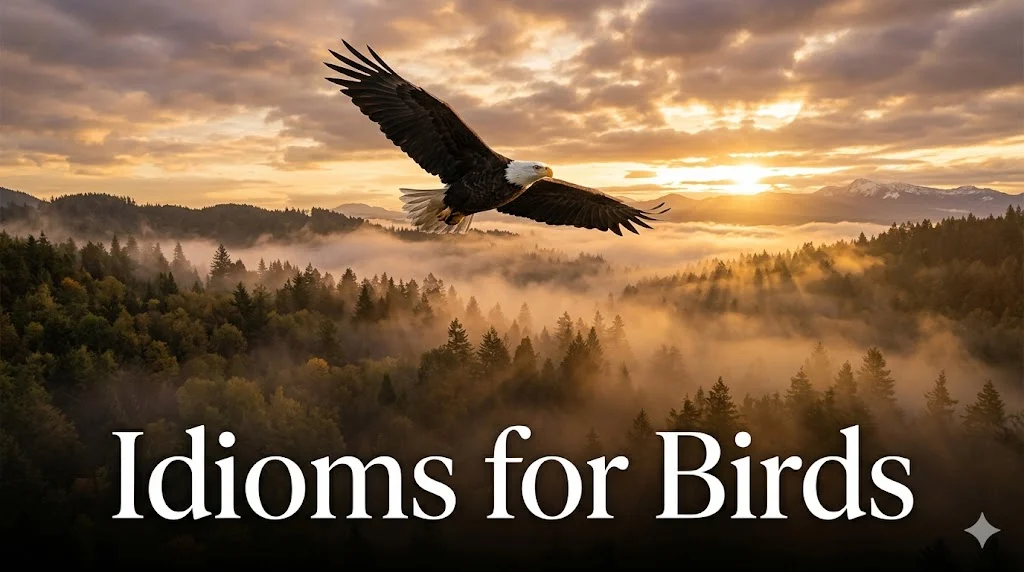
Idioms for “birds” are colorful expressions inspired by bird behavior, characteristics, and symbolism. They are used to describe human personalities, situations, and actions in a vivid, natural, and often poetic way.
Examples: free as a bird, kill two birds with one stone, the early bird catches the worm
Birds have inspired human language for centuries. Whether it is the soaring freedom of an eagle, the stubborn silence of an owl, or the cheerful chatter of a sparrow, birds carry powerful meaning in every culture around the world. That symbolic richness has made its way directly into the English language through dozens of idioms that people use every single day.
When someone says “she’s a rare bird,” you instantly understand they mean someone truly unique. When you hear “don’t count your chickens before they hatch,” you feel the warning without needing any explanation. That is the magic of bird idioms. They carry centuries of human observation and storytelling packed into just a few words.
These idioms are not just poetic. They are practical. They appear in business meetings, casual conversations, classic literature, news headlines, and everyday speech. Understanding them helps you not only communicate more naturally but also appreciate the deep cultural wisdom behind the words.
In this guide, you will learn:
Powerful idioms inspired by birds Real meanings and the situations where they fit Formal, casual, and creative examples for each Practical tips for using bird idioms naturally and confidently
Let us explore the most expressive and useful bird idioms that bring the English language to life.
Quick Summary Table
| Situation | Idioms |
|---|---|
| Freedom and independence | Free as a bird, spread your wings |
| Wisdom and observation | A little bird told me, wise old owl |
| Opportunity and timing | Early bird catches the worm, a bird in the hand |
| Rare or unique people | Rare bird, odd bird |
| Gossip and talk | Birdbrain, chatter like a magpie |
| Danger and warning | Ruffled feathers, watch like a hawk |
| Escape and leaving | Fly the coop, take flight |
| Anger or irritation | Get your feathers ruffled, ruffle someone’s feathers |
Idioms for Freedom and Independence
Birds in flight have always represented freedom and the desire to break away from limitations. These idioms capture that powerful feeling.
1. Free as a Bird
This is perhaps the most universally recognized bird idiom in the English language, and for good reason. It perfectly captures the feeling of complete freedom with no restrictions, no obligations, and no limits holding you back.
Meaning: Completely free and unrestricted When People Use It: After finishing a difficult task, leaving a job, or ending a stressful situation Alternative Expression: Unburdened, liberated
Examples: Formal: After completing the project, the entire team felt free as a bird. Casual: I handed in my resignation and now I’m free as a bird. Creative: The moment he closed that chapter of his life, something inside him soared like open sky.
2. Spread Your Wings
This idiom is deeply motivational. It draws on the image of a young bird leaving the nest for the first time and taking on the world with boldness and confidence.
Meaning: To explore new opportunities and grow beyond your current limits When People Use It: Career changes, personal growth, leaving home, trying something new Alternative Expression: Branch out, take a leap
Examples: Formal: The internship gave her a chance to spread her wings in a competitive industry. Casual: You should spread your wings and try something new. Creative: The world waited quietly as he finally stretched the parts of himself he had never dared to use.
3. Fly the Coop
Originally referring to a chicken escaping its enclosure, this idiom has evolved into a fun way to describe anyone who leaves a place, relationship, or situation, sometimes suddenly or unexpectedly.
Meaning: To escape or leave a place, often without warning When People Use It: When someone quits, moves out, or leaves suddenly Alternative Expression: Make a break for it, take off
Examples: Formal: Several key employees flew the coop after the merger was announced. Casual: He finally flew the coop and moved to another city. Creative: Without a word, she slipped out just like every wild thing eventually does.
Usage Insight: These idioms work beautifully in both personal storytelling and professional contexts when describing transitions and new beginnings.
Idioms for Wisdom and Observation
Certain birds like owls and hawks have long been associated with wisdom, sharp vision, and deep awareness. These idioms draw on that rich symbolism.
4. A Little Bird Told Me
This playful idiom is one of the oldest in the English language, appearing even in biblical texts. It refers to receiving secret or mysterious information from an unnamed source.
Meaning: To have learned something from a private or anonymous source When People Use It: Sharing gossip, surprising someone with inside knowledge, or being playfully secretive Alternative Expression: I heard through the grapevine, word got around
Examples: Formal: A little bird told me you are being considered for the promotion. Casual: A little bird told me it’s your birthday today! Creative: Secrets had a way of finding him, carried on wings he never saw.
5. Watch Like a Hawk
Hawks are renowned for their extraordinary eyesight and intense focus. This idiom captures exactly that quality in a human being, someone who misses absolutely nothing.
Meaning: To observe someone or something very closely and carefully When People Use It: Supervision, strict monitoring, protective behavior Alternative Expression: Keep a close eye, scrutinize
Examples: Formal: The manager watched the new team members like a hawk during their first week. Casual: My mom watched me like a hawk when I was a teenager. Creative: Nothing escaped her. She had the kind of attention that left no room for error.
6. Wise Old Owl
Owls have represented wisdom in cultures from ancient Greece to Native American traditions. This idiom is used to describe someone who is not just intelligent but deeply experienced and thoughtful.
Meaning: A person who is very wise, experienced, and full of quiet insight When People Use It: Complimenting an elder, a mentor, or someone known for good judgment Alternative Expression: Sage, seasoned thinker
Examples: Formal: The senior advisor was the wise old owl of the organization. Casual: Ask Grandpa. He’s a wise old owl about these things. Creative: He had lived long enough that his silence spoke louder than most people’s words.
Idioms for Opportunity and Timing
Many bird idioms carry lessons about timing, patience, and seizing the right moment. These have become some of the most used proverbs in the English-speaking world.
7. The Early Bird Catches the Worm
This is one of the most enduring proverbs in English, teaching that those who start early and act first gain the greatest advantage. It applies to careers, business, relationships, and everyday life.
Meaning: People who start early or act promptly gain the best opportunities When People Use It: Encouraging punctuality, hard work, or proactive behavior Alternative Expression: First come, first served
Examples: Formal: In competitive markets, the early bird catches the worm. Casual: Set your alarm. The early bird catches the worm. Creative: Success had a habit of arriving before most people even opened their eyes.
8. A Bird in the Hand is Worth Two in the Bush
This classic proverb urges caution and practicality over greed or risk. It teaches that a sure thing, even if small, is more valuable than chasing something uncertain.
Meaning: It is better to appreciate what you already have than to risk losing it for something better that may never come When People Use It: Decision-making, financial advice, relationship choices Alternative Expression: Don’t gamble on the uncertain, hold what you have
Examples: Formal: Before pursuing the new contract, consider that a bird in the hand is worth two in the bush. Casual: Take the offer. A bird in the hand is worth two in the bush. Creative: She had learned the hard way that chasing more often means losing everything.
9. Birds of a Feather Flock Together
This proverb describes a timeless social reality. People naturally gravitate toward others who share their values, habits, interests, and worldviews.
Meaning: People with similar personalities, beliefs, or behaviors tend to spend time together When People Use It: Social observations, explaining friendships or group dynamics Alternative Expression: Like attracts like
Examples: Formal: The networking event confirmed that birds of a feather flock together. Casual: Of course they hang out. Birds of a feather flock together. Creative: Every crowd told a story about what its members secretly believed about themselves.
Usage Insight: These proverb-style idioms are particularly powerful in advice-giving, mentoring, and motivational writing because they carry the weight of centuries of human wisdom.
Idioms for Unique or Unusual People
Some birds are rare, odd, or completely unlike the rest. Naturally, English has adopted several idioms to describe people who stand out from the crowd.
10. A Rare Bird
In Latin, the phrase “rara avis” meaning rare bird was used by the Roman poet Juvenal to describe something extraordinarily uncommon. Centuries later, it lives on in English as a sincere compliment.
Meaning: A person or thing that is exceptionally unusual, unique, or special When People Use It: Describing extraordinary talent, personality, or character Alternative Expression: One of a kind, a true original
Examples: Formal: A leader with both vision and humility is a rare bird in any industry. Casual: She’s a rare bird. You won’t find anyone quite like her. Creative: In a world full of echoes, she was her own sound entirely.
11. Odd Bird
Similar in feel to “rare bird,” this idiom has a slightly more playful or quirky tone. It describes someone whose behavior or thinking is noticeably different from what is considered normal.
Meaning: A person who behaves or thinks in an unusual or eccentric way When People Use It: Light-hearted descriptions of eccentric personalities Alternative Expression: Oddball, character
Examples: Formal: He was considered an odd bird in academic circles, but his methods produced results. Casual: My neighbor is a bit of an odd bird, but he’s harmless. Creative: The world had no clear category for him, and he preferred it that way.
12. Black Sheep
While technically referencing sheep, this idiom is closely related to bird idioms in spirit and structure. A black sheep stands out dramatically from a white flock, just as the person it describes stands apart from their group or family.
Meaning: A person who is considered different, problematic, or a disappointment within a group or family When People Use It: Family dynamics, social groups, workplace culture Alternative Expression: Outsider, rebel
Examples: Formal: He was the black sheep of a successful family, choosing art over business. Casual: Every family has a black sheep. Creative: He had stopped trying to be white wool long ago, and something in that choice felt like freedom.
Idioms for Gossip, Talk, and Communication
Birds are famously vocal creatures. From the chattering magpie to the repetitive parrot, bird behavior has given English some wonderfully expressive idioms about how people communicate.
13. Chatter Like a Magpie
Magpies are notoriously noisy birds known for their constant, animated vocalizations. This idiom perfectly captures someone who talks endlessly and often without much substance.
Meaning: To talk constantly, noisily, and often about trivial things When People Use It: Describing someone overly talkative or gossipy Alternative Expression: Ramble on, talk someone’s ear off
Examples: Formal: The meeting ran over schedule because one delegate chattered like a magpie. Casual: She chatters like a magpie from the moment she arrives. Creative: Words poured out of him like a tap no one had learned to turn off.
14. Parrot Someone
Parrots are famous for mimicking speech without understanding meaning. This idiom describes the same behavior in humans, repeating what others say without genuine thought or original contribution.
Meaning: To repeat or imitate someone else’s words or ideas without original thought When People Use It: Criticism of unoriginal thinking, academic plagiarism discussions, workplace dynamics Alternative Expression: Echo, mimic
Examples: Formal: The candidate simply parroted the party line without offering fresh ideas. Casual: Stop parroting him and tell me what you actually think. Creative: He had spent so long repeating other voices that he had forgotten the sound of his own.
15. Birdbrain
This is one of the more playful bird idioms, used humorously rather than cruelly in most contexts. It refers to someone who is forgetful, easily confused, or not particularly sharp.
Meaning: A person who is scatterbrained, forgetful, or not very intelligent When People Use It: Lighthearted teasing, self-deprecating humor Alternative Expression: Scatterbrained, forgetful
Examples: Formal: The repeated errors suggested a certain birdbrainedness in the planning process. Casual: I forgot my keys again. I’m such a birdbrain. Creative: Her mind was a lovely, colorful mess that followed no particular order.
Idioms for Anger, Tension, and Conflict
Even birds have moments of agitation and confrontation. Several powerful idioms capture the feeling of irritation, provocation, and social tension.
16. Ruffle Someone’s Feathers
When birds feel threatened or agitated, their feathers literally stand on end. This idiom takes that vivid image and applies it to human emotional reactions perfectly.
Meaning: To irritate, upset, or provoke someone When People Use It: Social conflicts, workplace tension, sensitive conversations Alternative Expression: Upset someone, get under someone’s skin
Examples: Formal: His blunt feedback ruffled more than a few feathers in the boardroom. Casual: Don’t ruffle his feathers, he’s already in a bad mood. Creative: Something about the way it was said left everyone sitting a little straighter and a little colder.
17. Get Your Feathers Ruffled
This is essentially the passive form of the above idiom, describing the state of being upset or irritated rather than the act of causing it.
Meaning: To become upset, irritated, or emotionally unsettled When People Use It: Describing personal reactions to provocation or criticism Alternative Expression: Get worked up, take offense
Examples: Formal: There is no need to get your feathers ruffled over a minor misunderstanding. Casual: Don’t get your feathers ruffled, it was just a joke. Creative: He told himself it did not bother him, but something in his posture disagreed.
18. Swan Song
In ancient legend, swans were believed to sing a hauntingly beautiful song just before they died, having been silent their entire lives. This idiom now refers to a final, often magnificent performance or act before ending something.
Meaning: A final performance, work, or act before retirement, death, or the end of a career When People Use It: Retirement, final projects, last performances Alternative Expression: Final bow, last hurrah
Examples: Formal: The retiring professor’s final lecture was considered his swan song. Casual: That concert felt like the band’s swan song. Creative: He poured everything he had left into it, the way things do when they know they are ending.
Idioms for Escape, Risk, and Bold Action
Birds have always symbolized the courage to leap, to fly, and to risk it all. These idioms capture the boldness of taking risks and the thrill of escape.
19. Take Someone Under Your Wing
Parent birds protect and guide their young beneath their wings until they are strong enough to fly alone. This tender image translates beautifully into a human relationship of mentorship and protection.
Meaning: To guide, mentor, or protect someone less experienced When People Use It: Mentorship, teaching, leadership, parenting Alternative Expression: Mentor, guide, sponsor
Examples: Formal: The senior executive took the new hire under her wing from day one. Casual: He really took me under his wing when I started the job. Creative: She taught him not by telling, but by simply staying close enough for him to learn.
20. Chicken Out
The domestic chicken has long been associated with timidity in English culture. This idiom, while casual and slightly humorous, perfectly captures the moment when someone loses their nerve.
Meaning: To back out of something due to fear or lack of courage When People Use It: Describing hesitation, backing down, or fear of commitment Alternative Expression: Back out, lose your nerve
Examples: Formal: Several investors chickened out when the market became volatile. Casual: I was going to ask her out, but I totally chickened out. Creative: The moment arrived, and something in him chose safety over everything he had planned to be.
21. Count Your Chickens Before They Hatch
This proverb warns against assuming success before it has actually arrived. The image of counting chickens before eggs have even hatched captures the foolishness of premature celebration perfectly.
Meaning: To assume success or plan around results that have not yet happened When People Use It: Business planning, cautious advice, managing expectations Alternative Expression: Don’t assume, wait and see
Examples: Formal: Celebrating before the contract is signed means counting chickens before they hatch. Casual: Don’t spend that money yet. Don’t count your chickens before they hatch. Creative: He had already built a life around something that had not yet decided to exist.
Idioms for Silence, Observation, and Hidden Behavior
Not all bird idioms are about noise or bold action. Some capture the quiet, watchful, and mysterious side of both birds and human nature.
22. Night Owl
Owls are creatures of the dark, active and alert long after the rest of the world has gone to sleep. This idiom has become one of the most universally understood expressions in modern English.
Meaning: A person who prefers staying up late and is most active at night When People Use It: Describing sleep habits, work schedules, personality types Alternative Expression: Late-night person, insomniac by choice
Examples: Formal: As a night owl, she scheduled her most demanding work after midnight. Casual: I’m such a night owl. I can’t fall asleep before two. Creative: While the world quieted, he came alive, as if darkness had been waiting to give him permission.
23. Eagle Eye
Eagles possess some of the most extraordinary vision in the animal kingdom, capable of spotting prey from extraordinary distances. This idiom celebrates that same quality of sharp, precise, almost supernatural observation in humans.
Meaning: An ability to notice small details with great precision and accuracy When People Use It: Proofreading, quality control, surveillance, skilled observation Alternative Expression: Sharp eye, keen eye for detail
Examples: Formal: Her eagle eye caught the discrepancy that the auditors had overlooked. Casual: Nice catch. You have a real eagle eye. Creative: Nothing hid from her long. Sooner or later, everything revealed itself.
24. Albatross Around Your Neck
This striking idiom comes from Samuel Taylor Coleridge’s famous poem The Rime of the Ancient Mariner. In the poem, killing an albatross brings terrible misfortune, and the dead bird is hung around the sailor’s neck as punishment and burden.
Meaning: A heavy, ongoing burden or source of guilt that someone cannot escape When People Use It: Long-term problems, financial burdens, moral guilt, lingering failures Alternative Expression: A millstone, a burden, a cross to bear
Examples: Formal: The failed acquisition became an albatross around the company’s neck for years. Casual: That old debt is like an albatross around my neck. Creative: He carried it silently, the way people carry things they believe they deserve.
How to Use Bird Idioms Naturally
Using bird idioms well is not just about knowing what they mean. It is about delivering them at the right moment, with the right tone, in the right relationship. Here is how to do exactly that.
Match the Idiom to the Situation
Bird idioms cover an enormous emotional and situational range. Some are celebratory, some are cautionary, some are playful, and some carry deep philosophical weight. Always ask yourself what feeling the idiom is meant to carry before you use it.
For freedom and transition: free as a bird, spread your wings, fly the coop For wisdom and advice: a little bird told me, watch like a hawk, wise old owl For caution and timing: early bird catches the worm, count your chickens, bird in the hand
Keep Tone in Mind
Some bird idioms, like “birdbrain” or “chicken out,” work beautifully in casual and self-deprecating humor but would feel out of place in formal settings. Others like “eagle eye” or “take under your wing” transition smoothly between professional and personal conversations.
When in doubt, lean toward neutral phrasing in formal writing and save the more colorful idioms for storytelling, speeches, and casual conversation.
Use One Idiom at a Time
The power of a bird idiom lies in its singularity. When you drop one well-chosen idiom into the right moment, it lands with weight and elegance. Using three or four in the same paragraph dilutes that effect and can make your writing feel forced.
One strong bird idiom placed thoughtfully is worth far more than a paragraph full of them.
Common Mistakes to Avoid
Even fluent speakers make errors when using bird idioms. Avoid these common pitfalls to sound natural and confident.
Do not mix idioms that create confusing or contradictory images. Saying “she spread her wings and chickened out” sends contradictory signals and confuses your listener.
Do not use bird idioms in emotionally serious contexts unless you are very certain of the tone. Using “fly the coop” to describe someone leaving a difficult marriage, for example, might sound dismissive when empathy is what the moment needs.
Do not assume every listener knows the cultural origin of idioms like “albatross around your neck.” For less familiar idioms, especially in international or multicultural settings, a brief explanation adds clarity rather than weakening your point.
Do not overload formal writing with multiple idioms. One well-placed idiom adds life. Five idioms in a single report paragraph reads as casual to the point of unprofessional.
Practice Method That Actually Works
Learning bird idioms is not about memorizing definitions. It is about building the natural instinct to reach for them at the right moment. Here is a proven practice approach.
Learn Three Idioms Each Week
Rather than overwhelming yourself with the full list, focus on three bird idioms per week. Study their meaning, their tone, and two or three real-world contexts where they would fit naturally.
Use Them in Real Conversations
Start inserting one new idiom into your natural speech each day. Even something simple works beautifully: “I completely chickened out” or “she has a real eagle eye.” The repetition builds instinct.
Write Creative Sentences
The most powerful way to cement an idiom in memory is to write a sentence that carries genuine emotion and imagery. Do not write a flat example. Write something vivid.
Instead of: “He spread his wings.”
Try: “The moment he moved abroad, he finally spread the wings he had kept folded his entire life.”
The more emotionally resonant your example, the more permanently the idiom lives in your language.
Read and Listen for Them
Bird idioms appear constantly in books, newspapers, speeches, podcasts, and films. Start noticing them. Each time you encounter one in the wild, it reinforces both its meaning and its natural rhythm in real speech.
FAQs
What are bird idioms used for?
Bird idioms are used to describe a wide range of human experiences including freedom, wisdom, opportunity, personality, fear, and conflict in a more vivid and expressive way than plain language.
Are bird idioms formal or informal?
Most bird idioms are semi-formal to informal. Some like “eagle eye” and “take under your wing” work well in professional settings. Others like “birdbrain” or “chicken out” are best reserved for casual speech.
Are bird idioms used globally?
Many bird idioms like “birds of a feather flock together” and “the early bird catches the worm” are understood globally. Others like “albatross around your neck” may require cultural context in non-English speaking environments.
Can I use bird idioms in professional writing?
Yes, selectively. Idioms like “eagle eye,” “spread your wings,” and “swan song” work well in professional contexts when used thoughtfully. Avoid casual or humorous bird idioms in formal reports or serious professional communication.
How many bird idioms should I learn first?
Start with the ten most commonly used ones: free as a bird, the early bird catches the worm, birds of a feather flock together, watch like a hawk, take someone under your wing, a little bird told me, ruffle feathers, eagle eye, chicken out, and a bird in the hand is worth two in the bush.
Conclusion
Bird idioms are among the most expressive and enduring treasures in the English language. They carry centuries of human observation, cultural wisdom, and natural imagery packed into phrases that feel instantly alive the moment you use them. Whether you are describing someone’s freedom, warning against impatience, celebrating a mentor, or capturing the feeling of finally breaking free, there is almost always a bird idiom that fits the moment better than any plain word could.
The key is simple: understand the context, feel the tone, and choose with intention. When you use these idioms naturally and confidently, your English stops sounding like a language you have studied and starts sounding like a language you genuinely live in.
Start with a few favorites. Practice them in real conversations. Write vivid, emotional sentences. And before long, these bird idioms will not just be phrases you have memorized. They will be a natural part of the way you think, speak, and write.
Read More Related Articles:
- Idioms for Mean | Expressing Rudeness, Cruelty and Harsh Behavior Naturally In 2026
- Idioms for Kindness | Expressing Compassion and Generosity Naturally In 2026
- Idioms for Funny | Express Humor Naturally in English Conversations In 2026

Tyler Zone is an American writer at IdiomCrafter.com, who enjoys exploring the meaning behind everyday phrases. He focuses on making idioms simple and relatable for readers of all backgrounds. In his free time, he likes discovering new expressions and how people use them in daily life.