Quick Answer
Idioms for “animals” are metaphorical phrases using animal traits to describe human behavior, situations, or emotions.
Examples: eagle eyes (sharp vision), hold your horses (wait), black sheep (outsider).
We share the planet with animals, but we also share their identities. In English, we don’t just observe creatures we become them, at least linguistically. When someone is quiet as a mouse, we instantly picture silence. When a deal feels fishy, we sense distrust without needing the word “suspicious.”
Animal idioms are among the oldest and most instinctive parts of the English language. They connect us to nature while describing deeply human situations. Unlike abstract expressions, these phrases tap into universal observations: wolves hunt in packs, bees work tirelessly, and foxes outsmart danger.
But here’s the challenge: using animal idioms naturally requires understanding their hidden tones. Some are playful (wild goose chase), others are harsh (wolf in sheep’s clothing), and many depend entirely on context.
In this guide, you’ll learn:
- Powerful animal idioms organized by behavior type
- Real meanings, origins, and modern usage
- Formal, casual, and creative examples
- Cultural variations and common mistakes
Let’s walk into the linguistic wild.
Quick Summary Table
| Situation | Idioms |
|---|---|
| Intelligence & Cunning | Smart as a fox, Owl in the night |
| Strength & Power | Strong as an ox, Elephant in the room |
| Social Behavior | Black sheep, Lone wolf |
| Speed & Quickness | Fast as a hare, Quick like a cat |
| Annoyance & Irritation | Get my goat, Horseplay |
| Confusion & Chaos | Wild goose chase, Rat race |
| Patience & Calm | Hold your horses, Still as a deer |
🦊 Idioms for Intelligence & Cunning
Animals have long symbolized different kinds of smartness. Some intelligence is sharp and predatory; other types are quiet and observant.
1. Smart as a Fox
This idiom celebrates cunning, strategic thinking rather than academic intelligence.
Meaning: Clever in a practical or deceptive way
When People Use It: Problem-solving, outsmarting someone
Alternative Expression: Cunning
Examples:
- Formal: The negotiator proved as smart as a fox, anticipating every objection.
- Casual: You didn’t get caught? Man, you’re smart as a fox.
- Creative: Her mind circled the problem like a fox around a henhouse patient, sharp, and never rushed.
2. Eagle Eyes
Few animals match the visual precision of an eagle. This idiom celebrates extreme attentiveness.
Meaning: Very sharp vision or observation skills
When People Use It: Noticing small details, supervising
Alternative Expression: Keen eyesight
Examples:
- Formal: The editor reviewed the manuscript with eagle eyes.
- Casual: Mom has eagle eyes she noticed my haircut immediately.
- Creative: His gaze swept the room, eagle eyes catching every nervous twitch.
3. Owl in the Night (Less common but poetic)
Owls symbolize wisdom, especially the kind that observes silently before acting.
Meaning: Wise and observant, often quiet
When People Use It: Describing thoughtful people
Alternative Expression: Wise as an owl
Examples:
- Formal: The old professor sat like an owl in the night, listening more than speaking.
- Casual: My grandfather is an owl he never misses anything.
- Creative: She watched the argument unfold, owl-like, storing every word for later.
💡 Usage Insight:
These idioms work best when describing strategic thinking. Avoid using “smart as a fox” for academic intelligence it implies cleverness with a hint of mischief.
🐘 Idioms for Strength & Power
When English needs to describe immovable force or quiet dominance, it turns to the animal kingdom.
4. Strong as an Ox
Simple, direct, and universally understood. No animal symbolizes raw power better.
Meaning: Physically very strong
When People Use It: Manual labor, endurance
Alternative Expression: Powerful
Examples:
- Formal: The construction workers were strong as oxen, lifting beams without machinery.
- Casual: You carried all those boxes? You’re strong as an ox!
- Creative: His grip tightened strong as an ox, gentle as a breeze.
5. Elephant in the Room
Perhaps the most famous animal idiom for social situations. The elephant isn’t strong in a physical sense here its power comes from unavoidable presence.
Meaning: An obvious problem or truth everyone ignores
When People Use It: Awkward conversations, avoided topics
Alternative Expression: Unaddressed issue
Examples:
- Formal: The budget shortfall was the elephant in the room during the entire meeting.
- Casual: We need to talk about the elephant in the room your brother isn’t coming back.
- Creative: Their silence circled something massive, an elephant none of them named.
6. Lion’s Share
This idiom comes from Aesop’s fables, where a lion takes everything by force.
Meaning: The largest portion or majority
When People Use It: Unequal distribution
Alternative Expression: Majority
Examples:
- Formal: The senior partner took the lion’s share of the profits.
- Casual: My brother ate the lion’s share of the pizza again.
- Creative: Attention flowed toward the lead singer, leaving the band with scraps the lion’s share of applause swallowed everything.
💡 Memory Tip:
Picture a lion standing over a kill while smaller animals wait. That visual encodes unfairness and majority simultaneously.
🐺 Idioms for Social Behavior
Humans are social animals, so it’s no surprise we borrow animal labels for each other.
7. Black Sheep
Every family or group has one. The black sheep stands out not always negatively, but always differently.
Meaning: An outcast or disgraced member of a group
When People Use It: Family discussions, workplace dynamics
Alternative Expression: Outsider
Examples:
- Formal: He was considered the black sheep of the family after abandoning the business.
- Casual: I’m the black sheep I’m the only one who didn’t become a doctor.
- Creative: The black sheep doesn’t run from the flock. The flock pushes it away, then wonders why it wanders.
8. Lone Wolf
Some people thrive alone. This idiom respects that choice while acknowledging its rarity.
Meaning: Someone who prefers solitude or independent action
When People Use It: Describing introverts, independent workers
Alternative Expression: Independent
Examples:
- Formal: As a lone wolf in the industry, she built her reputation without partnerships.
- Casual: He’s a lone wolf don’t expect him at the team lunch.
- Creative: The lone wolf doesn’t howl for company. His silence is not loneliness; it’s preference.
9. Social Butterfly (Positive contrast)
Not all social animal idioms are negative. The butterfly flits from group to group, spreading energy.
Meaning: A sociable, outgoing person
When People Use It: Parties, networking events
Alternative Expression: Gregarious
Examples:
- Formal: Her reputation as a social butterfly made her invaluable for fundraising.
- Casual: My sister is such a social butterfly she knew everyone at the wedding.
- Creative: She landed on conversations briefly, wings of charm opening and closing, never staying long enough to tire.
💡 Usage Insight:
“Black sheep” can be reclaimed as a positive identity (“I’m proud to be the black sheep”). “Lone wolf” carries a neutral-to-positive tone, while “social butterfly” is almost always complimentary.
🐇 Idioms for Speed & Quickness
When time matters, English reaches for rabbits, cats, and deer.
10. Fast as a Hare
Hares don’t just run they zigzag, accelerate instantly, and vanish into tall grass.
Meaning: Extremely fast
When People Use It: Racing, deadlines, reflexes
Alternative Expression: Lightning fast
Examples:
- Formal: The emergency response was fast as a hare, arriving within three minutes.
- Casual: That kid is fast as a hare I couldn’t catch him.
- Creative: His feet barely touched the ground, fast as a hare fleeing a hawk.
11. Quick Like a Cat
Cats embody sudden, explosive speed. One moment they’re still; the next, they’ve struck.
Meaning: Fast reflexes, sudden movement
When People Use It: Sports, combat, catching something
Alternative Expression: Lightning reflexes
Examples:
- Formal: The goalkeeper reacted quick like a cat deflecting the penalty shot.
- Casual: She caught the falling glass quick like a cat.
- Creative: His hand shot out quick like a cat, silent like snowfall.
12. In the Blink of an Eye (companion idiom)
While not strictly animal-based, this phrase pairs naturally with animal speed idioms.
Meaning: Very quickly
When People Use It: Unexpected changes
Alternative Expression: Instantly
Examples:
- Formal: The market shifted in the blink of an eye.
- Casual: He finished the task in the blink of an eye.
- Creative: The rabbit vanished in the blink of an eye, grass and shadow only.
🐐 Idioms for Annoyance & Irritation
Some animal behaviors frustrate us so much we turn them into idioms.
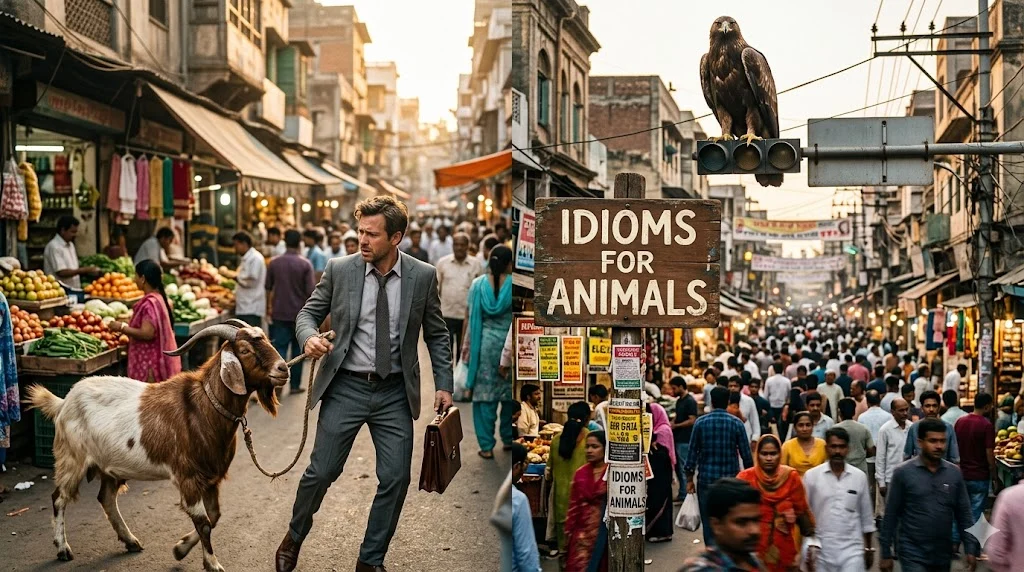
13. Get My Goat
A strange phrase with unclear origins, but its meaning is unmistakable.
Meaning: To annoy or irritate someone
When People Use It: Pet peeves, repeated frustration
Alternative Expression: Irritate
Examples:
- Formal: The constant interruptions really got his goat.
- Casual: Loud chewing gets my goat every time.
- Creative: Something about his smug smile got her goat not rage, just a slow, burning irritation.
14. Horseplay
Horses are large, powerful, and sometimes clumsy when playing. This idiom captures that.
Meaning: Rough, boisterous play
When People Use It: Kids, sports, warnings
Alternative Expression: Roughhousing
Examples:
- Formal: The school has a zero-tolerance policy for horseplay in hallways.
- Casual: No horseplay near the pool someone could get hurt.
- Creative: Their horseplay shook the walls, joy and danger tangling like young stallions.
15. Make a Monkey Out Of
Monkeys imitate. Sometimes that imitation humiliates.
Meaning: To make someone look foolish
When People Use It: Pranks, arguments, revenge
Alternative Expression: Embarrass
Examples:
- Formal: The opposing lawyer tried to make a monkey out of the witness.
- Casual: Stop making a monkey out of your little brother.
- Creative: He realized too late they had made a monkey out of him, and the audience was laughing.
💡 Memory Tip:
“Get my goat” works best for minor, repetitive annoyances, not major betrayals. Save it for traffic jams and loud neighbors, not broken promises.
🦆 Idioms for Confusion & Chaos
When situations stop making sense, English reaches for creatures acting strangely.
16. Wild Goose Chase
Geese fly in predictable patterns. A wild goose chase follows no pattern at all.
Meaning: A pointless or futile search
When People Use It: Wasted time, misleading directions
Alternative Expression: Futile effort
Examples:
- Formal: The investigation turned into a wild goose chase with no evidence.
- Casual: Sending me to that address was a wild goose chase nobody lives there.
- Creative: He followed clues like breadcrumbs, but each led deeper into the forest a wild goose chase with no goose, no chase, only exhaustion.
17. Rat Race
Rats in a maze run endlessly, competing for a reward that may not exist.
Meaning: Competitive, stressful urban life focused on material success
When People Use It: Career discussions, burnout
Alternative Expression: Endless competition
Examples:
- Formal: After twenty years in the rat race, he retired to a small farm.
- Casual: I’m tired of the rat race maybe I’ll teach English abroad.
- Creative: The rat race doesn’t end. It only changes tracks, and the rats keep running because stopping feels like losing.
18. Like Herding Cats
Anyone who manages creative teams, children, or chaotic groups understands this deeply.
Meaning: Trying to control something uncontrollable
When People Use It: Project management, parenting
Alternative Expression: Impossible to organize
Examples:
- Formal: Coordinating the volunteers was like herding cats.
- Casual: Getting my family to agree on a restaurant? Like herding cats.
- Creative: She raised herded cats into brief, beautiful alignment then watched them scatter again.
🐴 Idioms for Patience & Calm
Not every animal idiom is chaotic. Some teach stillness.
19. Hold Your Horses
Cowboys know: pulling reins too early spooks the horse. Patience prevents panic.
Meaning: Wait, be patient
When People Use It: Rushed decisions, excitement
Alternative Expression: Be patient
Examples:
- Formal: Hold your horses we haven’t reviewed all the data yet.
- Casual: You want to call him already? Hold your horses!
- Creative: The word “now” burned on his tongue, but he held his horses, counting breaths.
20. Still as a Deer
Deer freeze when sensing danger. This idiom captures perfect, alert stillness.
Meaning: Completely motionless, often from fear or concentration
When People Use It: Hide-and-seek, observation, tension
Alternative Expression: Frozen
Examples:
- Formal: The sniper lay still as a deer for six hours.
- Casual: When the teacher walked in, everyone went still as deer.
- Creative: She pressed against the wall, still as a deer under a hunter’s gaze, hoping invisibility would come.
21. Swan Song
A beautiful, sad idiom. Swans don’t actually sing before death but the metaphor persists.
Meaning: A final performance or achievement before retirement or death
When People Use It: Farewells, retirements, final projects
Alternative Expression: Final appearance
Examples:
- Formal: The conductor’s final concert was a magnificent swan song.
- Casual: This project is my swan song I’m retiring next month.
- Creative: She wrote until dawn, each word a feather, the whole novel her swan song beautiful, final, and silent afterward.
🐍 Idioms for Deception & Danger
Some animals teach us who not to trust.
22. Snake in the Grass
Snakes hide. The grass hides them. Together, they represent hidden betrayal.
Meaning: A treacherous, deceitful person
When People Use It: Betrayal, workplace politics
Alternative Expression: Traitor
Examples:
- Formal: He pretended to be her mentor but was a snake in the grass all along.
- Casual: I trusted you, and you’re a total snake in the grass.
- Creative: He smiled like a friend and struck like a snake the grass didn’t even rustle.
23. Wolf in Sheep’s Clothing
The Bible originated this warning (Matthew 7:15). It remains one of English’s most powerful deception idioms.
Meaning: Someone who pretends to be harmless but is dangerous
When People Use It: Manipulation, cults, toxic relationships
Alternative Expression: False friend
Examples:
- Formal: The charismatic leader turned out to be a wolf in sheep’s clothing.
- Casual: He seems nice, but I think he’s a wolf in sheep’s clothing.
- Creative: Soft words, gentle eyes, lamb’s clothing but at night, the teeth came out.
24. Kill Two Birds With One Stone
Not dangerous to humans, but brutal for the hypothetical birds. This idiom celebrates efficiency.
Meaning: Accomplish two goals with one action
When People Use It: Productivity, planning
Alternative Expression: Double benefit
Examples:
- Formal: By combining the meetings, we killed two birds with one stone.
- Casual: Grocery shopping and picking up the dry cleaning? Kill two birds with one stone.
- Creative: She answered his question and ended the conversation two birds, one stone, clean and cold.
💡 Cultural Note:
Some animal rights advocates avoid “kill two birds” due to violence. Alternatives include “feed two birds with one seed” or simply “accomplish two things at once.”
🐝 Idioms for Work Ethic
Bees build. Birds wake early. These animals model productivity.
25. Busy as a Bee
Bees never stop. Pollen collection, hive maintenance, honey production constant motion.
Meaning: Very industrious and active
When People Use It: Work, projects, parenting
Alternative Expression: Industrious
Examples:
- Formal: She was busy as a bee preparing the annual report.
- Casual: The kids are busy as bees building that fort.
- Creative: His hands moved busy as bees no pause, no hesitation, just production.
26. Early Bird Catches the Worm
Morning people love this one. Night owls tolerate it.
Meaning: Those who act early gain advantages
When People Use It: Deadlines, sales, opportunities
Alternative Expression: Timely action
Examples:
- Formal: The early bird catches the worm in real estate the first offer often wins.
- Casual: I’m at my desk by 6 AM. Early bird catches the worm.
- Creative: While the city slept, she worked early bird, patient worm, advantage invisible but absolute.
27. Dark Horse
This idiom comes from horse racing, where a dark-colored horse surprises everyone by winning.
Meaning: A little-known person who unexpectedly succeeds
When People Use It: Elections, competitions, promotions
Alternative Expression: Underdog
Examples:
- Formal: The junior senator emerged as a dark horse in the primary.
- Casual: Nobody expected him to win, but he was a dark horse.
- Creative: She entered the room unnoticed and left unforgettable the dark horse no one bet on, the victory everyone missed.
🎯 How to Use Animal Idioms Naturally
Animal idioms are powerful shortcuts to meaning. But like any shortcut, using them wrong gets you lost instead of arriving faster.
Match the Situation
Animal idioms carry emotional weight beyond their definitions.
Praise and compliments → Eagle eyes, Busy as a bee, Strong as an ox
- “You caught that typo? Eagle eyes!”
Criticism or warnings → Snake in the grass, Wolf in sheep’s clothing, Black sheep
- “Don’t trust him he’s a snake in the grass.”
Neutral observation → Lone wolf, Social butterfly, Dark horse
- “She’s a dark horse in this competition.”
Chaos and confusion → Wild goose chase, Like herding cats, Rat race
- “Trying to organize this event is like herding cats.”
💡 Insight: Animal idioms are rarely neutral. They judge. Make sure your judgment matches your intention.
Keep Cultural Context in Mind
Not every culture shares the same animal associations.
| Animal | Western English | Other Cultures |
|---|---|---|
| Owl | Wisdom | Some cultures associate with bad luck |
| Bat | Blindness (blind as a bat) | Chinese culture: good luck (bat = fortune homophone) |
| Fox | Cunning, clever | Japanese folklore: magical, sometimes dangerous |
| Snake | Deception | Some cultures: wisdom, rebirth |
If you’re speaking with non-native English speakers, avoid obscure animal idioms. Stick to the most common ones: black sheep, elephant in the room, hold your horses.
Use Sparingly for Impact
One animal idiom per paragraph is vivid. Three is exhausting.
❌ Overused:
“The black sheep was a snake in the grass, and herding him was like herding cats a total wild goose chase.”
✅ Effective:
“He was the black sheep of the team. Every task became a wild goose chase.”
💡 Golden Rule: If you remove the animal idiom and the sentence loses its soul, keep it. If the sentence survives fine without it, cut it.
🚫 Common Mistakes to Avoid
Even fluent speakers misuse animal idioms. Here’s what to watch for.
Mixing Metaphors
Animal idioms often mix violently with each other.
❌ Mixed metaphor:
“We need to kill two birds with one stone before the elephant in the room eats the early bird.”
Better:
“We need to solve the main problem before chasing smaller tasks.”
Using the Wrong Intensity
“Get my goat” is for minor annoyances, not betrayals.
❌ Wrong intensity:
“He embezzled company funds and really got my goat.”
✅ Correct intensity:
“He embezzled company funds he’s a snake in the grass.”
Assuming Everyone Knows Obscure Idioms
Some animal idioms are regional or outdated.
❌ Obscure:
“Stop cockering around and get to work.” (Cockering = acting like a young rooster, outdated British slang)
✅ Clear:
“Stop messing around and get to work.”
🧠 Practice Method That Actually Works
Learning animal idioms isn’t memorization it’s association.
1. Learn 3 Idioms by Animal Category
Pick one animal and learn all its associated idioms.
Fox examples:
- Smart as a fox
- Outfox someone
- Wild like a fox (pretending to be foolish)
2. Create Visual Cards
Draw or find an image of the animal. Write the idiom and one example sentence.
- Image: A bee on a flower
- Idiom: Busy as a bee
- Sentence: “She was busy as a bee planning the wedding.”
3. Use One New Idiom Daily
For seven days, use one animal idiom in conversation or writing.
- Day 1: “This traffic is driving me wild it’s a real rat race.”
- Day 2: “Hold your horses I’m not ready yet.”
- Day 3: “He has eagle eyes; he spotted my mistake immediately.”
4. Rewrite Without the Idiom
This reveals whether the idiom added value.
Original: “The contract negotiations became a wild goose chase.”
Without: “The contract negotiations wasted time and went nowhere.”
The idiom version is more vivid. Keep it.
📝 Real-World Application Examples
Let’s see animal idioms working naturally across different contexts.
Workplace Email (Professional but friendly)
Subject: Project coordination update
Hi team,
Just a quick update. Coordinating the three departments has been like herding cats, but we’re making progress.
Please hold your horses on the budget requests until Wednesday finance needs more time.
On the positive side, Sarah has eagle eyes for errors and caught a major discrepancy in the Q3 report. She’s our dark horse this quarter.
Best,
Marcus
Casual Conversation
Jenna: How was the conference?
Carlos: A total rat race. Everyone pushing for connections.
Jenna: Did you meet anyone useful?
Carlos: One guy seemed helpful, but I think he’s a wolf in sheep’s clothing. Too smooth.
Jenna: Trust your gut. Hey, let’s grab lunch.
Carlos: Hold your horses I need to send one email first.
Creative Writing (Short Story)
The old man moved slow as a sloth toward the window. Outside, the city churned a rat race* of headlights and hurried footsteps. He had escaped that maze twenty years ago. Now he watched it like an owl in the night, seeing everything, touching nothing.*
A knock came at the door. Three quick raps.
“Grandfather?”
His grandson stood in the hallway, fast as a hare at twenty-five, already tired. “They’re trying to fire me. The snake in the grass from accounting.”
The old man smiled. “Sit down. Let me tell you about the elephant in the room they don’t want you to see.”
🌍 Regional & Historical Origins
Understanding origins helps you remember and use idioms correctly.
Hunting (Medieval England)
- Wild goose chase: From horseback hunting. Geese flew unpredictably, making the chase futile.
- Hold your horses: 19th century America. Literal command to carriage drivers.
- Kill two birds with one stone: Ancient Greek myth (Daedalus and Icarus). Later popularized in hunting.
Fables & Literature
- Wolf in sheep’s clothing: Matthew 7:15, Bible.
- Lion’s share: Aesop’s fables (circa 600 BC).
- Black sheep: 18th century England. Black wool couldn’t be dyed, so black sheep were less valuable.
Observation of Animals
- Busy as a bee: Ancient Rome (Virgil’s Georgics).
- Snake in the grass: Roman writer Virgil again (“latet anguis in herba” – a snake lurks in the grass).
- Eagle eyes: Native American oral traditions, later adopted by English settlers.
❓ FAQs
1. What does “wild” have to do with animal idioms?
Nothing directly. Your provided example was about “wild,” but this article focuses on “animals” as requested in the title. Animal idioms describe behavior, intelligence, deception, and personality not mental states, though some overlap exists (e.g., “wild like a fox”).
2. Are animal idioms formal or informal?
Most are informal or neutral. A few (lion’s share, elephant in the room) work in formal writing. Avoid get my goat or like herding cats in legal or academic documents.
3. Can I use animal idioms in job interviews?
Yes, but carefully. Eagle eyes (attention to detail) works well. Snake in the grass (insulting former colleagues) destroys your chances.
4. Do English speakers invent new animal idioms?
Rarely. Animal idioms are mostly traditional. However, internet culture has created a few: yeet the chicken (discard something unimportant) – but this is slang, not a standard idiom.
5. How do I remember which animal goes with which trait?
Associate through stereotypes:
- Fox = clever (fairy tales)
- Ox = strong (farm work)
- Snake = betrayer (Garden of Eden)
- Bee = busy (observation)
- Eagle = sharp vision (observation)
6. Are any animal idioms offensive?
Some can be. Calling someone a pig implies greed or dirtiness, which is insulting. Dog as an insult (“you dog!”) varies by culture offensive in some, playful in others. When unsure, avoid using animals as direct insults.
📚 Conclusion
Animal idioms survive because they work. They compress complex human behaviors into single, vivid images. Snake in the grass says in three words what would take a paragraph to explain. Elephant in the room names the unnamable tension everyone feels but won’t discuss.
The best animal idioms feel inevitable. You hear them once and think, “Yes that’s exactly what it’s like.”
But mastery isn’t memorizing fifty idioms. Mastery is knowing when one perfect idiom replaces five adequate sentences. It’s choosing wild goose chase over “we wasted time looking for something that didn’t exist.” It’s saying hold your horses instead of “please be patient and wait for additional information before proceeding.”
Start small. Learn three idioms this week. Use one tomorrow. Notice how native speakers react not with confusion, but with recognition. Animal idioms are the language’s secret handshake. Now you know the grip.
The wild geese are waiting. Chase wisely.
Read More Related Articles:
- Idioms for Hard Work | Expressing Dedication, Effort & Perseverance Naturally In 2026
- Idioms for Kids / Children | Fun & Easy English Expressions In 2026
- Idioms for Achieving Goals | Expressing Ambition & Determination In 2026

Tyler Zone is an American writer at IdiomCrafter.com, who enjoys exploring the meaning behind everyday phrases. He focuses on making idioms simple and relatable for readers of all backgrounds. In his free time, he likes discovering new expressions and how people use them in daily life.