Quick Answer
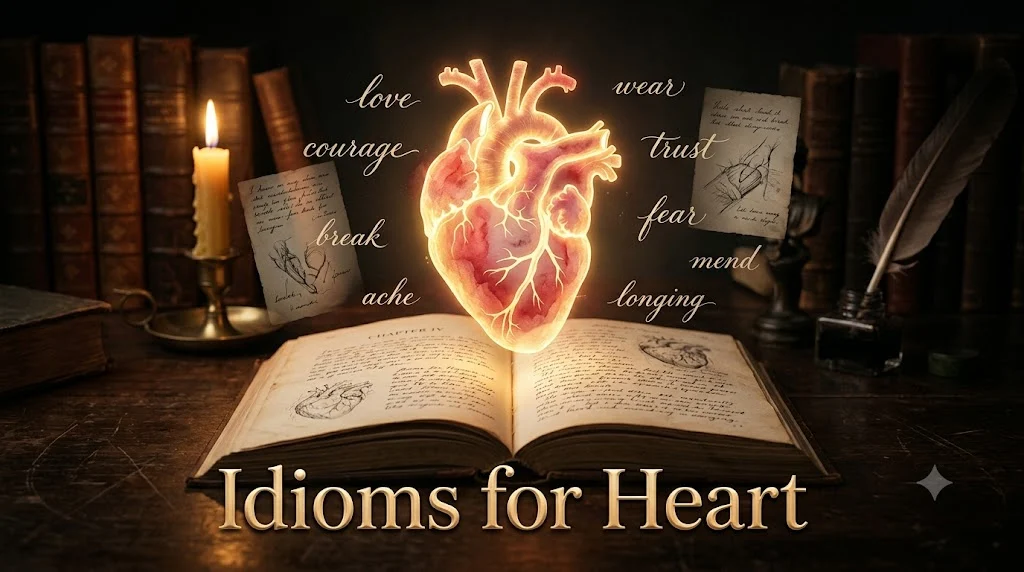
Idioms for “heart” are powerful expressions used to describe deep emotions love, bravery, heartbreak, kindness, fear, and sincerity often in a poetic, dramatic, or heartfelt way.Examples: break someone’s heart, wear your heart on your sleeve, take heart
We all experience emotions, but rarely do we find the exact words to describe what we feel inside. That’s where heart idioms come in.
The heart has always been more than just an organ. In every language, it represents the center of human emotion love, grief, courage, fear, passion, and even cruelty. When someone says “she has a heart of gold” or “he didn’t mean to break your heart,” you don’t imagine a biological heart. You feel the emotion behind the words.
English is filled with rich, colorful idioms that use the word “heart” to express everything from deep affection to complete despair. These phrases make conversations more vivid, stories more emotional, and writing more powerful.
In this guide, you will learn:
- Powerful idioms for heart broken into emotional categories
- Real meanings and when to use each one
- Formal, casual, and creative examples
- Practical tips to use them naturally in 2026
Let’s explore the most expressive heart idioms that bring language to life.
Quick Summary Table
| Situation | Idioms |
|---|---|
| Deep love & affection | Heart of gold, have a heart, sweetheart |
| Heartbreak & sadness | Break someone’s heart, heart sinks, heart aches |
| Courage & confidence | Take heart, heart of a lion, courage of one’s heart |
| Fear & nervousness | Heart in mouth, heart misses a beat, heart pounds |
| Honesty & emotion | Wear heart on sleeve, from the bottom of my heart |
| Cruelty & coldness | Heart of stone, cold-hearted |
❤️ Idioms for Deep Love and Affection
Love is the first emotion we connect with the heart. These idioms express genuine kindness, care, and warmth.
1. Heart of Gold
This is one of the most beautiful compliments in English.
Meaning: A kind, generous, and caring nature
When People Use It: To praise someone’s character
Alternative Expression: Genuinely kind
Examples:
Formal: She has a heart of gold and always helps those in need.
Casual: My grandmother? Yeah, she’s got a heart of gold.
Creative: Under his rough exterior lived a heart of gold, soft and untarnished.
2. Have a Heart
Used when someone is being unreasonable or unkind.
Meaning: Show compassion or mercy
When People Use It: Requesting kindness in a difficult situation
Alternative Expression: Be reasonable
Examples:
Formal: Have a heart and consider his circumstances before judging.
Casual: Come on, have a heart! Let me borrow the car just once.
Creative: The cold wind begged the sky to have a heart and stop the snow.
3. Sweetheart
A term of endearment used for loved ones.
Meaning: A kind, loving person or romantic partner
When People Use It: Direct address to a lover, child, or close friend
Alternative Expression: Darling, love
Examples:
Formal: He is known as a sweetheart among his colleagues.
Casual: Hey sweetheart, could you pass the salt?
Creative: She was everyone’s sweetheart, but no one knew her secret storm.
4. Close to One’s Heart
Something personally important or meaningful.
Meaning: Deeply valued or loved
When People Use It: Talking about causes, people, or memories
Alternative Expression: Personally meaningful
Examples:
Formal: Animal welfare is a cause close to her heart.
Casual: That old guitar is really close to my heart.
Creative: The handwritten letter stayed close to his heart, worn soft by years.
💔 Idioms for Heartbreak and Sadness
Sometimes love hurts. These idioms describe emotional pain, disappointment, and grief.
5. Break Someone’s Heart
One of the most common and powerful heart idioms.
Meaning: Cause deep emotional pain to someone who loves you
When People Use It: After betrayal, loss, or rejection
Alternative Expression: Devastate emotionally
Examples:
Formal: Leaving without explanation broke her heart completely.
Casual: Don’t break my heart, okay? I’ve been hurt before.
Creative: He didn’t just break her heart he shattered it into a thousand silent pieces.
6. Heart Sinks
A sudden feeling of disappointment or despair.
Meaning: Feel sudden sadness or loss of hope
When People Use It: After bad news or realization
Alternative Expression: Lose hope instantly
Examples:
Formal: Her heart sank when she read the rejection letter.
Casual: My heart sank as soon as I saw the empty parking spot.
Creative: The silence on the other end made his heart sink like a stone in deep water.
7. Heart Aches
A continuous, dull emotional pain.
Meaning: Feel persistent sadness or longing
When People Use It: Missing someone or regretting something
Alternative Expression: Yearn painfully
Examples:
Formal: His heart ached for the home he left behind.
Casual: Every time I see that photo, my heart aches.
Creative: Her heart ached with the rhythm of rain on an empty street.
8. Die of a Broken Heart
An extreme expression of emotional devastation.
Meaning: Suffer severely from emotional loss
When People Use It: Dramatic or literary situations
Alternative Expression: Be emotionally destroyed
Examples:
Formal: In old literature, characters often die of a broken heart.
Casual: I swear, if he leaves, I’ll die of a broken heart.
Creative: She didn’t die of illness she died of a broken heart, slowly and silently.
🦁 Idioms for Courage and Confidence
The heart also represents bravery. These idioms describe strength, determination, and fearlessness.
9. Take Heart
A phrase of encouragement.
Meaning: Be encouraged or feel hopeful
When People Use It: Comforting someone during difficulty
<strong>Alternative Expression: Stay strong
Examples:
Formal: Take heart, for better days are ahead.
Casual: Take heart, buddy. We’ve been through worse.
Creative: The survivors took heart from the first ray of morning light.
10. Heart of a Lion
Ultimate bravery.
Meaning: Extreme courage and determination
When People Use It: Praising someone’s bravery
Alternative Expression: Extremely brave
Examples:
Formal: The soldier fought with the heart of a lion.
Casual: That kid has the heart of a lion, facing bullies every day.
Creative: She was small in stature but carried the heart of a lion in her fragile chest.
11. Have the Heart (to do something)
Used in negative sentences to show inability to be cruel.
Meaning: Be able to do something unkind
When People Use It: Refusing to hurt someone’s feelings
Alternative Expression: Be cruel enough
Examples:
Formal: I didn’t have the heart to tell him he failed.
Casual: She didn’t have the heart to say no to the puppy.
Creative: How could anyone have the heart to silence such a beautiful voice?
12. Courage of One’s Heart
Inner strength despite fear.
Meaning: Bravery that comes from deep emotion
When People Use It: Describing moral or emotional courage
Alternative Expression: Inner strength
Examples:
Formal: She showed the courage of her heart when she spoke the truth.
Casual: It takes the courage of your heart to admit you’re wrong.
Creative: Not the sword, but the courage of his heart won the battle.
😨 Idioms for Fear and Nervousness
When afraid, your heart responds physically. These idioms capture that feeling perfectly.
13. Heart in One’s Mouth
Extreme fear or nervous anticipation.
Meaning: Feeling intense fear or anxiety
When People Use It: Before a big event or during danger
Alternative Expression: Terrified
Examples:
Formal: As the results were announced, her heart was in her mouth.
Casual: My heart was in my mouth during the entire horror movie.
Creative: He stepped onto the stage, heart in his mouth, but found his voice anyway.
14. Heart Misses a Beat
Sudden shock or excitement.
Meaning: Momentary fear or surprise
When People Use It: Unexpected scares or romantic moments
Alternative Expression: Startled
Examples:
Formal: When she saw the car swerve, her heart missed a beat.
Casual: I swear my heart missed a beat when you called my name.
Creative: The plot twist made every reader’s heart miss a beat in unison.
15. Heart POUNDS / RACES
Physical reaction to fear, excitement, or anger.
Meaning: Beat very fast due to strong emotion
When People Use It: After exercise, fear, or anticipation
Alternative Expression: Palpitate
Examples:
Formal: His heart pounded as he approached the interview room.
Casual: My heart was racing before the final penalty kick.
Creative: In the dark alley, his heart pounded louder than his footsteps.
🎭 Idioms for Honesty and Emotional Openness
These idioms describe how openly someone shows their feelings.
16. Wear Your Heart on Your Sleeve
Showing emotions openly without hiding.
Meaning: Make feelings obvious to everyone
When People Use It: Describing emotionally transparent people
Alternative Expression: Be emotionally open
Examples:
Formal: He wears his heart on his sleeve, for better or worse.
Casual: Don’t wear your heart on your sleeve so quickly protect yourself.
Creative: She wore her heart on her sleeve, and the world saw every beautiful bruise.
17. From the Bottom of My Heart
Complete sincerity.
Meaning: With total honesty and deep feeling
When People Use It: Apologies, thanks, or declarations
Alternative Expression: Sincerely
Examples:
Formal: I thank you from the bottom of my heart for your kindness.
Casual: From the bottom of my heart, I’m sorry I forgot your birthday.
Creative: The words came not from his lips but from the bottom of his heart.
18. Open One’s Heart
Reveal deepest feelings or secrets.
Meaning: Share vulnerable emotions
When People Use It: Intimate conversations or confession
Alternative Expression: Confess feelings
Examples:
Formal: In therapy, she finally opened her heart about the past.
Casual: He opened his heart to me last night. I had no idea he was struggling.
Creative: The old man opened his heart like a dusty book, and out fell decades of silence.
🧊 Idioms for Cruelty and Coldness
Not every heart is warm. These idioms describe emotional coldness and cruelty.
19. Heart of Stone
Complete lack of compassion.
Meaning: Emotionless and unkind
When People Use It: Describing cruel or indifferent people
Alternative Expression: Ruthless
Examples:
Formal: Only someone with a heart of stone could ignore such suffering.
Casual: You’d have to have a heart of stone not to cry at that movie.
Creative: He bargained with a heart of stone while others begged for mercy.
20. Cold-Hearted
Deliberately unfeeling or cruel.
Meaning: Showing no sympathy or kindness
When People Use It: Criticizing selfish behavior
Alternative Expression: Unfeeling
Examples:
Formal: The cold-hearted decision left dozens without shelter.
Casual: Don’t be so cold-hearted help her out.
Creative: Her cold-hearted laugh echoed through the empty hall.
21. Steal Someone’s Heart
Winning love, but through charm (can be manipulative).
Meaning: Make someone fall in love with you
When People Use It: Romantic contexts, sometimes negative
Alternative Expression: Win over romantically
Examples:
Formal: The charismatic stranger stole her heart within weeks.
Casual: He stole my heart the moment he smiled.
Creative: He didn’t ask for her heart. He stole it silently, like a thief in the night.
🔥 Idioms for Strong Desire and Passion
The heart can also burn with longing and intense emotion.
22. After One’s Own Heart
Someone who shares your values and preferences.
Meaning: A kindred spirit
When People Use It: Finding someone with similar tastes
Alternative Expression: Like-minded
Examples:
Formal: She is a leader after my own heart.
Casual: You love old jazz? You’re a man after my own heart.
Creative: In a world of noise, he found a friend after his own heart.
23. Set One’s Heart On
Strong desire or determination.
Meaning: Want something very badly
When People Use It: Goals, dreams, or material things
Alternative Expression: Be determined
Examples:
Formal: She set her heart on becoming a doctor at age ten.
Casual: I’ve set my heart on that red convertible.
Creative: He set his heart on the stars, and the earth could not hold him.
24. Heart Burns (with passion/desire)
Literary expression for intense longing.
Meaning: Feel overwhelming desire or love
When People Use It: Poetic or dramatic situations
Alternative Expression: Yearn intensely
Examples:
Formal: His heart burned with a passion that words could not express.
Casual: Every time I see you, my heart just burns.
Creative: Her heart burned not with fire, but with the quiet heat of waiting.
🌀 Idioms for Change of Heart
People change their minds. These idioms describe emotional shifts.
25. Change of Heart
Complete reversal of opinion or feeling.
Meaning: Change one’s decision or attitude
When People Use It: After reflection or new information
Alternative Expression: Reconsider
Examples:
Formal: After hearing her apology, he had a sudden change of heart.
Casual: I was going to quit, but I had a change of heart last night.
Creative: The villain’s change of heart came too late, but it came honestly.
26. Know in One’s Heart
Deep inner certainty.
Meaning: Be absolutely sure emotionally
When People Use It: Moral convictions or gut feelings
Alternative Expression: Feel certain
Examples:
Formal: She knew in her heart that the decision was right.
Casual: I don’t have proof, but I know in my heart he’s innocent.
Creative: No map could guide him, but he knew in his heart where to go.
27. Not Have the Heart
Inability to be harsh.
Meaning: Unable to be cruel or disappointing
When People Use It: Sparing someone’s feelings
Alternative Expression: Be too kind
Examples:
Formal: The teacher didn’t have the heart to give him a failing grade.
Casual: I don’t have the heart to tell her her cake is terrible.
Creative: The critic didn’t have the heart to destroy a dream so fragile.
🩹 Idioms for Healing and Recovery
After pain, the heart can heal. These idioms offer hope.
28. Heart Mends / Heals
Emotional recovery over time.
Meaning: Gradually recover from heartbreak
When People Use It: After loss or betrayal
Alternative Expression: Recover emotionally
Examples:
Formal: With time and support, a broken heart mends slowly.
Casual: Don’t worry. Your heart will heal. Give it time.
Creative: Her heart mended not like new, but like a mosaic more beautiful for its cracks.
29. Take to Heart
Take seriously, often too seriously.
Meaning: Be deeply affected by criticism or advice
When People Use It: When someone overreacts to feedback
Alternative Expression: Internalize
Examples:
Formal: She took his criticism to heart and worked twice as hard.
Casual: Don’t take every joke to heart relax a little.
Creative: Every unkind word he took to heart, planting thorns in his chest.
🧠 How to Use Idioms for “Heart” Naturally (2026 Guide)
Using heart idioms can make your English richer, but only if you use them with the right tone and timing.
✔ Match the Emotion to the Moment
Not all heart idioms fit every situation.
- For love and kindness → heart of gold, sweetheart
👉 “Thank you. You have a heart of gold.” - For sadness and loss → break my heart, heart sinks
👉 “My heart sank when I heard the news.” - For encouragement → take heart, have courage
👉 “Take heart. This isn’t the end.” - For fear → heart in mouth, heart misses a beat
👉 “My heart was in my mouth during the final exam.”
✔ Match the Relationship
Some idioms are intimate; others are universal.
- Close relationships → open your heart, steal someone’s heart
- Casual or professional → take heart, change of heart
- Avoid overly dramatic idioms in formal or serious contexts unless writing fiction.
✔ Don’t Overload Your Sentences
One strong idiom is better than three weak ones.
❌ “My heart sank, then broke, then ached, and I died of a broken heart.”
✅ “My heart ached for days after she left.”
⚠️ Common Mistakes to Avoid
Even fluent speakers make these errors.
❌ Using dramatic idioms in casual小事
Saying “I died of a broken heart” because someone ate your lunch is unnatural and confusing.
❌ Mixing metaphors
Avoid combining heart idioms with unrelated body parts incorrectly.
❌ “I put my heart on my sleeve and kicked the bucket.” (Makes no sense)
❌ Forgetting cultural tone
Some cultures find emotional openness uncomfortable. “Wear your heart on your sleeve” might be seen as weakness in certain professional settings.
🚀 Practice Method That Actually Works
You don’t need to memorize 50 idioms at once.
1. Learn 3 Idioms Per Week
Focus on one emotional category at a time. Week one: love idioms. Week two: sadness idioms.
2. Use Them in Real Sentences Daily
Write or speak one sentence each morning.
👉 “Today, I will take heart and face my fears.”
3. Create a Heart Idiom Journal
Write down every heart idiom you hear in movies, songs, or conversations. Note the context.
4. Practice with Stories
Rewrite a short paragraph from a book, replacing simple emotion words with heart idioms.
Original: She was sad when he left.
Rewritten: Her heart ached when he left, and she felt her heart sink with every mile.
❓ FAQs
1. What does “heart” mean in idioms?
In English idioms, “heart” represents emotion love, courage, sadness, fear, kindness, or cruelty not the physical organ.
2. Are heart idioms formal or informal?
Most are neutral to informal. Some like “from the bottom of my heart” work in formal thanks. Others like “wear your heart on your sleeve” are conversational.
3. Can I use heart idioms in professional writing?
Yes, carefully. “Take heart” and “change of heart” are fine in business emails. Avoid overly emotional ones like “die of a broken heart.”
4. Are heart idioms offensive?
Not usually. But calling someone “cold-hearted” is an insult. Context is everything.
5. How do I remember so many idioms?
Group them by emotion (love, sadness, courage, fear). Practice one group per week. Connect each idiom to a personal memory or a favorite movie scene.
Conclusion
Idioms for “heart” are more than just phrases they are emotional shortcuts that connect speakers across cultures. Whether you want to express love, describe heartbreak, encourage a friend, or admit fear, there is a heart idiom that fits perfectly.
- Instead of saying “I’m sad,” you can say “My heart aches.”
- Instead of “Be brave,” say “Take heart.”
- Instead of “She is kind,” say “She has a heart of gold.”
The difference is immediate. Your English becomes warmer, more vivid, and more human.
Start small. Learn three idioms this week. Use them in conversation. Listen for them in songs and movies. Soon, speaking with heart will feel as natural as breathing.
And when you truly feel something whether love, loss, or courage you will have the right words ready, straight from the heart.
Read More Related Articles:
- Idioms for Stress | Powerful Expressions to Describe Pressure Naturally In 2026
- 25 Idioms for Smile | Express Warmth and Emotion Naturally In 2026
- Idioms for Soccer | Powerful Expressions to Score in English In 2026

Urban Hunter is an American writer at IdiomCrafter.com, with a keen interest in how language shapes everyday conversations. She enjoys turning common expressions into engaging and easy-to-follow reads. Outside of writing, she spends time exploring new words and their hidden meanings.