Quick Answer
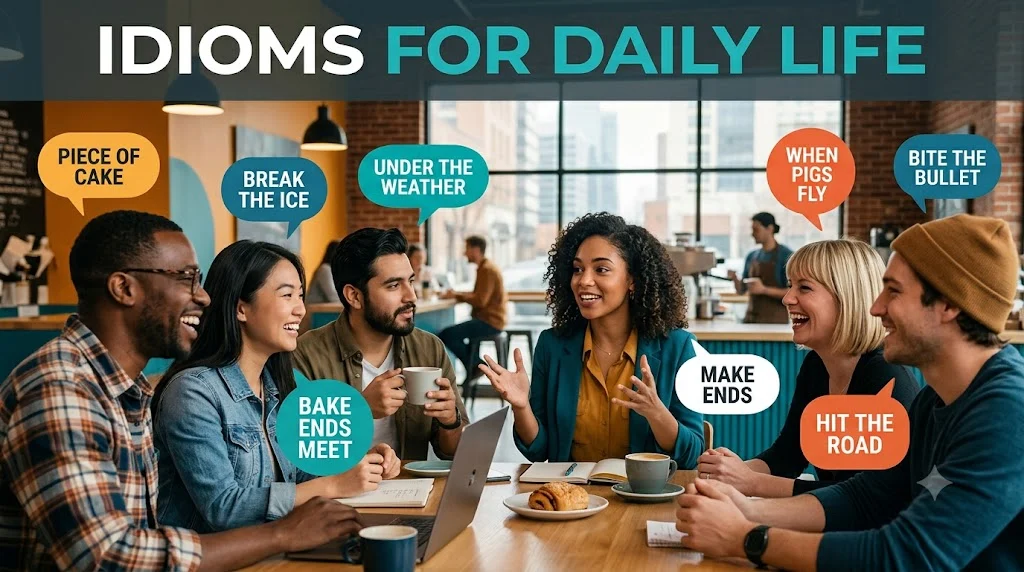
Idioms for daily life are common expressions used to describe everyday situations, emotions, habits, and experiences in a natural, colorful, and relatable way.Examples: hit the sack, break the ice, bite the bullet
English is full of expressions that go far beyond their literal meaning. When someone says “I’m under the weather,” they don’t mean they’re standing in the rain. When someone tells you to “bite the bullet,” they’re not talking about actual bullets. These are idioms, and they are everywhere in daily English.
The problem is that most people learn English words and grammar in classrooms but miss out on the natural, flowing expressions that native speakers use every single day. Whether you’re talking to a coworker, catching up with a friend, writing a casual email, or watching a TV show, idioms are constantly showing up, and if you don’t understand them, you miss the full meaning of what’s being said.
That’s exactly why this guide exists. Here you will find the most useful, practical, and commonly used idioms for daily life, organized by situation so you can actually apply them in real conversations.
In this guide, you’ll learn:
- Idioms for morning routines and daily habits
- Idioms for work and productivity
- Idioms for emotions and feelings
- Idioms for relationships and social situations
- Idioms for time and decision making
- Idioms for success and failure
- Practical tips for using them naturally
- Common mistakes to avoid
Let’s get started.
Quick Summary Table
| Situation | Idioms |
|---|---|
| Morning & Daily Routine | Hit the sack, Rise and shine, On the go |
| Work & Productivity | Burn the midnight oil, Hit the ground running |
| Emotions & Feelings | On cloud nine, Down in the dumps |
| Relationships | Break the ice, On the same page |
| Time & Decisions | Bite the bullet, Beat the clock |
| Success & Failure | Hit the nail on the head, Back to square one |
| Money & Lifestyle | Tighten your belt, Live it up |
| Health & Energy | Under the weather, Run on empty |
🌅 Idioms for Morning Routine and Daily Habits
Every day starts somewhere and these idioms perfectly capture the rhythm of daily routines.
1. Hit the Sack
One of the most widely used idioms in everyday English, this one comes up almost every night.
Meaning: Go to bed or go to sleep
When People Use It: End of the day, feeling tired
Alternative Expression: Call it a night
Examples:
- Formal: After a long day of meetings, she decided to hit the sack early.
- Casual: I’m exhausted. I’m going to hit the sack.
- Creative: By ten o’clock, his body begged him to hit the sack.
2. Rise and Shine
A cheerful, energetic expression often used in the morning to encourage someone to wake up and get moving.
Meaning: Wake up and be energetic
When People Use It: Morning motivation or waking someone up
Alternative Expression: Get up and get going
Examples:
- Formal: The team leader told everyone to rise and shine before the early session.
- Casual: Rise and shine! We have a big day ahead.
- Creative: The alarm rang and the world whispered, rise and shine.
3. On the Go
This idiom describes someone who is constantly busy and moving throughout the day.
Meaning: Constantly busy or active
When People Use It: Describing a hectic lifestyle or daily schedule
Alternative Expression: Always busy
Examples:
- Formal: He is constantly on the go, managing three different projects.
- Casual: I’ve been on the go since seven this morning.
- Creative: She lived her life entirely on the go, never stopping long enough to catch her breath.
4. Start From Scratch
A very practical idiom used when something has to be rebuilt or begun from the very beginning.
Meaning: Begin something from the very beginning with nothing prepared
When People Use It: After a failure or when restarting a task
Alternative Expression: Begin from zero
Examples:
- Formal: After the data was lost, they had to start from scratch.
- Casual: I messed up the recipe so I started from scratch.
- Creative: With nothing but a blank page, she chose to start from scratch and build something new.
💼 Idioms for Work and Productivity
The workplace is full of idioms. These are the ones you’ll hear in offices, meetings, and professional conversations every single day.
5. Burn the Midnight Oil
This idiom paints a vivid picture of someone working so late that they need a lamp burning while everyone else sleeps.
Meaning: Work very late into the night
When People Use It: Deadlines, heavy workloads, exam preparation
Alternative Expression: Work through the night
Examples:
- Formal: The development team burned the midnight oil to meet the launch deadline.
- Casual: I burned the midnight oil finishing that report.
- Creative: The office stayed lit long after midnight as the team burned the midnight oil one more time.
6. Hit the Ground Running
This is a favorite in professional settings because it perfectly captures the idea of starting something with full energy and preparation.
Meaning: Start something quickly and with great energy and enthusiasm
When People Use It: New jobs, new projects, new beginnings
Alternative Expression: Start strong
Examples:
- Formal: She hit the ground running in her new role from day one.
- Casual: We need to hit the ground running on this project.
- Creative: He walked into the office on his first day and hit the ground running without looking back.
7. Get the Ball Rolling
A motivating idiom used when someone wants to start a process or encourage others to begin moving forward.
Meaning: Start something, especially something that involves other people
When People Use It: Meetings, team projects, group activities
Alternative Expression: Get started, kick things off
Examples:
- Formal: The manager asked someone to get the ball rolling during the brainstorming session.
- Casual: Let’s get the ball rolling on this idea.
- Creative: All it took was one question to get the ball rolling, and soon the room was alive with ideas.
8. Back to the Drawing Board
When a plan fails and you need to rethink everything, this is the idiom you reach for.
Meaning: Start planning something again from the beginning after a failure
When People Use It: Failed projects, rejected plans, setbacks
Alternative Expression: Start over, rethink everything
Examples:
- Formal: The proposal was rejected, so the team went back to the drawing board.
- Casual: That didn’t work. Back to the drawing board.
- Creative: The crashed prototype sent everyone back to the drawing board with fresh eyes.
9. Cut to the Chase
Used when someone wants another person to skip unnecessary details and get straight to the important point.
Meaning: Get to the main point without wasting time
When People Use It: Meetings, conversations, explanations
Alternative Expression: Get to the point
Examples:
- Formal: The director asked the presenter to cut to the chase.
- Casual: Just cut to the chase. What happened?
- Creative: She had no patience for small talk. Cut to the chase was her personal motto.
😊 Idioms for Emotions and Feelings
Emotions are best expressed when language goes beyond the obvious. These idioms bring real feeling to everyday conversations.
10. On Cloud Nine
A beautiful idiom for extreme happiness that feels almost elevated, like floating above everything.
Meaning: Extremely happy and joyful
When People Use It: Good news, achievements, romantic moments
Alternative Expression: Over the moon, thrilled
Examples:
- Formal: After receiving the promotion, she was on cloud nine for days.
- Casual: He’s been on cloud nine ever since she said yes.
- Creative: The news arrived and lifted him straight to cloud nine, where he stayed for the rest of the week.
11. Down in the Dumps
The emotional opposite of cloud nine, this idiom describes a period of low mood or sadness.
Meaning: Feeling sad, low, or depressed
When People Use It: After disappointment, loss, or a difficult time
Alternative Expression: Feeling blue, low-spirited
Examples:
- Formal: He seemed rather down in the dumps following the project’s cancellation.
- Casual: She’s been down in the dumps all week.
- Creative: The grey sky outside matched exactly how down in the dumps he felt inside.
12. Keep Your Chin Up
An encouraging phrase used to remind someone to stay positive when things are difficult.
Meaning: Stay positive and brave in difficult situations
When People Use It: Comforting someone going through a tough time
Alternative Expression: Stay strong, hang in there
Examples:
- Formal: Despite the setback, the mentor encouraged her to keep her chin up.
- Casual: Keep your chin up. Things will get better.
- Creative: Even when the road looked long and uncertain, he kept his chin up and kept walking.
13. Wear Your Heart on Your Sleeve
This idiom describes someone who openly and openly shows their emotions without hiding them.
Meaning: Show your emotions openly and without hiding them
When People Use It: Describing an emotional or sensitive person
Alternative Expression: Be open about your feelings
Examples:
- Formal: She tends to wear her heart on her sleeve, which makes her very easy to read.
- Casual: He always wears his heart on his sleeve.
- Creative: In a world that hides its feelings, she wore her heart on her sleeve like a badge of courage.
🤝 Idioms for Relationships and Social Situations
Human connections are filled with beautiful and sometimes complicated moments. These idioms capture the way people interact every day.
14. Break the Ice
One of the most widely recognized idioms in social settings, this one describes that first brave move in an awkward or new situation.
Meaning: Do or say something to make a new social situation feel more relaxed and comfortable
When People Use It: First meetings, new groups, social events
Alternative Expression: Start the conversation
Examples:
- Formal: The facilitator told a light joke to break the ice at the beginning of the workshop.
- Casual: Someone needs to break the ice here.
- Creative: One small joke was all it took to break the ice and turn strangers into friends.
15. On the Same Page
A very common idiom used when people are in agreement or have the same understanding of something.
Meaning: Having the same understanding, goals, or opinions
When People Use It: Teamwork, relationships, planning
Alternative Expression: In agreement, aligned
Examples:
- Formal: Before proceeding, the manager ensured that everyone was on the same page.
- Casual: Are we on the same page about this?
- Creative: They had talked for hours, but only now did they finally feel like they were on the same page.
16. Hit It Off
A fun and natural idiom describing an instant connection between two people.
Meaning: Immediately like someone and get along very well with them
When People Use It: New friendships, first meetings, romantic beginnings
Alternative Expression: Click, connect instantly
Examples:
- Formal: The two partners hit it off during their first meeting and formed a strong working relationship.
- Casual: We totally hit it off at the party.
- Creative: From the very first conversation, they hit it off as though they had known each other for years.
17. Give Someone the Cold Shoulder
When someone intentionally ignores or is unfriendly toward another person, this idiom captures that behavior precisely.
Meaning: Ignore someone intentionally or treat them in an unfriendly way
When People Use It: Conflict, rejection, social tension
Alternative Expression: Ignore, shut someone out
Examples:
- Formal: She gave him the cold shoulder following the disagreement.
- Casual: Why is he giving me the cold shoulder?
- Creative: She walked past him without a word, giving him the cold shoulder as if he had simply stopped existing.
⏰ Idioms for Time and Decision Making
Time and choices are two of the biggest themes in daily life. These idioms reflect how people think, decide, and manage their time.
18. Bite the Bullet
A powerful idiom used when someone must face something painful or difficult with courage and just do it anyway.
Meaning: Endure a difficult situation or make a hard decision bravely
When People Use It: Facing difficult tasks, making tough choices
Alternative Expression: Face it head-on, tough it out
Examples:
- Formal: He knew the conversation would be difficult, but he bit the bullet and brought it up.
- Casual: Just bite the bullet and send the email.
- Creative: She stood at the edge of the decision, took a deep breath, and bit the bullet.
19. Beat the Clock
This idiom brings a sense of urgency, describing the race against time that many people feel in daily situations.
Meaning: Finish something before a deadline or before time runs out
When People Use It: Deadlines, urgent tasks, last-minute situations
Alternative Expression: Race against time
Examples:
- Formal: The team worked through the night to beat the clock before the submission deadline.
- Casual: We barely beat the clock on that one.
- Creative: With only minutes left, they pushed harder, determined to beat the clock one more time.
20. In the Nick of Time
A classic idiom used when something happens at the very last possible moment, just before it’s too late.
Meaning: Just in time, at the last possible moment
When People Use It: Near misses, last-minute successes
Alternative Expression: Just barely in time, at the last second
Examples:
- Formal: The ambulance arrived in the nick of time.
- Casual: You got here in the nick of time!
- Creative: The train doors began to close, and she slipped through in the nick of time, breathless and smiling.
21. Call It a Day
An incredibly useful idiom that people use to signal the end of work or effort for the day.
Meaning: Stop working or doing an activity for the rest of the day
When People Use It: End of workday, completing tasks, fatigue
Alternative Expression: Wrap up, finish for the day
Examples:
- Formal: After several productive hours, the team decided to call it a day.
- Casual: I’m tired. Let’s call it a day.
- Creative: When the last file was saved and the lights began to dim, they finally called it a day.
🏆 Idioms for Success and Failure
Life goes up and it goes down. These idioms capture both the highs of success and the reality of setbacks in a way that everyone instantly understands.
22. Hit the Nail on the Head
Perfection in expression. This idiom is used when someone says or does exactly the right thing.
Meaning: Do or say something exactly right
When People Use It: Correct answers, spot-on feedback, accurate observations
Alternative Expression: Get it exactly right, be spot on
Examples:
- Formal: Her analysis hit the nail on the head and impressed the entire panel.
- Casual: You hit the nail on the head with that one.
- Creative: He searched for the right words for days, and when they finally came, they hit the nail on the head.
23. Back to Square One
When all progress is lost and everything must restart from the very beginning, this idiom captures the frustration and reset perfectly.
Meaning: Return to the beginning after a failure or setback
When People Use It: Failed plans, rejected proposals, lost progress
Alternative Expression: Start over completely
Examples:
- Formal: The contract fell through, sending the negotiation back to square one.
- Casual: That didn’t work. Back to square one.
- Creative: Three weeks of effort vanished overnight, and with a sigh, they accepted they were back to square one.
24. Go the Extra Mile
An inspiring idiom used to describe putting in more effort than what is expected or required.
Meaning: Make more effort than necessary, exceed expectations
When People Use It: Hard work, exceptional service, dedication
Alternative Expression: Go above and beyond
Examples:
- Formal: She consistently goes the extra mile for her clients and that is why they trust her.
- Casual: He always goes the extra mile for his friends.
- Creative: While others did just enough, she chose every single time to go the extra mile, and it always showed.
25. Under the Weather
One of the most commonly used idioms in daily life, this one describes feeling sick or unwell in a gentle and indirect way.
Meaning: Feeling sick or unwell
When People Use It: Illness, fatigue, low energy
Alternative Expression: Not feeling well, feeling off
Examples:
- Formal: He was unable to attend the meeting as he was feeling under the weather.
- Casual: I’m a little under the weather today.
- Creative: She stayed in bed with tea and silence, completely under the weather and grateful for the rest.
💰 Idioms for Money and Lifestyle
Money plays a big role in daily conversations and these idioms reflect how people talk about finances, spending, and the way they live.
26. Tighten Your Belt
A very visual and practical idiom used when someone needs to spend less money or cut back on expenses.
Meaning: Spend less money, live more economically
When People Use It: Financial difficulty, budget cuts, saving goals
Alternative Expression: Cut back on spending
Examples:
- Formal: Given the economic climate, the company advised employees to tighten their belts.
- Casual: We need to tighten our belts this month.
- Creative: When the bills arrived and the savings felt thin, they knew it was time to tighten their belts.
27. Live It Up
The fun, celebratory side of money and lifestyle. This idiom is used when someone is enjoying life with enthusiasm, often by spending freely or celebrating.
Meaning: Enjoy life to the fullest, especially by spending money or celebrating
When People Use It: Vacations, celebrations, special occasions
Alternative Expression: Have a great time, enjoy yourself fully
Examples:
- Formal: After years of hard work, she finally decided to live it up on her holiday.
- Casual: It’s your birthday. Live it up!
- Creative: With a rare weekend off and nowhere to be, he decided for once to simply live it up.
28. Cost an Arm and a Leg
One of the most well-known idioms for expressing that something is very expensive.
Meaning: Be extremely expensive
When People Use It: Shopping, services, unexpected costs
Alternative Expression: Be very expensive, cost a fortune
Examples:
- Formal: The renovation project ended up costing an arm and a leg.
- Casual: That bag costs an arm and a leg.
- Creative: She fell in love with the dress immediately and then saw the price tag and realized it would cost an arm and a leg.
🎯 How to Use Idioms for Daily Life Naturally
Learning idioms is only half the journey. Using them naturally in real conversations is where the real progress happens. Here is exactly how to do it.
✔ Match the Situation
The biggest key to using idioms well is choosing the right one for the right moment. Every idiom has a specific emotional tone and social context.
- For morning energy → rise and shine, hit the ground running
- For work and effort → burn the midnight oil, go the extra mile
- For happiness → on cloud nine, hit it off
- For sadness or difficulty → down in the dumps, bite the bullet
Think of idioms as tools. Each one has a specific job. When you pick the right tool for the right situation, the result is clear, expressive, and natural.
✔ Keep Tone in Mind
One of the most common mistakes people make is using a casual idiom in a formal or professional context, which can feel awkward or even unprofessional.
For example, saying “We need to hit the sack early tomorrow” might be fine with friends but would sound strange in a formal business meeting. In professional settings, opt for neutral language or more formal expressions, and save casual idioms for everyday conversations.
✔ Use Sparingly for Maximum Impact
Idioms are powerful because they stand out. But if you use too many of them in a single conversation or piece of writing, they start to lose their punch and things begin to sound unnatural.
One or two well-placed idioms in a conversation are far more effective than six or seven crammed in without purpose. Let them breathe. Use them when they genuinely fit and when they do, they will land perfectly.
⚠️ Common Mistakes to Avoid
Even confident English speakers sometimes slip up with idioms. Here are the most common errors and how to avoid them.
❌ Taking Idioms Literally
If someone says “it’s raining cats and dogs,” they don’t mean animals are falling from the sky. Always interpret idioms based on context, not the literal words.
❌ Using Them in the Wrong Context
An idiom like “bite the bullet” works well for tough decisions, not for describing a busy morning. Using idioms outside their intended context confuses the listener.
❌ Overusing Idioms in Formal Writing
In academic essays, official letters, or business reports, idioms can sound too casual. Know when to stick to clear, direct language instead.
❌ Mixing Idioms Together
Combining two idioms in one sentence, sometimes called a mixed idiom, sounds confusing and unnatural. Keep them clean and separate.
🚀 Practice Method That Actually Works
The fastest way to learn idioms is not to memorize them from a list. It is to use them in real situations repeatedly until they become second nature.
1. Learn Three Idioms Per Day
Focusing on three idioms at a time allows your brain to actually absorb them rather than getting overwhelmed. Choose three, understand their meaning, and find out which situations they work best in.
2. Use Them in Real Conversations
Even if your sentence is simple, use the idiom in a real context during the day.
“I’m a little under the weather today.” “Let’s hit the ground running on this.” These small, real uses build the habit faster than any exercise sheet.
3. Write One Creative Sentence for Each
This is the most powerful practice technique. Instead of writing a basic sentence, write an expressive one that uses the idiom in a vivid, memorable way.
“The deadline crept closer as the team burned the midnight oil, refusing to let the project slip through their fingers.”
The more feeling and imagery you put into the sentence, the deeper the idiom embeds itself in your memory.
4. Watch Native English Content
Movies, TV shows, podcasts, and YouTube videos are filled with natural idiom usage. When you hear one you recognize, pause and appreciate how naturally it was used. This builds your instinct for context and tone.
FAQs
1. What are idioms for daily life?
They are fixed expressions used in everyday English conversations that have a meaning different from their literal words. They help speakers sound more natural, expressive, and fluent.
2. Are daily life idioms formal or informal?
Most are informal and best suited to casual conversations, storytelling, or relaxed writing. A few can work in semi-professional settings, but always consider your audience.
3. How many idioms should I learn at once?
Start with three per day. Quality and understanding matter more than quantity. Knowing ten idioms deeply is better than knowing one hundred superficially.
4. Can using idioms make my English better?
Absolutely. Idioms show language confidence and fluency. When used correctly, they make your English sound more natural and engaging to native speakers.
5. Are idioms the same in all English-speaking countries?
Not always. Some idioms are universal while others are more common in British, American, or Australian English. Pay attention to regional context when you learn new expressions.
Conclusion
Idioms for daily life are not just decorative language. They are the heartbeat of natural English. They carry emotion, paint pictures, and bring conversations to life in a way that ordinary words often cannot.
From waking up in the morning and hitting the ground running at work to breaking the ice with a new friend or calling it a day after a long evening, idioms are present in every corner of daily life. And now, so are you.
The key is simple: learn them in context, use them with the right tone, practice them in real situations, and let them become a natural part of the way you speak and think in English.
Once idioms stop feeling like something you’re trying to remember and start feeling like something you naturally reach for, that’s when your English truly comes alive.
Read More Related Articles:
- Idioms for Heart | Express Love, Courage, Sadness & Emotion In 2026
- Idioms for Nature | Expressing the Natural World Beautifully In 2026
- Idioms for Green | Expressing Growth, Envy & Inexperience In 2026

Loganx River is a passionate writer at IdiomCrafter.com, where he explores the meanings and stories behind everyday expressions. He enjoys breaking down complex phrases into simple, easy-to-understand ideas for readers. When he’s not writing, he spends his time reading and collecting interesting sayings from different cultures.