Quick Answer
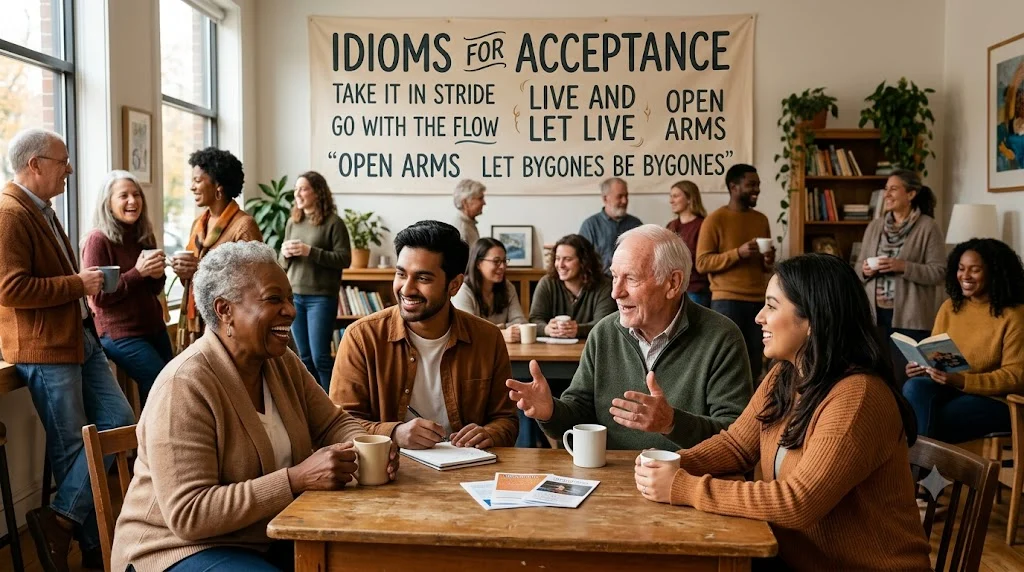
Idioms for “acceptance” are expressive phrases used to convey agreement, approval, understanding, or willingness to embrace situations, ideas, or outcomes naturally in conversation.Examples: come to terms with, embrace with open arms, take it on board, meet halfway
We all encounter moments in life when we need to express acceptance. Whether it’s accepting a difficult truth, agreeing to a proposal, embracing change, or simply acknowledging reality, the word “accept” alone often feels insufficient. That’s where idioms for acceptance transform ordinary statements into emotionally rich, relatable expressions.
Instead of repeatedly saying “I accept” or “I agree,” English offers a diverse collection of idioms that add depth, personality, and cultural nuance to your speech. When someone says “I’ve come to terms with it” or “we’re on the same page,” you immediately sense the emotional weight and sincerity behind their words.
These idioms prove especially valuable in professional negotiations, personal relationships, storytelling, and even conflict resolution. However, using them naturally requires understanding their tone, context, and appropriate application.
In this comprehensive guide, you’ll discover:
- Powerful idioms for various types of acceptance
- Clear meanings and authentic usage scenarios
- Formal, casual, and creative examples
- Cultural variations and regional preferences
- Practical tips for sounding natural and confident
- Common mistakes to avoid
Let’s explore the most expressive idioms that bring acceptance to life in English conversations.
Quick Summary Table
| Situation | Idioms |
|---|---|
| Accepting difficult truth | Come to terms with, Bite the bullet, Face the music |
| Agreeing willingly | Embrace with open arms, Take it on board, Jump on board |
| Accepting compromise | Meet halfway, Give and take, Split the difference |
| Acknowledging reality | Face facts, See reason, Wake up to reality |
| Accepting responsibility | Shoulder the burden, Step up, Own up to |
| Accepting criticism | Take it on the chin, Roll with the punches |
| Accepting help or advice | Take something to heart, Hear someone out |
🤝 Idioms for Accepting Difficult Truths
Life doesn’t always go as planned. Sometimes, acceptance means acknowledging harsh realities, unpleasant situations, or outcomes we wish were different. These idioms help you express that process with dignity and emotional intelligence.
1. Come to Terms With
One of the most commonly used idioms for acceptance, this phrase describes the gradual process of accepting something difficult or painful.
Meaning: Gradually accept a difficult or painful situation
When People Use It: Personal loss, life changes, disappointing outcomes
Alternative Expression: Accept reality, make peace with
Examples:
Formal: After months of reflection, she finally came to terms with the company’s restructuring decision.
Casual: It took me a while, but I’ve come to terms with not getting that promotion.
Creative: The truth settled into his heart slowly, and eventually, he came to terms with the silence that followed.
💡 Usage Insight: This idiom implies a process – acceptance doesn’t happen instantly but evolves over time.
2. Bite the Bullet
A powerful idiom that conveys accepting something unpleasant or difficult with courage and determination.
Meaning: Accept or face something difficult bravely
When People Use It: Making tough decisions, enduring pain, taking necessary actions
Alternative Expression: Face the inevitable, Take the plunge
Examples:
Formal: The management decided to bite the bullet and implement the new policies despite initial resistance.
Casual: I just need to bite the bullet and get my taxes done.
Creative: He bit the bullet, knowing the cost of hesitation was far greater than the price of action.
🔍 Origin: This phrase originates from the practice of soldiers biting on a bullet during surgery to endure pain before anesthesia existed.
3. Face the Music
This idiom suggests confronting the consequences of your actions or accepting an unpleasant reality.
Meaning: Accept the consequences of your actions
When People Use It: Accountability, consequences, owning mistakes
Alternative Expression: Face the consequences, Reap what you sow
Examples:
Formal: The CEO had to face the music after the quarterly results disappointed investors.
Casual: I made a mistake, and now I have to face the music.
Creative: The music of consequence played its inevitable tune, and he had no choice but to listen.
💡 Memory Tip: Think of facing the music as stepping onto a stage where everyone’s watching – you can’t hide.
4. Make Your Peace With
A gentle idiom describing the process of accepting something that cannot be changed, often involving inner resolution.
Meaning: Accept something you cannot change
When People Use It: Personal acceptance, forgiveness, letting go
Alternative Expression: Accept fate, Let go
Examples:
Formal: She made her peace with the decision and moved forward with grace.
Casual: I’ve made my peace with the situation – it is what it is.
Creative: His heart found stillness as he made peace with the memories that would never fade.
5. Swallow the Pill
A vivid metaphor suggesting acceptance of something unpleasant or bitter.
Meaning: Accept something unpleasant or hard to hear
When People Use It: Receiving bad news, criticism, or reality checks
Alternative Expression: Accept the bitter truth
Examples:
Formal: The team had to swallow the bitter pill of defeat before planning their comeback.
Casual: That was a hard pill to swallow, but I know he was right.
Creative: The truth was bitter medicine, but she swallowed it whole.
💡 Real-Life Application: Accepting Difficult Truths
Imagine you’ve just received news that a project you poured months into has been canceled. Instead of saying “I accept it,” you could naturally say:
“I’m still coming to terms with the cancellation, but I know I need to bite the bullet and move forward. It’s a bitter pill to swallow, but I’ll make my peace with it.”
See how each idiom adds a different shade of meaning? Coming to terms shows the process, bite the bullet shows courage, bitter pill shows difficulty, and make your peace shows eventual acceptance.
✅ Idioms for Willing Agreement and Approval
Not all acceptance is about difficulty. Sometimes, it’s about enthusiastically embracing ideas, opportunities, or proposals.
6. Embrace With Open Arms
A warm, welcoming idiom that conveys wholehearted acceptance.
Meaning: Welcome or accept enthusiastically
When People Use It: New ideas, opportunities, changes, people
Alternative Expression: Welcome wholeheartedly
Examples:
Formal: The board embraced the new sustainability initiative with open arms.
Casual: Our team will embrace you with open arms – we’re excited to have you!
Creative: Possibility waited at the threshold, and she embraced it with arms wide open.
💡 Usage Insight: This idiom carries strong positive emotion and is perfect for expressing genuine enthusiasm.
7. Take It on Board
A professional idiom meaning to accept and consider someone’s idea or suggestion seriously.
Meaning: Accept and consider a suggestion or idea
When People Use It: Professional settings, feedback, proposals
Alternative Expression: Consider seriously, Take into account
Examples:
Formal: We appreciate your feedback and will take it on board during the review process.
Casual: Great point – I’ll take that on board.
Creative: Every piece of advice found its way onto the ship of his thoughts.
8. Jump on Board
A more enthusiastic version of “get on board,” suggesting eager acceptance.
Meaning: Enthusiastically agree to join or support something
When People Use It: Teams, projects, partnerships
Alternative Expression: Sign up, Get involved
Examples:
Formal: Several investors jumped on board after hearing the innovative proposal.
Casual: Everyone jumped on board with the new plans.
Creative: The team jumped on board, carried by a wave of collective excitement.
9. See Eye to Eye
This idiom describes mutual acceptance and agreement between people.
Meaning: Agree with someone; share the same opinion
When People Use It: Discussions, negotiations, relationships
Alternative Expression: Agree completely
Examples:
Formal: The two departments finally saw eye to eye on the budget allocation.
Casual: We don’t always see eye to eye, but we respect each other.
Creative: Their visions aligned, two perspectives seeing the same horizon.
10. On the Same Page
A collaborative idiom suggesting mutual understanding and agreement.
Meaning: In agreement; having the same understanding
When People Use It: Teams, meetings, relationships
Alternative Expression: In agreement, Aligned
Examples:
Formal: Before proceeding, we need to ensure everyone is on the same page.
Casual: Are we all on the same page about the plan?
Creative: Their thoughts turned pages in perfect sync, each word landing in unison.
💡 Professional Scenario: Meeting Acceptance
Imagine you’re in a team meeting where new procedures are proposed. Here’s how acceptance idioms can make your response more professional and nuanced:
“I’m happy to jump on board with this new approach. I think we’re all on the same page about the benefits. Let me take your suggestions on board and implement them in my section.”
⚖️ Idioms for Accepting Compromise
Acceptance often involves meeting others halfway, finding middle ground, or accepting partial outcomes.
11. Meet Halfway
A classic idiom for compromise and mutual acceptance.
Meaning: Reach a compromise; accept part of what someone wants
When People Use It: Negotiations, relationships, conflict resolution
Alternative Expression: Compromise, Find middle ground
Examples:
Formal: To resolve the deadlock, both parties agreed to meet halfway.
Casual: Let’s meet halfway – I’ll do the research if you handle the presentation.
Creative: They traveled toward each other, finding common ground in the space between.
12. Give and Take
An idiom that acknowledges acceptance requires flexibility from both sides.
Meaning: Compromise through mutual concession
When People Use It: Relationships, negotiations, partnerships
Alternative Expression: Compromise
Examples:
Formal: Successful negotiations always involve some give and take.
Casual: Any relationship needs a bit of give and take.
Creative: In the dance of dialogue, every step of giving met a step of taking.
13. Split the Difference
A practical idiom used when accepting a middle-ground solution.
Meaning: Accept an amount or position halfway between two extremes
When People Use It: Financial negotiations, disagreements, pricing
Alternative Expression: Compromise on price
Examples:
Formal: To close the deal, they decided to split the difference on the price.
Casual: You want $100, I want $80 – let’s split the difference at $90.
Creative: The two numbers found reconciliation in the space between.
14. Bend Over Backwards
This idiom describes accepting inconvenience to accommodate someone else.
Meaning: Make a great effort to accommodate or help someone
When People Use It: Customer service, relationships, support
Alternative Expression: Go out of your way
Examples:
Formal: Our support team bends over backwards to ensure customer satisfaction.
Casual: I bent over backwards to help him, but he didn’t appreciate it.
Creative: She bent over backwards to create space for his dreams within hers.
15. Take the Rough With the Smooth
A wise idiom about accepting both good and bad aspects of any situation.
Meaning: Accept both good and bad experiences
When People Use It: Life lessons, relationships, career advice
Alternative Expression: Accept the ups and downs
Examples:
Formal: In any business partnership, you must take the rough with the smooth.
Casual: Life has its ups and downs – you just take the rough with the smooth.
Creative: She learned to savor the sweet while accepting the bitter.
💡 Negotiation Example
Imagine you’re negotiating a contract with a client. These idioms can make your language more sophisticated:
“We need to find a way to meet halfway on these terms. There’s been some give and take on both sides, and I think we can split the difference on the pricing. Let’s both take the rough with the smooth and come to an agreement.”
🧠 Idioms for Acknowledging Reality
Sometimes acceptance means stopping denial and acknowledging facts.
16. Face Facts
A straightforward idiom for accepting reality.
Meaning: Accept the truth about a situation
When People Use It: Denial, reality checks, decision-making
Alternative Expression: Accept reality, Be realistic
Examples:
Formal: The committee needs to face facts about the project’s viability.
Casual: It’s time to face facts – this approach isn’t working.
Creative: The truth stood unmasked before him, and he couldn’t look away.
17. See Reason
This idiom describes accepting logical arguments or reasonable advice.
Meaning: Accept logical arguments; be reasonable
When People Use It: Arguments, negotiations, persuasion
Alternative Expression: Be reasonable
Examples:
Formal: We hope they’ll see reason and accept the compromise.
Casual: I wish he’d see reason and stop being so stubborn.
Creative: Reason knocked at the door of his conviction, waiting to be let in.
18. Wake Up to Reality
A vivid idiom about accepting truth after denial.
Meaning: Start accepting the truth about a situation
When People Use It: Warnings, reality checks, difficult truths
Alternative Expression: Face the truth
Examples:
Formal: The company finally woke up to the reality of the changing market.
Casual: It’s time you woke up to reality – this isn’t working.
Creative: Sleep fell away as she woke to the truth that had been waiting all along.
19. Call a Spade a Spade
An idiom about accepting and stating the truth directly.
Meaning: Speak plainly and truthfully
When People Use It: Direct conversations, honesty, straightforwardness
Alternative Expression: Be direct
Examples:
Formal: We need someone who will call a spade a spade.
Casual: Let’s call a spade a spade – this project is failing.
Creative: He named the truth by its true name, and acceptance followed.
20. See the Writing on the Wall
This idiom describes accepting an inevitable outcome.
Meaning: Accept that something is inevitable
When People Use It: Warnings, future predictions, unavoidable changes
Alternative Expression: Recognize the signs
Examples:
Formal: The declining sales figures made them see the writing on the wall.
Casual: I could see the writing on the wall months ago.
Creative: The letters of fate were already written on the wall.
🔍 Cultural Note
Many of these idioms reflect cultural attitudes toward honesty and directness. In some cultures, “calling a spade a spade” is admired, while others prefer more indirect communication. Always consider your audience.
💪 Idioms for Accepting Responsibility
True acceptance often means acknowledging your role in a situation.
21. Shoulder the Burden
A weighty idiom about accepting responsibility.
Meaning: Accept and carry responsibility
When People Use It: Leadership, accountability, difficult situations
Alternative Expression: Take responsibility
Examples:
Formal: The new CEO shouldered the burden of turning the company around.
Casual: I’ll shoulder the burden if things go wrong.
Creative: Responsibility settled on his shoulders, and he bore its weight.
22. Step Up
This idiom emphasizes willingly accepting a challenge or responsibility.
Meaning: Accept a challenge or responsibility willingly
When People Use It: Leadership, volunteering, taking action
Alternative Expression: Take charge
Examples:
Formal: We need team members to step up and lead the initiative.
Casual: It’s time for someone to step up and take charge.
Creative: He stepped up to the challenge, fully aware of what it demanded.
23. Own Up To
A humble idiom about admitting and accepting your actions.
Meaning: Admit and accept responsibility for something
When People Use It: Mistakes, admissions, accountability
Alternative Expression: Admit guilt
Examples:
Formal: The executive owned up to the strategic errors.
Casual: Just own up to it – we all make mistakes.
Creative: Truth demanded ownership, and he gave it freely.
24. Take the Blame
An idiom about accepting fault or responsibility.
Meaning: Accept blame willingly
When People Use It: Accountability, apologies, accepting consequences
Alternative Expression: Accept fault
Examples:
Formal: The manager took the blame for the team’s failure.
Casual: I’ll take the blame – it was my idea.
Creative: Blame’s shadow found its rightful owner.
25. Bear the Brunt
This idiom describes accepting the main force of something negative.
Meaning: Accept the main impact of something unpleasant
When People Use It: Consequences, difficulties, hardship
Alternative Expression: Face the worst part
Examples:
Formal: The marketing department bore the brunt of the budget cuts.
Casual: I’ll bear the brunt of his anger if you want.
Creative: She bore the brunt of fate’s heaviest blow.
🗣️ Idioms for Accepting Criticism or Feedback
Growth often requires accepting feedback gracefully.
26. Take It on the Chin
A resilient idiom about accepting criticism or a blow without complaint.
Meaning: Accept criticism or misfortune stoically
When People Use It: Receiving feedback, handling setbacks
Alternative Expression: Accept gracefully
Examples:
Formal: She took the constructive criticism on the chin and improved.
Casual: You need to learn to take it on the chin and move on.
Creative: The blow landed, but he took it on the chin and stood taller.
27. Roll With the Punches
A boxing-inspired idiom about accepting and adapting to difficulties.
Meaning: Adapt to difficulties or criticism
When People Use It: Handling stress, adapting to change
Alternative Expression: Go with the flow
Examples:
Formal: In this industry, you must learn to roll with the punches.
Casual: Life throws curveballs – you just roll with the punches.
Creative: He learned to dance with life’s blows, rolling with each one.
28. Take Something to Heart
This idiom describes accepting advice or criticism deeply.
Meaning: Accept advice or criticism seriously
When People Use It: Personal growth, learning, relationships
Alternative Expression: Take seriously
Examples:
Formal: She took the mentor’s advice to heart and transformed her approach.
Casual: I took his words to heart – he made a good point.
Creative: Every word found a home in his heart and changed him.
29. Hear Someone Out
An idiom about accepting someone’s perspective by listening completely.
Meaning: Listen to someone completely before responding
When People Use It: Disagreements, understanding, patience
Alternative Expression: Listen fully
Examples:
Formal: Before making a decision, please hear me out.
Casual: Just hear me out before you say no.
Creative: Silence gave way to listening, and listening gave way to understanding.
30. Eat Humble Pie
A humble idiom about accepting you were wrong.
Meaning: Accept you were wrong and apologize
When People Use It: Apologies, admitting mistakes
Alternative Expression: Admit defeat
Examples:
Formal: After the evidence came to light, he had to eat humble pie.
Casual: I was wrong – time to eat humble pie.
Creative: Pride crumbled as he tasted the humble pie of truth.
💡 How to Use Idioms for Acceptance Naturally
Using acceptance idioms effectively requires more than memorization – it requires understanding nuance, context, and cultural appropriateness. Here’s how to sound natural and confident.
✔ Match the Situation
Each acceptance idiom serves a different emotional purpose:
- Difficult acceptance: come to terms with, bite the bullet, face the music
- Enthusiastic agreement: embrace with open arms, jump on board
- Compromise: meet halfway, split the difference
- Acknowledging reality: face facts, see reason
- Accepting responsibility: shoulder the burden, own up to
- Accepting criticism: take it on the chin, roll with the punches
✔ Consider Formality Level
Professional settings:
- ✓ Take on board, come to terms with, shoulder the burden
- ✗ Bite the bullet (can be too casual in formal writing)
Casual conversations:
- ✓ Bite the bullet, swallow the pill, own up to it
- ✗ Make your peace with (can sound overly formal)
Creative writing:
- ✓ Face the music, see the writing on the wall, roll with the punches
- ✗ (These add vivid imagery perfect for storytelling)
✔ Use Sparingly
One powerful idiom often beats three forced ones:
❌ “I’ve come to terms with, and I’m ready to bite the bullet, and I think I’ll just face the music and…”
✅ “I’ve come to terms with the decision – it’s time to face the music.”
✔ Use Idioms to Show Emotional Intelligence
Acceptance idioms can demonstrate maturity and emotional awareness:
❌ “Fine, I guess I have to accept this.” (resentful)
✅ “I’m learning to make my peace with this change, even though it’s challenging.” (reflective and mature)
⚠️ Common Mistakes to Avoid
Even experienced English speakers make mistakes with acceptance idioms. Avoid these common pitfalls:
❌ Using “Bite the Bullet” for Easy Decisions
This idiom should be reserved for genuinely difficult situations:
❌ “I bit the bullet and bought that coffee.” (too trivial)
✅ “I had to bite the bullet and tell the team the project was canceled.” (difficult situation)
❌ Confusing “Coming to Terms” with “Getting Over”
Come to terms with means acceptance, not necessarily moving on:
✓ “I’ve come to terms with my diagnosis.” (acceptance)
✗ “I’ve come to terms with my ex.” (better: moved on from)
❌ Using “Embrace With Open Arms” for Reluctant Acceptance
This idiom should convey genuine enthusiasm, not forced agreement:
❌ “I embraced the pay cut with open arms.” (contradictory)
✅ “I embraced the new opportunity with open arms.” (enthusiastic)
❌ Overusing One Idiom
Repeating the same idiom can sound repetitive:
❌ “We came to terms with the budget. Then we came to terms with the timeline. Later we came to terms with the new policy.”
✅ “We came to terms with the budget, accepted the timeline changes, and made our peace with the new policy.”
🚀 Practice Method (That Actually Works)
1. Learn in Context
Instead of memorizing definitions, learn idioms through authentic examples:
Bad: “Come to terms with = accept” (rote memorization)
Good: “After months of grief counseling, he finally came to terms with losing his father.” (contextual learning)
2. Use the “3-2-1” Method
- Learn 3 new acceptance idioms
- Write 2 original sentences with each
- Use 1 in conversation that day
3. Create Emotional Connections
Memory trick: Connect each idiom to a specific feeling:
- Come to terms with → gradual healing
- Bite the bullet → courage
- Embrace with open arms → joy
- Face the music → accountability
4. Practice Real Scenarios
Scenario 1: Professional (Budget cuts)
“We need to come to terms with the reduced budget. Everyone must shoulder the burden and make necessary adjustments.”
Scenario 2: Personal (Relationship change)
“It took time, but I’ve made my peace with the way things ended. We’ll never see eye to eye on everything, but I can accept that.”
Scenario 3: Creative (Storytelling)
“He bit the bullet and faced the music, ready to bear the brunt of his decisions. The writing was on the wall, and he finally saw it.”
📝 Practical Examples for Different Situations
🏢 Professional Workplace
Email to Team:
“I appreciate everyone’s feedback on the new policy. We’ve taken all your suggestions on board and made adjustments. While we may not all see eye to eye on every detail, I hope we can jump on board with the final version. Let’s embrace this change with open arms as we work toward our shared goals.”
💑 Personal Relationships
Apology Conversation:
“I need to own up to what happened. I should have shouldered the responsibility instead of avoiding it. I’m not asking you to split the difference or meet halfway on this – I know I was wrong. I’m trying to come to terms with my behavior and roll with the constructive feedback you’ve given me.”
🌍 Cultural Situations
Moving to a New Country:
“Moving here meant learning to take the rough with the smooth. Some days I face the reality that I’m a foreigner, but I also embrace new experiences with open arms. I’ve made my peace with being outside my comfort zone.”
🎯 Cultural Variations
British English vs. American English
| British | American | Meaning |
|---|---|---|
| Do my head in | Drive me wild | Annoy |
| Take it on board | Take it into consideration | Accept advice |
| Do a U-turn | Flip-flop | Reverse position |
| Chin up | Keep your head up | Stay positive |
Formal vs. Informal Variations
Formal:
- Come to an agreement
- Reach a consensus
- Accept the inevitable
- Acknowledge reality
Informal:
- Meet halfway
- Bite the bullet
- Face the music
- Roll with the punches
🔄 Related Idiom Categories
Idioms for Acceptance vs. Rejection
| Acceptance | Rejection |
|---|---|
| Embrace with open arms | Give someone the cold shoulder |
| Take on board | Turn a deaf ear |
| Meet halfway | Dig your heels in |
| See eye to eye | See things differently |
Idioms for Acceptance vs. Denial
| Acceptance | Denial |
|---|---|
| Face facts | Bury your head in the sand |
| See the writing on the wall | Turn a blind eye |
| Come to terms with | Refuse to accept |
| Make peace with | Live in denial |
📚 Real-Life Application: The Acceptance Journey
Consider how these idioms describe different stages of the acceptance process:
Stage 1: Resistance
“I was living in denial and burying my head in the sand.”
Stage 2: Realization
“I finally saw the writing on the wall.”
Stage 3: Acknowledgment
“I had to face facts and see reason.”
Stage 4: Struggle
“It was a bitter pill to swallow, but I tried to bite the bullet.”
Stage 5: Compromise
“I started to meet halfway and make some concessions.”
Stage 6: True Acceptance
“I’ve come to terms with it and made my peace.”
Stage 7: Moving Forward
“Now I can embrace the new reality with open arms.”
✨ Creative Writing Examples
Example 1: Personal Narrative
“The diagnosis came like a punch I wasn’t prepared to take on the chin. For weeks, I buried my head in the sand, refusing to see the writing on the wall. But eventually, I had to bite the bullet and face the music. The journey wasn’t easy – some days I couldn’t make peace with what was happening. But slowly, I started to come to terms with my new reality. Now, six months later, I’ve learned to roll with the punches and take the rough with the smooth. I’m not saying I embrace it with open arms, but I’ve stopped fighting what I cannot change.”
Example 2: Business Story
“The board had to own up to their miscalculations. The writing on the wall was impossible to ignore. Instead of splitting the difference or meeting halfway, they decided to bear the brunt of their decisions. The CEO shouldered the burden and took the blame, even though everyone knew the failure was collective. They made their peace with the loss and stepped up to rebuild. Today, they’ve come to terms with their mistakes and are ready to jump on board with a new vision.”
Example 3: Dialogue
“Look, I know we don’t always see eye to eye,” she said, “but can we try to meet halfway on this?”
“I appreciate you trying to split the difference,” he replied, “but some things can’t be compromised. You need to face facts – this approach isn’t working.”
“I hear you,” she nodded. “I’m trying to take your feedback on board. Maybe I need to own up to my part in this.”
“That’s all I’m asking,” he said softly. “Just come to terms with what’s not working, and we’ll figure out the rest together.”
🧠 Memory Hacks for Acceptance Idioms
Visual Associations
- Bite the bullet: Imagine biting on an actual bullet – extreme bravery
- Face the music: Picture standing on stage before a critical audience
- Embrace with open arms: Visualize welcoming someone with a warm hug
- Come to terms with: Imagine signing a peace treaty
- Take it on the chin: Picture taking a punch and staying standing
Story Method
Create a mini-story connecting related idioms:
“When the company restructured (face the music), many employees were shocked (bitter pill). Some took it on the chin and adapted (roll with the punches). Others needed time to come to terms with the changes. Eventually, most made their peace with the decision, and some even embraced the new direction with open arms.”
📝 5-Minute Practice Exercise
Part 1: Fill in the Blanks
- After the breakup, it took her months to _______ _______ _______ with the loss.
- I need to just _______ the _______ and tell my boss I made a mistake.
- The team decided to _______ the _______ and accept responsibility.
- Let’s try to _______ _______ on this issue instead of arguing.
- The manager _______ the _______ for the project’s failure.
Answers: 1. come to terms 2. bite, bullet 3. face, music 4. meet halfway 5. took, blame
Part 2: Convert Simple Sentences
Simple: “I accept that I was wrong.”
With Idioms:
- “I own up to being wrong.”
- “I’ll eat humble pie on this one.”
- “I need to face the music and admit my error.”
Simple: “They agreed on the compromise.”
With Idioms:
- “They met halfway on the issue.”
- “They split the difference.”
- “They saw eye to eye after negotiations.”
🎓 Advanced Tips for Natural Usage
1. Mix Formal and Casual Appropriately
Too Casual for Business:
“We need to bite the bullet on this one, folks.”
More Professional:
“We need to come to terms with this challenge and approach it strategically.”
2. Use Idioms as Emotional Signposts
Idioms can signal your emotional state to listeners:
- “I’ve made my peace” → calm acceptance
- “I’m trying to come to terms” → ongoing struggle
- “I embrace it completely” → full acceptance
- “I’ll take it on the chin” → resigned acceptance
3. Avoid Over-Idiomizing
With Too Many Idioms:
“I’ve come to terms with biting the bullet and facing the music while making my peace and rolling with the punches.” (confusing)
Better Balance:
“I’ve come to terms with the situation. Now I need to bite the bullet and face the consequences.” (two powerful idioms)
4. Consider Your Audience
Younger listeners: Bite the bullet, face the music, embrace with open arms (most idioms work)
Older listeners: Come to terms with, make your peace with, take it on the chin (more traditional)
International audiences: Stick to clearer idioms that translate well, like meet halfway or face reality
📊 Summary Table: Acceptance Idioms by Category
| Category | Idioms | Formality |
|---|---|---|
| Difficult Truths | Come to terms with, Bite the bullet, Face the music | Informal-Formal |
| Difficult Truths | Make your peace with, Swallow the pill | Informal |
| Willing Agreement | Embrace with open arms, Jump on board | Informal |
| Willing Agreement | Take it on board, See eye to eye | Formal |
| Compromise | Meet halfway, Give and take | Informal |
| Compromise | Split the difference, Bend over backwards | Informal-Formal |
| Acknowledging Reality | Face facts, See reason | Formal |
| Acknowledging Reality | Wake up to reality, Call a spade a spade | Informal |
| Responsibility | Shoulder the burden, Step up | Formal |
| Responsibility | Own up to, Take the blame | Informal |
| Criticism | Take it on the chin, Roll with the punches | Informal |
| Criticism | Take something to heart, Hear someone out | Formal |
🎬 Conclusion:
Mastering idioms for acceptance isn’t just about expanding your vocabulary – it’s about expressing yourself with emotional intelligence, cultural awareness, and authenticity. These phrases allow you to:
- Show emotional maturity when facing difficulty
- Build stronger relationships through understanding
- Navigate professional situations with grace
- Communicate subtly in personal conversations
The key to natural usage lies in practicing regularly, understanding context, and choosing idioms that feel authentic to you. Start with 3-5 idioms you genuinely connect with and use them in real conversations. As you grow more comfortable, gradually expand your repertoire.
Remember, the goal isn’t to sound like a walking idiom dictionary – it’s to communicate your acceptance in ways that feel genuine, nuanced, and deeply human.
Begin practicing today:
- Identify situations where you typically say “I accept” or “I agree”
- Choose an appropriate idiom for each situation
- Practice using it in low-stakes conversations
- Pay attention to how native speakers use acceptance idioms
- Gradually incorporate more as you gain confidence
With consistent practice, these idioms will become second nature – enhancing your English with richness, emotional depth, and authentic expression.
Read More Related Articles:
- English Idioms | Complete Guide to Speak Expressively In 2026
- Business Idioms | Expressing Professional Ideas In 2026
- Animal Idioms | Comprehensive Guide to Expressive English In 2026

Urban Hunter is an American writer at IdiomCrafter.com, with a keen interest in how language shapes everyday conversations. She enjoys turning common expressions into engaging and easy-to-follow reads. Outside of writing, she spends time exploring new words and their hidden meanings.