Quick Answer
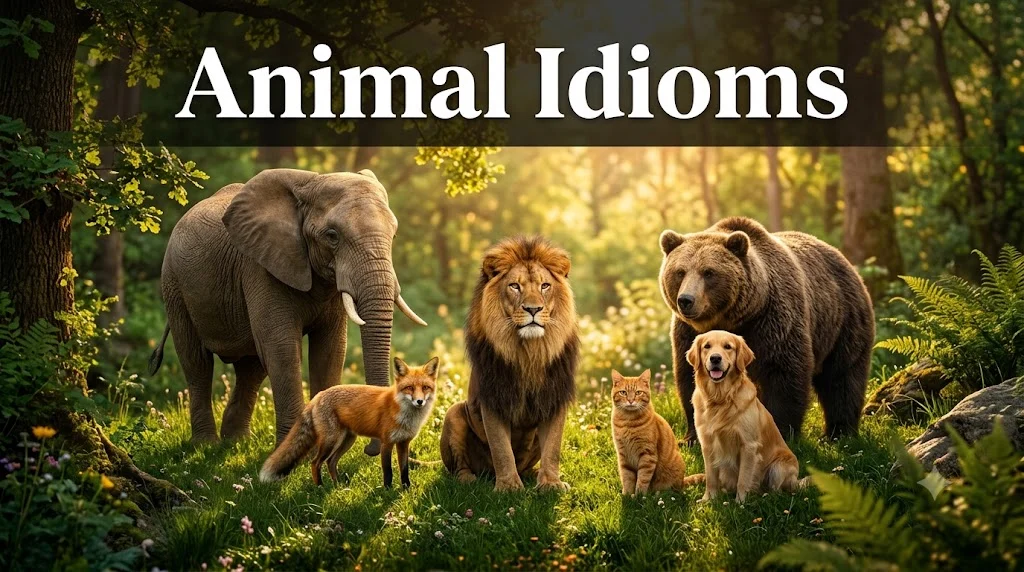
Animal idioms are common English expressions that use animals to describe human behavior, emotions, and situations often in vivid, memorable, and surprisingly accurate ways.Examples: let the cat out of the bag, the elephant in the room, a wolf in sheep’s clothing
Animals have been part of human life since the beginning of time. We farm them, fear them, admire them, and even name our children after them. So it makes perfect sense that when we developed language, animals came with it.
Animal idioms are everywhere in English. You might hear them in a business meeting (“the elephant in the room”), in a family argument (“open a can of worms”), or in casual conversation (“she’s been working like a dog”). These expressions are so woven into everyday speech that native speakers often don’t even notice they’re using them.
But for anyone learning English, or even for native speakers who want to use language more expressively, understanding animal idioms is incredibly valuable. They help you sound more natural, more colorful, and more confident in your communication.
In this guide, you’ll learn:
- The most important animal idioms in English
- What each one actually means in context
- When and how to use them naturally
- Formal, casual, and creative examples for each
- Common mistakes to avoid and tips that actually work
Let’s dive in and explore the wild world of animal idioms.
Quick Summary Table
| Animal | Idiom | Meaning |
|---|---|---|
| Cat | Let the cat out of the bag | Reveal a secret |
| Elephant | Elephant in the room | Obvious but ignored problem |
| Wolf | Wolf in sheep’s clothing | Dangerous person pretending to be kind |
| Dog | Work like a dog | Work extremely hard |
| Fish | Fish out of water | Uncomfortable in a situation |
| Bird | Kill two birds with one stone | Achieve two things at once |
| Horse | Straight from the horse’s mouth | From a reliable source |
| Bee | Busy as a bee | Very active and hardworking |
| Fox | Sly as a fox | Clever and cunning |
| Bear | Bear the brunt | Take the most difficult part |
🐱 Cat Idioms
Cats have been symbols of mystery, independence, and cleverness for centuries. It’s no surprise they appear in some of the most popular English idioms.
1. Let the Cat Out of the Bag
This is one of the most widely used idioms in the English language. It refers to accidentally or deliberately revealing something that was supposed to remain secret.
Meaning: Reveal a secret, usually by accident When People Use It: Surprise parties, confidential news, hidden plans Alternative Expression: Spill the beans
Examples:
- Formal: The assistant let the cat out of the bag before the official announcement was made.
- Casual: You let the cat out of the bag! Now everyone knows about the birthday party.
- Creative: One careless whisper and the cat was already out of the bag, running wild.
2. Curiosity Killed the Cat
This idiom is a cautionary expression, warning someone that being too nosy or inquisitive can lead to trouble or danger.
Meaning: Being too curious can lead to problems When People Use It: Warning someone against prying into other people’s affairs Alternative Expression: Mind your own business
Examples:
- Formal: He was advised to step back, as curiosity killed the cat in such sensitive matters.
- Casual: Stop asking so many questions curiosity killed the cat.
- Creative: She pressed deeper into the mystery until she remembered what curiosity had done to the cat.
3. Cat Nap
A short, light sleep taken during the day. Cats are famous for sleeping in short bursts, which gave birth to this expression.
Meaning: A brief sleep, especially during the day When People Use It: When someone takes a quick rest at work, after lunch, or between tasks Alternative Expression: Short rest, quick snooze
Examples:
- Formal: He took a brief cat nap between his afternoon meetings.
- Casual: I just need a quick cat nap and I’ll be fine.
- Creative: A ten-minute cat nap and she woke up sharper than before.
💡 Usage Insight: Cat idioms often carry themes of secrecy, independence, or quiet observation. Use them when the situation involves something hidden, subtle, or surprising.
🐘 Elephant Idioms
Elephants are known for their size, memory, and undeniable presence. These qualities make them perfect symbols in idioms about things that are impossible to ignore.
4. The Elephant in the Room
This is one of the most powerful idioms in English. It describes a serious, uncomfortable topic or problem that everyone is aware of but no one wants to bring up or discuss.
Meaning: An obvious problem or difficult topic that is being avoided When People Use It: Workplace conflicts, family issues, political discussions Alternative Expression: Unspoken issue
Examples:
- Formal: The budget crisis was the elephant in the room throughout the entire meeting.
- Casual: No one mentioned his resignation it was the elephant in the room.
- Creative: The elephant stood quietly between them, too large to ignore and too uncomfortable to name.
5. Have a Memory Like an Elephant
Elephants are widely believed to have exceptional memory, which makes this idiom a vivid way to describe someone who never forgets anything.
Meaning: Have an excellent, long-lasting memory When People Use It: Complimenting or describing someone with extraordinary recall Alternative Expression: Remember everything
Examples:
- Formal: She has a memory like an elephant she recalled every detail of the case from five years ago.
- Casual: Don’t try to lie to him. He has a memory like an elephant.
- Creative: Years passed, but she remembered every word, every gesture an elephant never forgets, and neither did she.
💡 Memory Tip: Think of elephants as symbols of something too big to ignore or too strong to forget.
🐺 Wolf and Fox Idioms
Wolves and foxes represent cunning, deception, and cleverness in many cultures, making them popular animals in idioms about manipulation and intelligence.
6. A Wolf in Sheep’s Clothing
This classic idiom describes someone who appears to be harmless, friendly, or trustworthy but is actually dangerous, dishonest, or has hidden motives.
Meaning: Someone dangerous disguised as something harmless When People Use It: Betrayals, business scams, toxic relationships Alternative Expression: A hidden threat
Examples:
- Formal: The investor appeared generous but turned out to be a wolf in sheep’s clothing.
- Casual: Watch out for him he’s a wolf in sheep’s clothing.
- Creative: He smiled warmly and offered his hand, the wool of his disguise soft against the sharp edge beneath.
7. Cry Wolf
Based on the old Aesop’s fable, this idiom refers to raising false alarms so often that when a real emergency occurs, no one believes or responds.
Meaning: Give false alarms repeatedly When People Use It: When someone loses credibility due to repeated exaggeration Alternative Expression: Raise a false alarm
Examples:
- Formal: His constant complaints had made him someone who cried wolf, and no one took his warnings seriously anymore.
- Casual: Don’t cry wolf people will stop listening to you.
- Creative: He had cried wolf so many times that when the real storm came, no one looked up.
8. Sly as a Fox
This idiom is used to describe someone who is exceptionally clever, cunning, and smart about getting what they want, often in a sneaky way.
Meaning: Very clever and sneaky When People Use It: Negotiations, strategies, someone who outsmarts others Alternative Expression: Cunning, crafty
Examples:
- Formal: The negotiator was sly as a fox, securing a deal no one expected.
- Casual: She got the promotion without anyone realizing how sly as a fox.
- Creative: His plan moved quietly, like a fox at dusk, and by morning the deal was done.
💡 Usage Insight: Wolf and fox idioms are especially useful in professional or competitive settings where strategy, trust, and deception are themes.
🐦 Bird Idioms
Birds represent freedom, perspective, and observation. Bird idioms often involve efficiency, opportunity, or wisdom.
9. Kill Two Birds with One Stone
One of the most universally recognized idioms in English. It means to accomplish two things with a single action, saving time and effort.
Meaning: Achieve two goals with one effort When People Use It: Multitasking, efficiency, smart planning Alternative Expression: Two for one
Examples:
- Formal: By scheduling the client meeting during the office tour, we killed two birds with one stone.
- Casual: I’ll grab your package on the way to the gym kill two birds with one stone.
- Creative: She combined the meetings and smiled why take two flights when one arrow could reach both targets?
10. A Bird’s Eye View
This idiom describes looking at something from a high position or gaining a broad, comprehensive understanding of a situation.
Meaning: A wide, overall perspective When People Use It: Planning, analysis, strategy Alternative Expression: Big picture view
Examples:
- Formal: The report gave us a bird’s eye view of the entire market situation.
- Casual: Let me give you a bird’s eye view of what happened.
- Creative: From above, the chaos organized itself into patterns only a bird could see.
11. Early Bird Catches the Worm
An encouraging idiom that rewards those who start early, act quickly, or take initiative before others do.
Meaning: Those who act first gain an advantage When People Use It: Motivation, punctuality, seizing opportunities Alternative Expression: First come, first served
Examples:
- Formal: Our sales team adopted an early-bird approach, contacting clients before competitors could.
- Casual: You snooze, you lose the early bird catches the worm.
- Creative: She was always at her desk before sunrise, hunting her goals while others were still dreaming.
🐟 Fish Idioms
Fish idioms often relate to being out of place, making decisions, or the vast ocean of possibilities.
12. Fish Out of Water
This idiom describes someone who is clearly uncomfortable, awkward, or out of place in a particular environment or situation.
Meaning: Someone uncomfortable in an unfamiliar situation When People Use It: New jobs, social events, unfamiliar cultures Alternative Expression: Out of place
Examples:
- Formal: As the only non-technical member on the team, she often felt like a fish out of water.
- Casual: I was a total fish out of water at that party.
- Creative: He sat in the boardroom surrounded by suits, a fish blinking slowly in the dry air.
13. Plenty of Fish in the Sea
A comforting expression, often used after a breakup, meaning that there are many other people or opportunities available.
Meaning: There are many other options or people available When People Use It: Relationships, missed opportunities, rejection Alternative Expression: More options out there
Examples:
- Formal: After the contract fell through, the team was reminded there were plenty of fish in the sea.
- Casual: Don’t worry about him there are plenty of fish in the sea.
- Creative: The ocean was wide and she had only just dipped her toe in so many fish yet unseen.
14. A Red Herring
This idiom describes something that misleads or distracts from the real issue, often used in mystery stories, debates, and problem-solving.
Meaning: A misleading clue or distraction When People Use It: Arguments, investigations, debates Alternative Expression: False lead, distraction
Examples:
- Formal: The audit revealed that the initial complaint had been a red herring.
- Casual: That whole argument was just a red herring to change the subject.
- Creative: The clue gleamed like bait in shallow water, a red herring designed to pull her off course.
🐝 Bee and Insect Idioms
Bees and insects bring energy, hard work, and social life into the world of idioms.
15. Busy as a Bee
Used to describe someone who is extremely active, hardworking, and constantly occupied with tasks.
Meaning: Very busy and hardworking When People Use It: Admiring someone’s productivity Alternative Expression: Always working, nonstop
Examples:
- Formal: The entire department has been as busy as a bee preparing for the annual conference.
- Casual: She’s been busy as a bee getting everything ready for the wedding.
- Creative: She moved from task to task without pause, wings invisible but always humming.
16. Have a Bee in Your Bonnet
This idiom means to be obsessed or constantly preoccupied with an idea or concern, often in an annoying or excessive way.
Meaning: Be obsessed or fixated on something When People Use It: When someone can’t stop talking about one topic Alternative Expression: Can’t let it go
Examples:
- Formal: He clearly had a bee in his bonnet about the proposed policy changes.
- Casual: She’s had a bee in her bonnet about redecorating the house for weeks.
- Creative: The idea had gotten in and wouldn’t fly free no matter how hard she shook her thoughts.
🐴 Horse Idioms
Horses represent power, loyalty, and directness. Horse idioms are often used in the context of truth, work ethic, and determination.
17. Straight from the Horse’s Mouth
This idiom means getting information directly from the most reliable, firsthand source the person who was there or directly involved.
Meaning: Information from a direct and trustworthy source When People Use It: Confirming reliable news, avoiding rumors Alternative Expression: Firsthand account
Examples:
- Formal: I got the news straight from the horse’s mouth the CEO confirmed the merger.
- Casual: Don’t trust the rumors. I heard it straight from the horse’s mouth.
- Creative: No second-guessing, no filtering the truth had walked up and spoken clearly.
18. Hold Your Horses
A very common expression used to tell someone to slow down, be patient, or wait before acting too quickly.
Meaning: Wait, slow down, be patient When People Use It: When someone is rushing or acting impulsively Alternative Expression: Slow down, wait a moment
Examples:
- Formal: Before we move forward with the proposal, let’s hold our horses and review the data.
- Casual: Hold your horses we haven’t even heard the full plan yet.
- Creative: The future was right there, but wisdom reached out and gently pulled back the reins.
19. Dark Horse
This idiom refers to a person or competitor who is not well known but unexpectedly performs very well or succeeds when no one saw it coming.
Meaning: An unexpected or unknown competitor who succeeds When People Use It: Competitions, elections, business, sports Alternative Expression: Surprise contender
Examples:
- Formal: The young startup emerged as a dark horse in the technology sector.
- Casual: Nobody expected her to win she was a total dark horse.
- Creative: She entered quietly, unannounced, and left with the trophy in hand.
🐻 Bear and Big Animal Idioms
Bears and larger animals convey strength, resilience, and serious challenges.
20. Bear the Brunt
This idiom means to endure the worst or hardest part of a difficult situation, often while protecting others from the impact.
Meaning: Suffer the most or hardest part When People Use It: Describing who suffered most from a difficult event Alternative Expression: Take the hit
Examples:
- Formal: The coastal communities bore the brunt of the economic downturn.
- Casual: She bore the brunt of his bad mood all morning.
- Creative: She stood at the front and let the storm crash into her, protecting everyone behind.
21. Bull in a China Shop
A vivid idiom describing someone who acts recklessly, roughly, or without care in a delicate situation, causing damage through thoughtlessness.
Meaning: Clumsy or reckless in a delicate situation When People Use It: Describing poor social behavior or lack of sensitivity Alternative Expression: Reckless, tactless
Examples:
- Formal: His approach to the negotiation was like a bull in a china shop aggressive and damaging.
- Casual: Don’t bring him to the meeting he’s a bull in a china shop.
- Creative: He entered the conversation with force, every sentence toppling something fragile.
🐍 Snake and Reptile Idioms
Snakes carry themes of deception and hidden danger, making them perfect for idioms about dishonesty and betrayal.
22. Snake in the Grass
This idiom describes someone who is secretly untrustworthy or deceitful, appearing harmless on the surface but hiding dangerous intentions.
Meaning: A hidden traitor or dishonest person When People Use It: Betrayal, backstabbing, untrustworthy colleagues Alternative Expression: Two-faced, backstabber
Examples:
- Formal: It was revealed too late that one of the partners had been a snake in the grass.
- Casual: Be careful with that guy he’s a total snake in the grass.
- Creative: He smiled with the warmth of a trusted friend while waiting patiently in the green.
🐑 Sheep and Farm Animal Idioms
Farm animals are used in idioms that touch on conformity, behavior, and social dynamics.
23. Black Sheep
This widely used idiom describes someone who is considered different, problematic, or an outsider within a group, family, or community.
Meaning: The odd one out, often seen negatively When People Use It: Describing someone who doesn’t fit in or causes embarrassment Alternative Expression: Outcast, odd one out
Examples:
- Formal: He was considered the black sheep of the department due to his unconventional methods.
- Casual: Every family has a black sheep mine just happens to be my uncle.
- Creative: She wore her differences proudly, the only black fleece in a field of white.
24. Follow the Herd
This idiom is used to describe someone who blindly does what everyone else is doing without thinking independently.
Meaning: Follow the majority without independent thought When People Use It: Conformity, peer pressure, trends Alternative Expression: Go with the flow, follow the crowd
Examples:
- Formal: Investors who simply follow the herd rarely outperform the market.
- Casual: Don’t just follow the herd decide what you actually want.
- Creative: She stopped at the edge of the field and watched the others move, then turned and walked the other way.
25. Separate the Sheep from the Goats
This idiom means to distinguish between the good and the bad, the competent and the incompetent, or the worthy and the unworthy.
Meaning: Distinguish the good from the bad When People Use It: Evaluations, judgments, competitive scenarios Alternative Expression: Sort the wheat from the chaff
Examples:
- Formal: The final exam will separate the sheep from the goats in terms of preparation.
- Casual: The real test will separate the sheep from the goats.
- Creative: The challenge arrived, and in its wake, the field was never quite as crowded.
🎯 How to Use Animal Idioms Naturally
Using animal idioms well is about more than memorizing their meanings. It’s about knowing when they belong, how they land, and what tone they carry.
✔ Match the Animal to the Situation
Every animal carries symbolic weight. Cats suggest mystery or independence. Dogs suggest loyalty or hard work. Wolves suggest deception. Matching the animal energy to your context makes the idiom feel natural rather than forced.
For trust and reliability → straight from the horse’s mouth For deception → wolf in sheep’s clothing, snake in the grass For hard work → busy as a bee, work like a dog For ignoring something obvious → elephant in the room
💡 Insight: When the idiom’s animal matches the emotional tone of the situation, the expression lands far more powerfully.
✔ Keep Tone in Mind
Animal idioms range from playful to serious. “Busy as a bee” is light and friendly. “Snake in the grass” carries real weight and warning. Matching tone to context is essential.
In formal writing or professional settings, stick with idioms that feel grounded: “bear the brunt,” “straight from the horse’s mouth,” or “dark horse” work well without sounding too casual.
In casual conversations, feel free to be more expressive and colorful: “You let the cat out of the bag!” or “He’s such a bull in a china shop” land naturally with friends or family.
✔ Use Sparingly
One animal idiom per conversation is usually enough. If you stack multiple idioms back-to-back, speech starts to feel unnatural and performative.
Instead of: “She’s a dark horse who’s busy as a bee and never follows the herd.” Try: “She’s a real dark horse completely unexpected and impossible to put in a box.”
One idiom. Strong placement. Real impact.
⚠️ Common Mistakes to Avoid
Even fluent speakers misuse idioms. Here are the most common pitfalls:
❌ Mixing animal idioms with unrelated contexts Saying “elephant in the room” when describing personal productivity makes no sense. The idiom belongs to group dynamics or avoided conversations.
❌ Changing the animal Idioms are fixed expressions. You cannot say “cat in sheep’s clothing” the wolf is non-negotiable. Changing the animal breaks the idiom entirely.
❌ Using them too formally or too casually “The stakeholders were running around like headless chickens” might work in casual business conversation but would sound strange in a formal report. Read the room.
❌ Overusing the same idiom If you use “the elephant in the room” three times in one conversation, it loses its punch. Vary your language.
🚀 Practice Method
The best way to master animal idioms isn’t to memorize a list it’s to use them in real life as quickly as possible.
1. Learn Three Animal Idioms Weekly
Don’t overwhelm yourself. Pick three idioms, understand their tone and context, and focus on those for the week.
2. Connect Each Idiom to a Real Situation
Think of a moment in your own life where the idiom would have fit.
“I was a fish out of water at my first networking event.” “My coworker is always crying wolf about deadlines.”
Connecting idioms to real memories makes them stick.
3. Write One Expressive Sentence for Each
Go beyond the basic example. Make it vivid:
“The pitch meeting was going well until he walked in like a bull in a china shop and questioned everything on the first slide.”
The more specific and visual your sentence, the faster the idiom enters your natural vocabulary.
4. Listen and Notice
Watch English movies, podcasts, or TV shows and listen for animal idioms in the wild. When you hear one, pause and consider the context. This is the fastest way to understand how native speakers actually use them.
FAQs
1. What are animal idioms?
Animal idioms are expressions that use animals to describe human behavior, emotions, or situations. They are common in everyday English speech and writing.
2. Are animal idioms formal or informal?
Most animal idioms are semi-formal to informal. Some, like “straight from the horse’s mouth” or “bear the brunt,” work in professional settings. Others, like “busy as a bee” or “cat nap,” are more casual.
3. Can I use animal idioms in writing?
Yes, in creative, journalistic, or informal writing they are excellent tools. For academic or formal reports, use them sparingly and only when the tone allows it.
4. How do I remember animal idioms?
Connect each idiom to the animal’s natural personality or behavior. Cats are mysterious, so cat idioms often involve secrecy. Elephants are unforgettable, so elephant idioms involve memory or unavoidable presence.
5. Are animal idioms used globally or only in English?
Many languages have their own animal idioms. The ones in this guide are standard in American and British English and are widely understood around the world.
Conclusion
Animal idioms are one of the most vivid, memorable, and expressive tools in the English language. Whether you’re calling out the elephant in the room, warning someone about a wolf in sheep’s clothing, or admitting you felt like a fish out of water these expressions give your language texture, color, and life.
The key is simple: learn the meaning, understand the tone, and use each idiom in a moment where it truly belongs. When you match the right animal idiom to the right situation, your language stops sounding like a textbook and starts sounding like a conversation.
Practice consistently, connect idioms to real moments, and let the animal kingdom enrich every word you say.
Read More Related Articles:
- Idioms for Hope | Expressing Optimism, Faith & Positive Belief In 2026
- Idioms for Dreams | Expressing Ambitions, Fantasies & Sleeping Visions In 2026
- Idioms for Patience | Expressing Calm, Endurance & Resilience In 2026

Urban Hunter is an American writer at IdiomCrafter.com, with a keen interest in how language shapes everyday conversations. She enjoys turning common expressions into engaging and easy-to-follow reads. Outside of writing, she spends time exploring new words and their hidden meanings.