Quick Answer
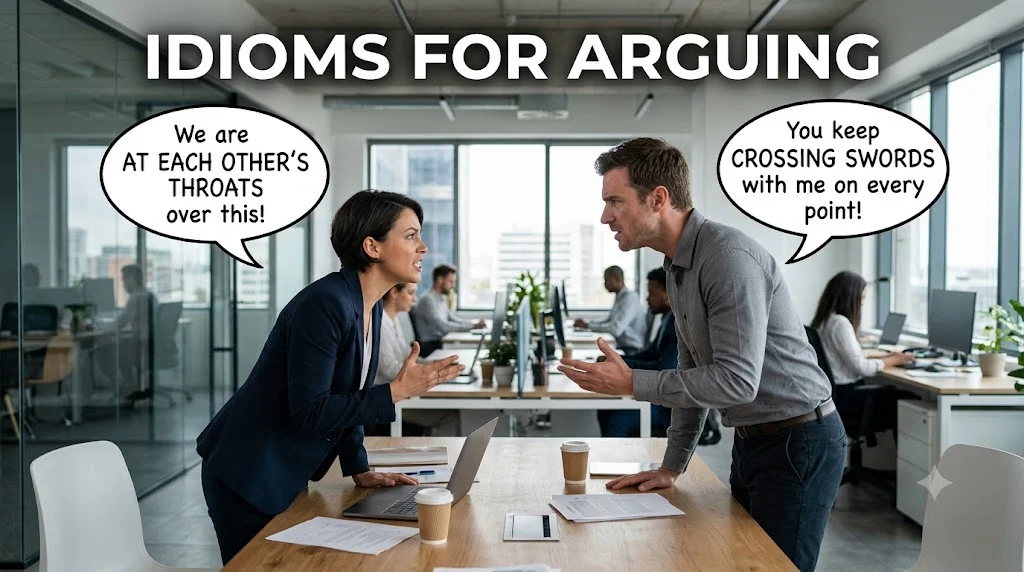
Idioms for arguing help you express disagreements, debates, conflicts, and heated discussions more naturally in English. Popular expressions like go head to head, at each other’s throats, and see eye to eye make your conversations and writing sound more fluent, expressive, and authentic.
We all experience disagreements. Whether it’s a minor difference of opinion with a friend, a heated debate at work, or a full-blown family feud, conflict is an inevitable part of human interaction. But how often do we find ourselves repeating the same boring phrases like “we had a fight” or “they were arguing”?
This is where idioms for arguing come to the rescue. These colorful expressions transform mundane descriptions of conflict into vivid, engaging language that instantly conveys the intensity, emotion, and nature of a disagreement. Instead of simply saying “they argued,” you can say “they were at each other’s throats” or “sparks were flying” and suddenly, your listener can picture exactly what happened .
English offers a rich vocabulary of idioms for every type of argument, from minor disagreements to intense confrontations. These expressions bring emotion, tone, and personality into your speech, making you sound more fluent and natural .
In this comprehensive guide, you’ll learn:
- Powerful idioms for every stage of an argument
- Real meanings with clear examples
- Formal, casual, and creative usage
- Metaphors and similes that make language come alive
- Practical tips for natural usage
Let’s explore the most expressive idioms that will transform how you talk about disagreements in 2026.
Quick Summary Table
| Situation | Idioms |
|---|---|
| Starting an argument | Pick a fight, Stir the pot, Throw down the gauntlet |
| Intense conflict | At each other’s throats, Lock horns, Cross swords |
| Minor disagreements | Split hairs, Have a bone to pick, Tread on toes |
| Trying to stay calm | Bite your tongue, Keep your cool, Take the high road |
| Escalating arguments | Add fuel to the fire, Hit the roof, Blow up |
| Ending an argument | Agree to disagree, Call it quits, Throw in the towel |
| Strong emotional reactions | Give someone a piece of your mind, Lose it, Blow off steam |
🤬 Idioms for Starting an Argument
Sometimes arguments don’t just happen someone deliberately provokes them. These idioms describe the act of initiating conflict.
1. Pick a Fight
This idiom describes someone who deliberately tries to start an argument for no good reason.
Meaning: To deliberately provoke or start a quarrel with someone
When People Use It: Describing someone who seems to enjoy conflict
Alternative Expression: Start trouble
Examples:
- Formal: He seemed determined to pick a fight with every colleague who disagreed with him.
- Casual: Why are you always trying to pick a fight with me?
- Creative: His words were carefully chosen to pick a fight, each syllable a tiny grenade.
2. Stir the Pot
This colorful expression describes someone who deliberately causes trouble or makes a situation more complicated.
Meaning: To cause trouble or provoke an argument
When People Use It: When someone brings up sensitive topics or old grievances
Alternative Expression: Cause drama
Examples:
- Formal: She stirred the pot by bringing up the budget cuts at the family dinner .
- Casual: Don’t stir the pot we just made peace!
- Creative: He stirred the pot with every comment, watching the tension bubble and rise .
3. Throw Down the Gauntlet
This formal idiom has historical origins and means to issue a challenge or invitation to argue .
Meaning: To challenge someone to an argument or competition
When People Use It: Formal debates, political discussions
Alternative Expression: Issue a challenge
Examples:
- Formal: The opposition leader threw down the gauntlet during the parliamentary debate.
- Casual: She threw down the gauntlet with that comment about my cooking.
- Creative: His accusation lay on the table like a gauntlet, daring anyone to pick it up.
4. Put the Cat Among the Pigeons
This British idiom describes doing or saying something that causes trouble and makes people angry or worried .
Meaning: To cause trouble or start an argument by saying something unexpected
When People Use It: When a controversial topic is introduced
Alternative Expression: Rock the boat
Examples:
- Formal: His comment about the merger really put the cat among the pigeons .
- Casual: You really put the cat among the pigeons when you mentioned the layoffs.
- Creative: The suggestion hung in the air, a cat let loose among the pigeons of their fragile peace.
5. Have a Bone to Pick
This idiom is used when someone wants to discuss or complain about something that’s been bothering them .
Meaning: To have an issue to discuss or a complaint to make
When People Use It: When approaching someone about a specific grievance
Alternative Expression: Have a problem with
Examples:
- Formal: I have a bone to pick with you regarding the project timeline.
- Casual: Hey, I have a bone to pick with you why didn’t you put gas in my car?
- Creative: The unresolved issue was a bone she’d been carrying, waiting for the right moment to pick it clean.
💡 Usage Insight: These idioms are useful when you want to describe the instigation of a disagreement. They signal that conflict is either brewing or about to explode.
⚔️ Idioms for Intense Conflict
When arguments escalate, they become more than just disagreements they become battles. These idioms describe intense, angry, and often dramatic conflicts.
6. At Each Other’s Throats
This vivid idiom paints a picture of people fighting with such intensity that they seem ready to harm each other .
Meaning: Fighting or arguing in a very angry way
When People Use It: Describing family feuds, workplace conflicts
Alternative Expression: Constantly fighting
Examples:
- Formal: The board members were at each other’s throats over the proposed restructuring .
- Casual: Tom and Ben were at each other’s throats the whole time.
- Creative: Their relationship had devolved into a cycle of accusations, constantly at each other’s throats like cornered animals .
7. Lock Horns
This idiom draws an image of two animals fighting with their horns locked together, representing a stubborn, fierce disagreement .
Meaning: To argue or fight with someone, especially in a stubborn way
When People Use It: When both sides are equally determined to win
Alternative Expression: Butt heads
Examples:
- Formal: The two managers locked horns over the new strategy .
- Casual: My friends locked horns over which game to play .
- Creative: They locked horns like two bulls in a field, neither willing to yield an inch .
8. Cross Swords
This formal idiom describes people engaging in a verbal argument, often with skill and intensity .
Meaning: To argue or have a disagreement with someone
When People Use It: Formal debates, political discussions
Alternative Expression: Engage in a dispute
Examples:
- Formal: The two professors crossed swords over the interpretation of the data.
- Casual: They crossed swords when discussing who should lead the project .
- Creative: Their debate was a crossing of swords, each argument parried and thrust with precision.
9. Sparks Fly
When arguments become intense and emotional, there can be a palpable energy in the air this is where “sparks fly” comes in .
Meaning: When people argue with strong emotion and intensity
When People Use It: Dramatic confrontations
Alternative Expression: Heated exchange
Examples:
- Formal: Sparks flew between the manager and the journalist during the press conference .
- Casual: The sparks were really flying at the family dinner last night.
- Creative: With every accusation, sparks flew across the table, igniting the tension in the room.
10. Fight Like Cats and Dogs
This idiom describes people who constantly argue and can’t seem to get along .
Meaning: To argue or fight frequently and intensely
When People Use It: Describing siblings, roommates, or colleagues who clash constantly
Alternative Expression: Constant bickering
Examples:
- Formal: The two department heads fight like cats and dogs over budget allocation.
- Casual: My cousins fight like cats and dogs every time they visit .
- Creative: They lived under the same roof, but they fought like cats and dogs, each day a new battleground.
11. Go Head to Head
This idiom describes a direct confrontation or competition .
Meaning: To argue or compete directly with someone
When People Use It: Debates, competitions, direct confrontations
Alternative Expression: Face off
Examples:
- Formal: The two candidates went head to head during the debate .
- Casual: They went head to head about which movie was the best.
- Creative: Their opinions collided head to head, leaving no room for compromise.
12. Have a Shouting Match
When arguments get loud and no one is listening, you have a shouting match.
Meaning: A noisy argument where people yell at each other
When People Use It: Loud, public arguments where both sides are shouting
Alternative Expression: Screaming match
Examples:
- Formal: The debate soon degenerated into a shouting match .
- Casual: They had a shouting match over the last donut .
- Creative: The discussion dissolved into a shouting match, voices competing for dominance.
💡 Memory Tip: These idioms all convey high intensity. The more violent the imagery (throats, horns, swords), the more severe the conflict.
🔥 Idioms for Escalating Arguments
Arguments rarely stay calm. These idioms describe how conflicts intensify, becoming more heated and emotional.
13. Add Fuel to the Fire
This idiom describes actions or words that make an already bad situation worse .
Meaning: To make a bad argument or situation worse
When People Use It: When someone says something that escalates the conflict
Alternative Expression: Make things worse
Examples:
- Formal: His inflammatory comments only added fuel to the fire.
- Casual: Laughing just added fuel to the fire .
- Creative: She threw her words into the blaze, adding fuel to the fire until it consumed them both.
14. Hit the Roof
This idiom describes someone who becomes extremely angry, often suddenly .
Meaning: To become extremely angry
When People Use It: Unexpected angry reactions
Alternative Expression: Lose your temper
Examples:
- Formal: The CEO hit the roof when he saw the quarterly results.
- Casual: Dad hit the roof when I broke his favorite mug .
- Creative: When she saw the damage, she hit the roof, her fury cascading through the house.
15. Blow Up
A sudden, explosive release of anger .
Meaning: To become suddenly and violently angry
When People Use It: When someone loses their temper dramatically
Alternative Expression: Explode
Examples:
- Formal: She blew up at the meeting when her proposal was rejected .
- Casual: Dad blew up at me when I broke the lamp .
- Creative: The pressure had been building for weeks, and when she finally blew up, the release was explosive.
16. Blow Up at Someone
A variation of “blow up,” specifically directed at a person.
Meaning: To get very angry at someone suddenly
When People Use It: Describing sudden, targeted anger
Alternative Expression: Yell at
Examples:
- Formal: The manager blew up at the team for missing the deadline.
- Casual: She blew up at her friend after being ignored .
- Creative: He blew up at her in front of everyone, his anger a public spectacle.
17. The Gloves Are Off
This idiom comes from boxing, where removing gloves signals a serious, no-holds-barred fight .
Meaning: When people stop being polite and start arguing seriously
When People Use It: When a conflict becomes more serious and personal
Alternative Expression: No holding back
Examples:
- Formal: When the debate started, the gloves were off .
- Casual: The gloves were off once he mentioned her ex-boyfriend.
- Creative: The negotiation had been civil until the gloves came off and the real battle began.
18. Fight Fire with Fire
This idiom describes responding to aggression with equal or greater force .
Meaning: To respond to an argument with an even stronger argument
When People Use It: When someone fights back using similar tactics
Alternative Expression: Match aggression
Examples:
- Formal: The company decided to fight fire with fire by releasing a competitive product.
- Casual: She fought fire with fire by yelling back at her brother .
- Creative: They met his anger with equal fury, fighting fire with fire.
💡 Usage Insight: These idioms are perfect for describing moments when conflicts intensify. They convey a sense of escalation that “got angry” simply cannot capture.
😤 Idioms for Annoyance & Frustration
Not all arguments are explosive confrontations. Sometimes, they’re about simmering annoyance and persistent frustration.
19. Get Under Someone’s Skin
This idiom describes actions or behaviors that cause persistent irritation .
Meaning: To annoy or irritate someone
When People Use It: Describing ongoing minor annoyances
Alternative Expression: Irritate
Examples:
- Formal: His constant interruptions really got under her skin.
- Casual: His loud talking really got under my skin during class .
- Creative: The repetitive complaint was a splinter under his skin, impossible to ignore.
20. Rub Someone the Wrong Way
Similar to “get under someone’s skin,” this idiom describes actions that cause irritation .
Meaning: To annoy or bother someone
When People Use It: When someone’s behavior is irritating
Alternative Expression: Bother
Examples:
- Formal: His arrogant attitude rubs many colleagues the wrong way.
- Casual: His loud talking rubs me the wrong way .
- Creative: His voice rubbed her the wrong way like sandpaper on raw skin.
21. Get on Someone’s Nerves
A straightforward idiom for describing consistent irritation .
Meaning: To annoy someone repeatedly
When People Use It: Daily annoyances
Alternative Expression: Annoy
Examples:
- Formal: The behavior got on her nerves during the meeting.
- Casual: You’re getting on my nerves .
- Creative: The clock’s ticking got on his nerves, each second a needle pricking his patience.
22. Push Someone’s Buttons
This idiom describes deliberately provoking someone by saying or doing things you know will irritate them .
Meaning: To provoke or annoy someone intentionally
When People Use It: Deliberate provocation
Alternative Expression: Provoke
Examples:
- Formal: The opposition candidate knew exactly how to push the prime minister’s buttons.
- Casual: My sister always pushes my buttons when I’m trying to read .
- Creative: He pressed each button with surgical precision, watching her composure crumble.
23. Ruffle Feathers
A gentler idiom for causing irritation or offense .
Meaning: To upset or annoy someone
When People Use It: Minor offenses
Alternative Expression: Offend
Examples:
- Formal: His comments about the new policy ruffled quite a few feathers.
- Casual: She didn’t mean to ruffle feathers with her joke .
- Creative: The suggestion ruffled feathers like a breeze disturbing a roost.
💡 Memory Tip: These idioms all describe varying degrees of irritation. The imagery ranges from gentle (ruffling feathers) to more intense (getting under skin).
🧊 Idioms for Staying Calm During Arguments
Sometimes, the most challenging part of an argument is maintaining your composure. These idioms describe efforts to stay calm.
24. Bite Your Tongue
This idiom describes the effort of stopping yourself from saying something that could cause or worsen an argument .
Meaning: To stop yourself from saying something that could cause an argument
When People Use It: When you want to speak but know you shouldn’t
Alternative Expression: Hold back
Examples:
- Formal: I wanted to argue, but I had to bite my tongue and keep quiet .
- Casual: I had to bite my tongue when he criticized my cooking.
- Creative: The words were waiting on his tongue, but he bit them back, swallowing the argument whole.
25. Keep Your Cool
This idiom describes maintaining emotional control during a conflict .
Meaning: To stay calm even when someone is arguing with you
When People Use It: During heated moments
Alternative Expression: Stay calm
Examples:
- Formal: I tried to keep my cool when my colleague blamed me for the mistake .
- Casual: He kept his cool even though his sister was yelling.
- Creative: The air was thick with accusations, but she kept her cool, a calm center in the storm.
26. Take the High Road
This idiom describes choosing to act in a calm, respectful way rather than engaging in an argument .
Meaning: To choose a morally superior path by avoiding conflict
When People Use It: When someone refrains from retaliating
Alternative Expression: Be the bigger person
Examples:
- Formal: Even when provoked, he took the high road and didn’t argue .
- Casual: I decided to take the high road and not respond to his insult.
- Creative: She could have fought back, but she chose the high road, leaving him alone with his bitterness.
27. Agree to Disagree
A classic idiom for ending an argument by accepting that you won’t change each other’s minds .
Meaning: To accept that both sides won’t agree and stop arguing
When People Use It: To end unproductive disagreements
Alternative Expression: End the discussion
Examples:
- Formal: After a long discussion, we agreed to disagree on the best approach .
- Casual: We agreed to disagree on which pizza topping was best.
- Creative: They stood on opposite shores of the argument and finally agreed to disagree, accepting the water between them.
28. Keep a Stiff Upper Lip
A British idiom describing emotional control, especially during difficult moments.
Meaning: To stay calm and not show your emotions
When People Use It: When someone is facing conflict without showing distress
Alternative Expression: Stay composed
Examples:
- Formal: Despite the criticism, she kept a stiff upper lip.
- Casual: He kept a stiff upper lip even when they were arguing.
- Creative: The accusations rained down, but he maintained a stiff upper lip, refusing to give them the reaction they wanted.
💡 Usage Insight: These idioms are useful for describing emotional resilience during conflicts. They show strength rather than aggression.
🏳️ Idioms for Ending Arguments
All arguments eventually end. These idioms describe the various ways conflicts can be resolved or abandoned.
29. Call It Quits
This idiom describes deciding to stop arguing .
Meaning: To end an argument because it’s not going anywhere
When People Use It: When the argument becomes pointless
Alternative Expression: Give up
Examples:
- Formal: After 30 minutes of arguing, we called it quits .
- Casual: We called it quits after arguing for an hour.
- Creative: Words had failed them, so they called it quits, leaving the argument unfinished.
30. Throw in the Towel
This idiom comes from boxing, where throwing in the towel signals surrender .
Meaning: To stop arguing because you feel it’s pointless
When People Use It: When someone gives up the fight
Alternative Expression: Surrender
Examples:
- Formal: After hours of arguing, he threw in the towel and said he was done .
- Casual: She threw in the towel when the discussion wasn’t going anywhere.
- Creative: Exhausted and defeated, he finally threw in the towel, the argument slipping away from his grasp.
31. Let Sleeping Dogs Lie
This idiom advises against bringing up old arguments or problems .
Meaning: To avoid disturbing a situation that’s currently peaceful
When People Use It: When someone is tempted to revisit an old conflict
Alternative Expression: Don’t stir up old trouble
Examples:
- Formal: It’s best to let sleeping dogs lie and not bring up that old disagreement .
- Casual: I wanted to bring up the issue again, but I decided to let sleeping dogs lie.
- Creative: The old argument lay buried between them, and they both agreed to let sleeping dogs lie.
32. Hold Out an Olive Branch
This idiom describes making a gesture of peace or reconciliation .
Meaning: To do something to show you want to end a disagreement
When People Use It: After a conflict, when someone tries to make peace
Alternative Expression: Make peace
Examples:
- Formal: The prime minister held out an olive branch to the opposition .
- Casual: I tried to hold out an olive branch by apologizing.
- Creative: The offer hung between them like an olive branch, fragile but full of possibility.
33. Clear the Air
This idiom describes having a conversation to resolve tension or misunderstanding .
Meaning: To improve a tense situation by talking about it
When People Use It: After conflicts or misunderstandings
Alternative Expression: Resolve differences
Examples:
- Formal: We had a meeting to clear the air after last week’s difficulties .
- Casual: We talked for a while to clear the air.
- Creative: The truth finally spilled out, clearing the air like a storm leaving behind calm.
34. A Bone of Contention
This idiom describes the specific issue that people are arguing about .
Meaning: A topic or issue that causes ongoing disagreement
When People Use It: When identifying the source of conflict
Alternative Expression: Source of conflict
Examples:
- Formal: The budget has become a real bone of contention between us .
- Casual: The main bone of contention between them was who should do the dishes.
- Creative: The unresolved issue lay between them like a bone of contention, always present, never settled.
💡 Memory Tip: These idioms all describe different outcomes of arguments from giving up to making peace. The key is matching the idiom to the situation.
🗣️ Idioms for Speaking During Arguments
How people speak during arguments matters as much as what they say. These idioms describe argumentative speech patterns.
35. Give Someone a Piece of Your Mind
This idiom describes speaking your mind, often angrily .
Meaning: To tell someone exactly what you think, especially when you’re angry
When People Use It: When someone lets out their frustration verbally
Alternative Expression: Tell off
Examples:
- Formal: The customer gave the manager a piece of his mind about the poor service.
- Casual: Mom gave me a piece of her mind when I didn’t do my chores .
- Creative: She’d held back for too long, and now she gave him a piece of her mind, every word sharp and true.
36. Raise Your Voice
A straightforward idiom for speaking loudly in anger .
Meaning: To speak loudly because you are angry
When People Use It: During emotional arguments
Alternative Expression: Shout
Examples:
- Formal: The speaker raised his voice to be heard over the audience’s objections.
- Casual: Mom raised her voice when we didn’t clean up .
- Creative: Her voice rose like a tide of anger, filling the room.
37. Bite Someone’s Head Off
This vivid idiom describes reacting with sudden, sharp anger .
Meaning: To respond very angrily, especially to a minor question or comment
When People Use It: When someone overreacts
Alternative Expression: Snap at
Examples:
- Formal: He bit my head off just for asking a simple question .
- Casual: Don’t bite her head off she didn’t know .
- Creative: Her response was a bite to the head, untamed and undeserved.
38. Have Words
A restrained way of saying people argued .
Meaning: To argue or speak angrily with someone
When People Use It: Polite or indirect references to arguments
Alternative Expression: Exchange words
Examples:
- Formal: We had words this morning over her refusal to cooperate .
- Casual: Dad and the neighbor had words about the fence .
- Creative: Words were had, sharp and final, after the meeting.
39. Bark at Someone
A dismissive idiom for speaking harshly .
Meaning: To speak in an angry or harsh tone
When People Use It: When someone is treated rudely
Alternative Expression: Snap at
Examples:
- Formal: The supervisor barked at the intern for the mistake.
- Casual: My brother barked at me when I asked to borrow his game .
- Creative: His commands were barks, sharp and dismissive.
40. Under Your Breath
This idiom describes muttering complaints or criticism quietly .
Meaning: To say something quietly, often complaining or criticizing
When People Use It: Passive-aggressive comments
Alternative Expression: Mumble
Examples:
- Formal: I heard him mutter something under his breath.
- Casual: She criticized him under her breath during the whole meeting.
- Creative: The complaints slipped out under his breath, barely audible but full of venom.
💡 Usage Insight: These idioms add specificity to how people speak during arguments. They help paint a complete picture of the conflict.
🌊 Metaphors for Arguing
Metaphors take the description of arguments to another level. They compare arguments to other things, making the description more vivid and powerful .
41. A War of Words
One of the most common metaphors, this describes arguments as verbal battles .
Meaning: An argument characterized by strong, aggressive language
When People Use It: Intense verbal conflicts
Alternative Expression: Verbal battle
Examples:
- Formal: The two politicians engaged in a war of words during the debate .
- Casual: Their argument was a war of words, both of them unwilling to admit defeat .
- Creative: The war of words raged across the table, each sentence a bullet aimed at the other side.
42. A Tug-of-War
This metaphor describes arguments where both sides pull in opposite directions .
Meaning: A back-and-forth argument where no one is willing to give in
When People Use It: Arguments where both sides are equally matched
Alternative Expression: Stalemate
Examples:
- Formal: The negotiation felt like a tug-of-war .
- Casual: The discussion was a tug-of-war, each person pulling for their point of view .
- Creative: Their argument stretched between them like a rope, each side pulling for victory.
43. A Battlefield
This metaphor describes arguments as combat zones .
Meaning: A conflict where both sides are fighting for victory
When People Use It: Intense, emotionally charged arguments
Alternative Expression: War zone
Examples:
- Formal: The meeting room turned into a battlefield of competing ideas.
- Casual: The kitchen became a battlefield over what to eat .
- Creative: The living room lay like a battlefield, strewn with the casualties of their argument.
44. A Volcano
This metaphor describes arguments that build up pressure and then explode .
Meaning: An argument that has built up with emotion and then explodes
When People Use It: Arguments with explosive anger
Alternative Expression: Pressure cooker
Examples:
- Formal: His anger was like a volcano waiting to erupt .
- Casual: Their anger bubbled up like a volcano .
- Creative: The argument had been dormant too long, and now it erupted like a volcano, lava-hot and destructive.
45. A Chess Match
This metaphor describes strategic arguments where each side thinks carefully before speaking .
Meaning: A well-thought-out, strategic argument
When People Use It: Debates or intellectual disagreements
Alternative Expression: Strategic discussion
Examples:
- Formal: Their conversation was a chess match of words .
- Casual: Their talk was like a chess match each word was part of a plan .
- Creative: They faced each other across the table, the argument a chess match where every move mattered.
46. A Storm
This metaphor describes arguments that are loud and chaotic .
Meaning: An argument full of strong emotions and noise
When People Use It: Intense, emotional conflicts
Alternative Expression: Tempest
Examples:
- Formal: The disagreement felt like a storm brewing .
- Casual: The classroom turned into a storm when they couldn’t agree .
- Creative: The argument blew through the room like a storm, leaving destruction in its wake.
💡 Memory Tip: Metaphors make arguments more vivid by comparing them to familiar, concrete things. The more dramatic the comparison, the more intense the argument.
🎯 Similes for Arguing
Similes compare arguments to other things using “like” or “as,” making descriptions more vivid and relatable .
47. Argue Like Cats and Dogs
One of the most common similes for constant conflict .
Meaning: To argue frequently and loudly
When People Use It: Describing people who are always fighting
Alternative Expression: Constant conflict
Examples:
- Formal: The siblings argued like cats and dogs over every issue .
- Casual: My brothers argued like cats and dogs over the remote.
- Creative: They fought like cats and dogs, each day a new territorial dispute.
48. Argue Like Thunder and Lightning
This simile describes loud, frightening arguments .
Meaning: To argue in a loud and intimidating way
When People Use It: Dramatic confrontations
Alternative Expression: Explosive
Examples:
- Formal: Their argument was like thunder and lightning, impossible to ignore .
- Casual: Dad and Uncle Joe argued like thunder and lightning during the game.
- Creative: Their voices clashed like thunder and lightning, each syllable a bolt of anger.
49. Argue Like Two Roosters
This simile describes arguments where both sides are trying to establish dominance .
Meaning: To argue in a competitive, showy way
When People Use It: Arguments where ego is involved
Alternative Expression: Dominance display
Examples:
- Formal: The two executives argued like roosters in a yard .
- Casual: Those boys argued like two roosters in a yard.
- Creative:* Their argument was a rooster fight, each trying to crow louder than the other.
50. Argue Like a Broken Record
This simile describes arguments where the same points are repeated endlessly .
Meaning: To repeat the same arguments over and over
When People Use It: Unproductive arguments
Alternative Expression: Repetitive
Examples:
- Formal: He argued like a broken record, repeating the same points .
- Casual: Mom said we sounded like a broken record when we argued.
- Creative: The argument spun like a broken record, stuck on the same old grievances.
51. Argue Like Two Goats on a Bridge
This simile describes stubborn arguments where neither will yield .
Meaning: To argue stubbornly with neither side willing to back down
When People Use It: Stalemates
Alternative Expression: Stubborn
Examples:
- Formal: The two teams were like goats on a bridge, neither willing to compromise.
- Casual: They were like goats on a narrow bridge .
- Creative: The argument was a standoff, two goats on a bridge with nowhere to move.
52. Argue Like Fire and Ice
This simile describes arguments between people with completely different perspectives .
Meaning: To argue due to fundamental differences
When People Use It: Irreconcilable differences
Alternative Expression: Opposites
Examples:
- Formal: Their opinions were like fire and ice .
- Casual: She argued like fire and ice with her partner in class.
- Creative: They clashed like fire and ice, each side impossible to reconcile.
💡 Usage Insight: Similes add color and relatability to descriptions. They help listeners or readers visualize the argument in familiar terms.
📝 How to Use Idioms for Arguing Naturally
Using idioms related to arguing can instantly make your language more expressive but only if you use them with the right tone, timing, and intention. The goal isn’t just to sound interesting; it’s to sound natural, relatable, and appropriate.
✔ Match the Situation
Not all arguing idioms mean the same thing. Some express intense conflict, others describe minor irritation, and some focus on resolution. The key is choosing the right one for the moment.
- For intense conflict → at each other’s throats, lock horns, cross swords
- For minor disagreements → have a bone to pick, split hairs
- For attempts to stay calm → bite your tongue, keep your cool
- For resolving conflicts → clear the air, hold out an olive branch
💡 Insight: Think of these idioms as emotional shortcuts they instantly show the intensity of the conflict.
✔ Keep Tone in Mind
Some arguing idioms can sound too informal, slightly rude, or even aggressive in formal contexts. For example:
Saying “They were at each other’s throats” in a professional meeting might feel too dramatic.
Instead, you can soften it:
- “They had a strong disagreement about the project timeline.”
A more appropriate alternative:
💡 Pro Tip: If you’re unsure, switch to a neutral expression in formal settings and save colorful idioms for casual conversations.
✔ Use Sparingly
Idioms are powerful, but too many can overwhelm your message. Imagine someone saying:
- “They were at each other’s throats, sparks were flying, and then they locked horns and had a war of words before throwing in the towel.”
It starts to feel repetitive and unnatural.
Instead, use one strong idiom to carry the emotion:
- “They were at each other’s throats the entire meeting.”
💡 Golden Rule: One well-placed idiom is more impactful than five forced ones.
✔ Practice Method
Learning idioms isn’t about memorization it’s about usage. Here’s a simple but powerful method:
1. Learn 3 Idioms Daily
Don’t overload yourself. Focus on a few and understand their tone and context.
2. Use Them in Real Conversations
Even simple sentences help:
- “We were going in circles we just couldn’t agree.”
3. Write One Creative Sentence for Each
This is where real improvement happens. Instead of basic sentences, try expressive ones:
- “The argument had become a bone of contention between them, affecting every interaction.”
⚠️ Common Mistakes to Avoid
Even advanced learners slip up when using idioms. Avoid these to sound more natural and confident:
Using overly aggressive idioms in serious contexts
- Some idioms can sound harsh. “Bite someone’s head off” is fine for friends but inappropriate for formal complaints.
- Overusing metaphors and similes
- Mixing metaphors or using too many similes can make language convoluted.
Confusing British and American usage
Using idioms incorrectly
- Ensure you understand the exact meaning of an idiom before using it. Misusing one can lead to confusion.
🚀 Advanced Tips for Idiom Mastery
Once you’re comfortable with basic usage, try these advanced techniques:
1. Combine idioms creatively
- “The gloves were off, and they were ready to fight fire with fire.”
2. Use idioms as metaphors
- “Their relationship was a battlefield, each argument a new skirmish.”
3. Play with idioms in writing
- “The bone of contention between them grew into a skeleton of resentment, each old argument adding another bone.”
4. Pay attention to context
- Formal vs. informal settings require different idioms. “Take the high road” works well in most contexts, while “fight like cats and dogs” is strictly informal.
❓ FAQs
1. What does “at each other’s throats” mean?
It means people are arguing angrily and intensely .
2. Are these idioms formal?
Most are informal, but some like “at loggerheads” can be used in semi-formal settings.
3. Can I use these idioms at work?
Some, like “agree to disagree” or “take the high road,” are professional. Avoid overly aggressive idioms like “bite someone’s head off” in the workplace .
4. Are these idioms outdated?
While some are classic, many are still widely used in modern English.
5. How can I remember them?
Practice regularly, read widely, and connect them with real situations.
6. What’s the difference between an idiom and a metaphor for arguing?
Idioms are fixed expressions like “lock horns,” while metaphors are more flexible comparisons like “the argument was a battlefield” .
📚 Conclusion
Idioms for arguing add energy, emotion, and personality to your language. Instead of repeating simple phrases like “we had a fight,” you can express yourself in a way that feels more natural and engaging. Whether you’re describing a minor disagreement or an intense conflict, the right idiom can transform your communication.
The key is simple: understand the context, choose wisely, and practice consistently. Start with the most common idioms and gradually expand your repertoire. Pay attention to how native speakers use these expressions in different settings.
Once you start using these idioms in real conversations, your English will feel more alive, expressive, and truly human. Remember, language is about connection and these idioms help you connect by making your descriptions of conflict more vivid, relatable, and engaging.
Happy learning, and may all your arguments end with agreement or at least with you getting the last word!
Read More Related Articles:
- Idioms for Heart | Express Love, Courage, Sadness & Emotion In 2026
- Idioms for Nature | Expressing the Natural World Beautifully In 2026
- Idioms for Green | Expressing Growth, Envy & Inexperience In 2026

Loganx River is a passionate writer at IdiomCrafter.com, where he explores the meanings and stories behind everyday expressions. He enjoys breaking down complex phrases into simple, easy-to-understand ideas for readers. When he’s not writing, he spends his time reading and collecting interesting sayings from different cultures.