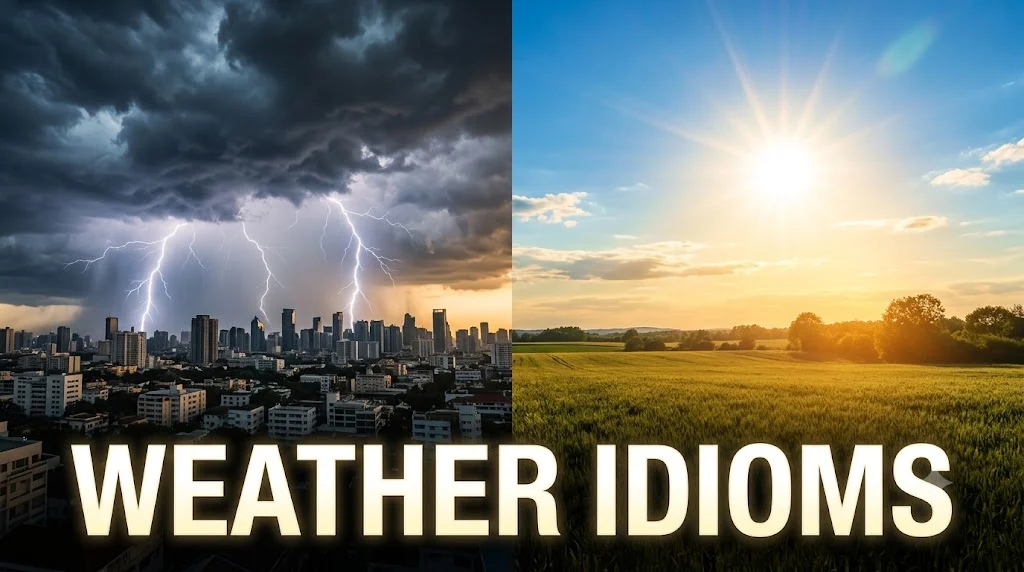
There’s a reason why weather dominates our small talk. Rain, sunshine, storms, and wind affect everyone they’re shared experiences that cross cultures, borders, and languages. But English takes this universal fascination a step further.
Instead of simply saying “I feel sick,” a native speaker might say “I’m feeling under the weather.” Instead of calling someone unreliable, they might label them a “fair-weather friend.” These weather idioms add emotional color, personality, and vivid imagery to everyday speech.
Weather idioms are special because they transform ordinary forecasts into shorthand for human emotion. When someone says “the storm has passed,” they rarely mean an actual storm they mean a difficult period is over. This metaphorical power makes weather idioms some of the most expressive tools in the English language.
In this comprehensive guide, you’ll discover:
- 30+ essential weather idioms with clear meanings
- Real-life examples for every situation
- The fascinating origins behind common phrases
- When to use each expression naturally
- Common mistakes to avoid
Let’s dive into the wonderful world of weather idioms that will make your English sound more natural, expressive, and truly human.
Quick Reference Table: Weather Idioms at a Glance
| SituationBest Idioms | |
|---|---|
| Feeling unwell | Under the weather |
| Reliable commitment | Come rain or shine |
| Unexpected shock | A bolt from the blue, Out of the blue |
| Finding hope | Every cloud has a silver lining |
| Facing difficulties | Weather the storm |
| Unreliable people | Fair-weather friend |
| Heavy rain | Raining cats and dogs, Bucketing down |
| Spoiling happiness | Rain on someone’s parade |
| Postponing plans | Take a rain check |
| Extreme happiness | On cloud nine |
| Small problems exaggerated | Storm in a teacup |
| Taking credit unfairly | Steal someone’s thunder |
| Being daydreamy | Head in the clouds |
| Getting a rumor | Get wind of something |
| Acting recklessly | Throw caution to the wind |
| Feeling overwhelmed | Snowed under |
| Being confused | In a fog |
| Casual conversation | Shoot the breeze |
| Warning sign | Cloud on the horizon |
| Inconsistent behavior | Blow hot and cold |
| Before chaos | Calm before the storm |
| Easy task | Be a breeze |
| Saving for future | Save for a rainy day |
| Rapid success | Take by storm |
| Unrealistic goals | Chase rainbows |
| Seizing opportunity | Make hay while the sun shines |
| Angry expression | Face like thunder |
| Breaking tension | Break the ice |
| Chaotic place | Like a mad house (weather version: stormy) |
🌧️ Idioms for Feeling Unwell or Low Energy
Under the Weather
Meaning: Feeling slightly sick, tired, or in low spirits
When to use: Casual conversations, workplace check-ins, explaining mild illness
Origin: This phrase has maritime roots. Sailors used it to describe seasickness or being knocked down by bad weather. Sickness was often blamed on stormy conditions, as exposure to harsh weather could weaken sailors.
Examples:
- I’m feeling a bit under the weather today, so I’ll work from home.”
- “She’s been under the weather since yesterday I hope she recovers soon.”
Dialogue:
- Tom: “Are you coming to the gym tonight?”
- Sarah: “I don’t think so. I’m a bit under the weather.”
- Tom: “Get some rest then. Hope you feel better!”
Common mistake: Say “under the weather,” not “below the weather” or “underneath the weather”.
☀️ Idioms for Hope and Positivity
Every Cloud Has a Silver Lining
Meaning: Even bad situations have something good hidden within them
When to use: Offering encouragement after disappointment, finding hope in hard times
Origin: This phrase comes from John Milton’s 1634 poem “Comus.” It likens clouds to problems, with sunlight peeking through as a symbol of opportunity.
Examples:
- Losing that job led him to a better career every cloud has a silver lining.
- “I know the trip was canceled, but every cloud has a silver lining. We can save money for something even better.”
Dialogue:
- Aisha: “I failed my driving test again.”
- Rahul: “Every cloud has a silver lining now you know exactly what to practice.
A Ray of Sunshine
Meaning: A cheerful, uplifting person who brings happiness to others
When to use: Compliments, friendly descriptions, showing appreciation
Examples:
- “My niece is a ray of sunshine she brightens everyone’s day.”
- “Having her in our team is such a ray of sunshine.”
On Cloud Nine
Meaning: Extremely happy, delighted, or euphoric
When to use: Celebrations, good news, achievements
Examples:
- “She was on cloud nine after getting the job offer.”
- “They’ve just had a baby, so they’re on cloud nine all day long.”
Light at the End of the Tunnel
Meaning: A sign of hope or improvement after a period of difficulty
When to use: Encouraging someone during hard times, discussing recovery
Examples:
- After months of hard work, I finally see light at the end of the tunnel.
- “The project is almost finished there’s light at the end of the tunnel.”
⛈️ Idioms for Difficult Times and Resilience
Weather the Storm
Meaning: Survive or endure a difficult period successfully
When to use: Work challenges, family setbacks, financial difficulties, emotional struggles
Examples:
- “The team weathered the storm after the budget cuts and came out stronger.”
- “Our relationship weathered the storm of that difficult year.”
Dialogue:
- Mike: “This project is incredibly difficult.”
- Anna: “We can weather the storm together. I see a break in the clouds already.”
The Calm Before the Storm
Meaning: A peaceful period just before a chaotic or difficult time
When to use: Describing tense anticipation, preparing for upcoming challenges
Origin: Derived from meteorology, where real storms are often preceded by a drop in wind and pressure, creating a brief lull before turbulence hits.
Examples:
- “The office was quiet the calm before the storm of the annual audit.”
- “Enjoy this peaceful moment. It’s the calm before the storm.”
A Cloud on the Horizon
Meaning: A sign that trouble may happen soon
When to use: Warning about potential problems, identifying early risks
Examples:
- “Rising costs were a cloud on the horizon for the project.”
- “The quiet argument became a cloud on the horizon for the group.”
When It Rains, It Pours
Meaning: Bad events often happen all at once
When to use: When multiple problems occur simultaneously
Examples:
- “My phone broke, then my laptop failed, and then my car wouldn’t start when it rains, it pours.”
- “Bills arrived together this month. When it rains, it pours.”
Out of the Blue / A Bolt from the Blue
Meaning: A shocking event that happens with no warning
When to use: Unexpected news, surprising announcements
Origin: Derived from the real phenomenon of lightning appearing from a seemingly clear sky. The earliest recorded use in English dates to the 19th century.
Examples:
- “His resignation came as a bolt from the blue.”
- “She called me out of the blue after ten years.”
🌪️ Idioms for Unreliable People and Relationships
Fair-Weather Friend
Meaning: A person who is only your friend when times are good, disappearing at the first sign of trouble
When to use: Describing unreliable people, warning about untrustworthy friends
Origin: First recorded in the 1600s, this cautionary phrase compares fickle friendships to sunny weather thriving only when conditions are favorable and vanishing when trouble appears.
Examples:
- “When I needed help, my so-called friend vanished. She’s just a fair-weather friend.”
- “He’s a fair-weather friend always there for parties but never for problems.”
Steal Someone’s Thunder
Meaning: Take credit for someone else’s achievement or preempt their announcement
When to use: Social or professional situations involving recognition, when someone upstages another
Origin: Playwright John Dennis invented a “thunder machine” for a play in the early 18th century. Competitors later stole his idea, prompting Dennis to accuse them of “stealing his thunder”.
Examples:
- “He announced the news early and stole her thunder.”
- “I didn’t want to steal your thunder, so I waited for you to share the news.”
Blow Hot and Cold
Meaning: Change feelings often sometimes warm and friendly, other times cold and distant
When to use: Describing inconsistent people, confusing relationships
Examples:
- “He blows hot and cold about joining our team. One day he’s excited, the next he’s not.”
- “She keeps blowing hot and cold toward me in class.”
See Which Way the Wind Blows
Meaning: Wait to decide until the situation becomes clearer
When to use: Delaying a choice to avoid risk, being cautious about commitment
Examples:
- “They’ll see which way the wind blows before making any major changes.”
- “I’ll see which way the wind blows before I speak up at the meeting.”
🌧️ Idioms for Heavy Rain and Bad Weather
Raining Cats and Dogs
Meaning: Raining very hard, with heavy drops
When to use: Describing intense rain that affects outdoor plans
Origin: One explanation traces to 17th-century England, where heavy storms often washed unfortunate animals into the streets. Another theory links it to the Greek “kata doxa,” meaning “against what’s expected”.
Examples:
- “It’s raining cats and dogs outside we should stay in.”
- “Spring is weird: some days it’s sunny, others it’s raining cats and dogs.”
Bucketing Down
Meaning: Raining extremely hard, sometimes for a long period
When to use: Non-stop heavy rain situations
Examples:
- “It was bucketing down when we left the shop.”
- “The match was stopped because it was bucketing down.”
Coming Down in Sheets
Meaning: Rain falling in thick, steady lines that look like a curtain
When to use: When rain appears solid and heavy
Examples:
- “The rain was coming down in sheets across the road.”
- “It started coming down in sheets near the bridge.”
It’s Pelting Down
Meaning: Rain falling fast and hard, sometimes with wind
When to use: When rain hits strongly and feels sharp
Examples:
- “It’s pelting down outside I’m getting soaked!”
- “The rain was pelting against the windows all night.”
🌤️ Idioms for Postponement and Practicality
Take a Rain Check
Meaning: Say no to an invitation now but accept for another time
When to use: Polite social postponements, when you can’t attend but want to maintain the connection
Origin: From 19th-century American baseball, where fans received “rain checks” when games were canceled due to weather. These guaranteed admission at a later date.
Examples:
- “I can’t do dinner tonight, but I’ll take a rain check.”
- “She took a rain check on coffee and said she’d meet tomorrow.”
Dialogue:
- Hina: “Can I take a rain check on tonight?”
- Omar: “Sure, another day works.”
Save for a Rainy Day
Meaning: Keep money or resources for a time when they’ll be needed
When to use: Money conversations, planning for the future, practical advice
Examples:
- “He saved for a rainy day instead of buying a new phone.”
- “We save part of every paycheck for a rainy day.”
Make Hay While the Sun Shines
Meaning: Take advantage of favorable conditions while they last
When to use: Seizing opportunities, time-sensitive decisions
Examples:
- “Business is good right now, so we need to make hay while the sun shines.”
- “She invested early and made hay while the sun shone.”
🌩️ Idioms for Anger and Frustration
A Face Like Thunder
Meaning: Looking very angry, with a dark, harsh expression
When to use: Describing someone who appears furious
Examples:
- “He walked in with a face like thunder after the meeting.”
- “The boss had a face like thunder yesterday.”
Dialogue:
- Nadia: “He has a face like thunder today.”
- Farhan: “Yes, his anger is obvious.”
Rain on Someone’s Parade
Meaning: Ruin someone’s happiness by bringing bad news or criticism
When to use: When someone dampens another’s excitement or joy
Examples:
- “He rained on her parade by pointing out every flaw.”
- “I didn’t want to rain on your parade, but I have to mention the deadline.”
🌪️ Idioms for Chaos, Confusion, and Overwhelm
A Storm in a Teacup
Meaning: A lot of fuss or drama about something very small or trivial
When to use: Downplaying minor disputes, when someone is overreacting
Origin: British in origin, it compares intense disputes over trivial matters to a violent storm contained within a teacup.
Examples:
- “The seating issue was just a storm in a teacup.”
- “In my opinion, the whole thing is just a storm in a teacup.”
Caution: Can sound dismissive if the other person feels genuinely upset.
Snowed Under
Meaning: Overwhelmed with work, responsibilities, or tasks
When to use: Work situations, busy periods
Examples:
- “I’m completely snowed under with deadlines this week.”
- “She’s been snowed under with paperwork all month.”
In a Fog
Meaning: Confused, unable to think clearly
When to use: Mental fatigue, lack of clarity
Examples:
- “I’ve been in a fog all day I didn’t sleep well.”
- “After the long flight, my mind was in a fog.”
Head in the Clouds
Meaning: Daydreaming, not being realistic, or not paying attention
When to use: Describing someone who seems disconnected from reality
Examples:
- “He can’t continue going around with his head in the clouds. He must be realistic about his problems.”
- “She has her head in the clouds during class.”
💨 Idioms for Getting Information and Acting Recklessly
Get Wind of Something
Meaning: Hear a rumor or become aware of something that’s happening
When to use: Suspecting or learning about something
Examples:
- “Marty got wind of a plot being planned against him.”
- “The press got wind of the scandal before we could prepare.”
Throw Caution to the Wind
Meaning: Act recklessly without worrying about the consequences
When to use: Taking bold risks, abandoning caution
Origin: First recorded in the 16th century, referring to abandoning prudence, likening “caution” to something thrown into unpredictable air currents.
Examples:
- “He threw caution to the wind and invested all his savings in the startup.”
- “Sometimes you have to throw caution to the wind and just go for it.”
Take by Storm
Meaning: Achieve rapid, widespread success or capture attention dramatically
When to use: Describing swift success in business, entertainment, or politics
Origin: This military-inspired idiom first appeared in the 18th century to describe swift battlefield victories.
Examples:
- “The new band took the music scene by storm.”
- “The product took the market by storm within weeks.”
🥶 Idioms for Cold and Winter
Break the Ice
Meaning: Initiate conversation in a social setting, overcome awkwardness
When to use: Social situations, meetings, introductions
Examples:
- “A smile and ‘Bonjour’ was usually sufficient to break the ice in any conversation.”
- “The team-building exercise helped break the ice between colleagues.”
In a Fog (Cold weather connection)
Meaning: Confused, unable to think clearly (already covered above)
🏃♂️ Idioms for Commitment and Reliability
Come Rain or Shine
Meaning: No matter what happens, regardless of difficulties
When to use: Commitment, reliability, routines
Examples:
🌈 Idioms for Unrealistic Goals
Chase Rainbows
Meaning: Pursue something that’s unrealistic or unattainable
When to use: Describing unrealistic goals, being gently critical
Origin: Linked to Irish folklore, where rainbows were thought to hide treasure. The phrase metaphorically describes the pursuit of something unattainable.
Examples:
- “They’re giving their marriage another shot, though it’s probably just a rainbow chase.”
- Stop chasing rainbows and focus on achievable goals.”
🎯 How to Use Weather Idioms Naturally
Using weather idioms can instantly make your language more expressive but only when you use them with the right tone, timing, and intention.
Match the Situation
Not all weather idioms mean the same thing. Some express hope, others frustration, and some describe unreliability.
- For resilience and strength:
- → “We’ll weather the storm together.”
- For hope in hard times:
- → “Every cloud has a silver lining.”
- For describing unreliable people:
- → “He’s just a fair-weather friend.”
- For spoiling someone’s joy:
- → “I don’t want to rain on your parade.”
Keep Tone in Mind
Some weather idioms can sound too casual for formal situations.
For example, saying “He’s a fair-weather friend” in a professional meeting might feel inappropriate. Instead, you could say: “He has been unreliable in challenging situations.”
Use Sparingly
Idioms are powerful, but too many can overwhelm your message. Instead of multiple idioms in one sentence, use one well-placed phrase:
Instead of: “I’m under the weather, and this storm in a teacup is raining on my parade.”
Better: “I’m feeling under the weather today. Let’s not make a storm in a teacup about this.”
Learn the Origins
Understanding where idioms come from can help you remember them more easily. For instance, knowing that “under the weather” comes from sailors dealing with harsh conditions makes the phrase more memorable.
⚠️ Common Mistakes to Avoid
Using the Wrong Phrase for the Situation
- “Raining cats and dogs” is only for very heavy rain, not normal rain.
- “Under the weather” means slightly ill, not seriously sick.
Incorrect Prepositions
Overusing Idioms in Formal Writing
Weather idioms are mostly informal and work best in conversation, casual writing, and storytelling. In professional documents, use them sparingly.
Using Offensive or Insensitive Language
Be careful with some weather idioms in serious contexts. “A storm in a teacup” can sound dismissive of someone’s genuine concerns.
🔍 The Fascinating Origins Behind Weather Idioms
Understanding the history behind these phrases adds depth to your vocabulary. Here are some of the most interesting origins:
Under the Weather: Maritime roots from sailors dealing with seasickness and harsh conditions.
Every Cloud Has a Silver Lining: From John Milton’s 1634 poem “Comus”.
Steal Someone’s Thunder: From playwright John Dennis in the 18th century.
Take a Rain Check: From 19th-century American baseball, where rain-delayed games issued tickets for future games.
Raining Cats and Dogs: Possibly from 17th-century England, where heavy storms carried animals through streets.
Fair-Weather Friend: First recorded in the 1600s.
🚀 Practice Method That Actually Works
Learning idioms isn’t just about memorization it’s about usage. Here’s a simple but powerful method:
1. Learn 3 Idioms Daily
Don’t overwhelm yourself. Focus on a few and understand their tone and context.
2. Use Them in Real Conversations
Even simple sentences help. Say: “This heat is making me feel under the weather.”
The more you use them, the more natural they feel.
3. Write One Creative Sentence for Each
Instead of basic sentences, try expressive ones:
- “The silence in the room was the calm before the storm of her confession.”
- “His anger came out of the blue a thunderbolt we never saw coming.”
4. Connect to Mental Images
Weather metaphors work because they’re visual. Connect each idiom to a mental image:
- “Raining cats and dogs” → Imagine cats and dogs falling from the sky
- “On cloud nine” → Floating on a happy cloud
- “Fair-weather friend” → Someone who disappears when the rain starts
📝 Quick Review: Essential Weather Idioms by Category
Feeling Unwell
- Under the weather
Resilience
- Weather the storm
- Every cloud has a silver lining
- Light at the end of the tunnel
Unreliable People
- Fair-weather friend
- Blow hot and cold
Sudden Events
- Out of the blue
- Bolt from the blue
- Calm before the storm
Heavy Rain
- Raining cats and dogs
- Bucketing down
- Coming down in sheets
Social Situations
- Break the ice
- Take a rain check
- Rain on someone’s parade
Happiness
- On cloud nine
- Ray of sunshine
Pragmatism
- Save for a rainy day
- Make hay while the sun shines
Overwhelm
- Snowed under
- In a fog
Risk and Boldness
- Throw caution to the wind
- Take by storm
FAQs
1. What are weather idioms?
Weather idioms are figurative expressions that use weather-related words like rain, sunshine, wind, or storms to describe emotions, situations, or experiences rather than the actual weather.
2. Why are weather idioms so common in English?
Weather affects everyday life, making it an easy source of comparison. As a result, English speakers frequently use weather idioms to express feelings, relationships, success, challenges, and changing circumstances.
3. What are some common weather idioms?
Some of the most popular weather idioms include under the weather, every cloud has a silver lining, come rain or shine, storm in a teacup, and save for a rainy day.
4. Can weather idioms be used in formal writing?
Yes, many weather idioms are suitable for speeches, articles, and business writing when used appropriately. However, very informal idioms are generally better suited to casual conversations.
5. How can I learn and use weather idioms naturally?
The best way to master weather idioms is to learn their meanings in context, read example sentences, and practice using them in everyday conversations. This helps you understand when each idiom sounds natural and appropriate.
🏁 Conclusion
Weather idioms add energy, emotion, and personality to your language. Instead of repeating simple words, you can express yourself in a way that feels more natural, engaging, and emotionally resonant.
Whether you’re describing excitement (“on cloud nine”), frustration (“rain on my parade”), resilience (“weather the storm”), or unreliability (“fair-weather friend”), these expressions turn plain speech into vivid communication.
The key is simple: understand the context, choose wisely, and practice consistently. Once you start using weather idioms in real conversations, your English will feel more alive, expressive, and truly human.
Remember: The weather isn’t just something outside it’s a reflection of what’s happening inside us all.
Read More Related Articles:
- Idioms for Stress | Powerful Expressions to Describe Pressure Naturally In 2026
- 25 Idioms for Smile | Express Warmth and Emotion Naturally In 2026
- Idioms for Soccer | Powerful Expressions to Score in English In 2026

Urban Hunter is an American writer at IdiomCrafter.com, with a keen interest in how language shapes everyday conversations. She enjoys turning common expressions into engaging and easy-to-follow reads. Outside of writing, she spends time exploring new words and their hidden meanings.