Quick Answer
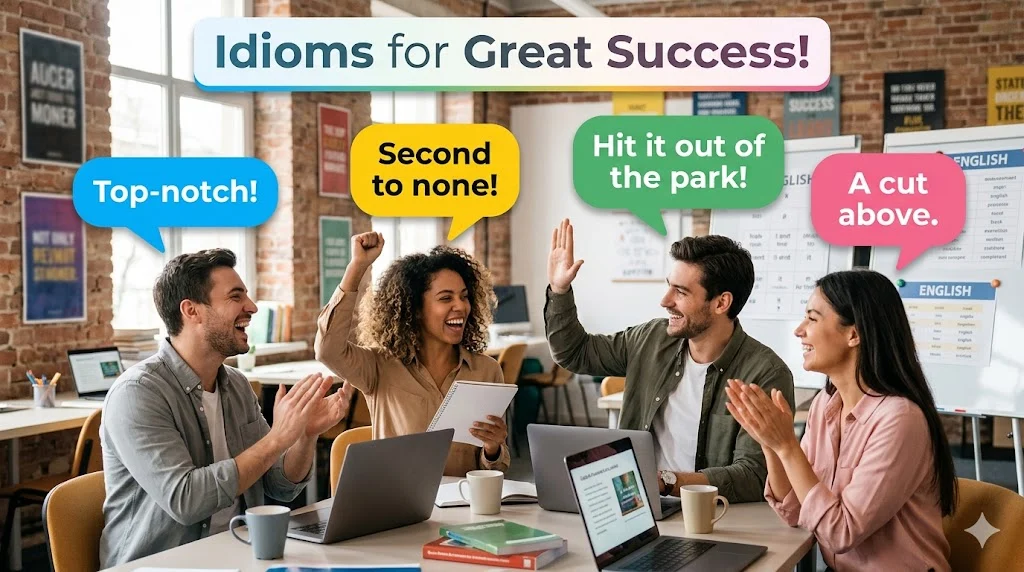
Idioms for “great” are expressions used to describe something excellent, impressive, successful, or exceptionally good in a more natural and expressive way.Examples: top-notch, second to none, a cut above, hit it out of the park
While the word “great” is useful, using it repeatedly can make your communication sound repetitive. Native English speakers often use idioms to add personality, emotion, and variety to their language.
For example, instead of saying:
“The presentation was great.”
You could say:
“The presentation hit it out of the park.”
The second sentence feels more vivid, memorable, and natural.
Whether you’re describing:
- Outstanding performance
- Excellent quality
- Remarkable achievements
- Successful experiences
- Impressive people
These idioms help make your English more engaging and fluent.
Let’s explore the most useful idioms for describing greatness and excellence.
Quick Summary Table
| Situation | Idioms |
|---|---|
| Excellence | Top-notch, Second to none |
| Success | Hit it out of the park, Knock it out of the park |
| High Quality | A cut above, First-rate |
| Outstanding Achievement | Go above and beyond, Raise the bar |
| Positive Impression | Make a splash, Leave a mark |
| Exceptional Talent | The whole package, A natural |
| Outstanding Results | Strike gold, Hit the jackpot |
🌟 Idioms for Excellence
These idioms describe something that stands above average.
1. Top-Notch
One of the most common expressions for excellence.
Meaning: Extremely high quality
When People Use It: Products, services, skills, or performance
Alternative Expression: Excellent
Examples
Formal:
The company consistently delivers top-notch service.
Casual:
That’s top-notch work.
Creative:
Every detail reflected top-notch craftsmanship.
2. Second to None
Used when nothing else compares.
Meaning: The very best
When People Use It: Performance, reputation, quality
Alternative Expression: Unmatched
Examples
Formal:
Their customer support is second to none.
Casual:
This restaurant is second to none.
Creative:
Its excellence stood beyond comparison.
3. A Cut Above
An expression that highlights superiority.
Meaning: Better than others
When People Use It: People, products, services
Alternative Expression: Superior
Examples
Formal:
Their technology is a cut above competitors.
Casual:
That phone is a cut above the rest.
Creative:
Its quality elevated it above everything else.
🎯 Idioms for Outstanding Success
Success often deserves stronger praise than simply saying “great.”
4. Hit It Out of the Park
Originally from baseball.
Meaning: Achieve remarkable success
When People Use It: Projects, presentations, performances
Alternative Expression: Succeed brilliantly
Examples
Formal:
The marketing team hit it out of the park.
Casual:
You really hit it out of the park!
Creative:
The project exceeded every expectation.
5. Knock It Out of the Park
A variation of the previous idiom.
Meaning: Do exceptionally well
When People Use It: Accomplishments and achievements
Examples
Formal:
She knocked it out of the park during the interview.
Casual:
You absolutely knocked it out of the park.
Creative:
Her performance left everyone impressed.
6. Hit the Jackpot
Success beyond expectations.
Meaning: Achieve an excellent result
When People Use It: Opportunities and discoveries
Examples
Formal:
The company hit the jackpot with its new product.
Casual:
We hit the jackpot finding this place.
Creative:
Fortune seemed to smile upon them.
🚀 Idioms for High Quality
These expressions are useful when something is exceptionally good.
7. First-Rate
A classic expression for excellence.
Meaning: Of the highest quality
When People Use It: Services, products, work
Examples
Formal:
The hotel offers first-rate accommodations.
Casual:
That was first-rate service.
Creative:
Everything reflected first-rate standards.
8. Cream of the Crop
A popular idiom.
Meaning: The very best among a group
When People Use It: People, teams, products
Examples
Formal:
The finalists represent the cream of the crop.
Casual:
These players are the cream of the crop.
Creative:
Only the finest remained.
9. World-Class
A globally recognized level of quality.
Meaning: Among the best in the world
When People Use It: Organizations, talent, facilities
Examples
Formal:
The university provides world-class education.
Casual:
That chef is world-class.
Creative:
Their reputation reached international heights.
💥 Idioms for Exceptional Achievement
Sometimes greatness comes from effort and accomplishment.
10. Go Above and Beyond
Describes exceeding expectations.
Meaning: Do more than required
Examples
Formal:
The staff went above and beyond to help customers.
Casual:
You really went above and beyond.
Creative:
They exceeded every expectation.
11. Raise the Bar
Used when standards improve dramatically.
Meaning: Set a higher standard
Examples
Formal:
The innovation raised the bar for the industry.
Casual:
That performance raised the bar.
Creative:
The benchmark shifted upward.
12. Set the Gold Standard
An expression for ultimate excellence.
Meaning: Become the best example
Examples
Formal:
The company set the gold standard for customer service.
Casual:
That’s the gold standard.
Creative:
Others measured themselves against it.
⭐ Idioms for Impressive People
Some individuals consistently stand out.
13. The Whole Package
Someone with many positive qualities.
Meaning: Attractive, talented, and capable
Examples
Formal:
She’s the whole package professionally.
Casual:
He’s the whole package.
Creative:
Talent and charisma came together perfectly.
14. A Natural
Someone gifted without much effort.
Meaning: Naturally talented
Examples
Formal:
She’s a natural leader.
Casual:
He’s a natural at sports.
Creative:
Ability seemed effortless.
15. Head and Shoulders Above
Far superior to others.
Meaning: Clearly better
Examples
Formal:
The candidate stood head and shoulders above the competition.
Casual:
That team is head and shoulders above everyone else.
Creative:
Their excellence was impossible to ignore.
🌈 Idioms for Positive Impact
Great things often leave lasting impressions.
16. Make a Splash
Create strong positive attention.
Meaning: Gain immediate recognition
Examples
Formal:
The startup made a splash in the market.
Casual:
They really made a splash.
Creative:
Their arrival changed everything.
17. Leave a Mark
Create a memorable impact.
Meaning: Be remembered positively
Examples
Formal:
The campaign left a lasting mark.
Casual:
That experience left a mark.
Creative:
Its influence endured long afterward.
18. Turn Heads
Attract significant attention.
Meaning: Impress many people
Examples
Formal:
The new design turned heads.
Casual:
That car turns heads.
Creative:
Attention followed wherever it appeared.
🎉 Idioms for Remarkable Experiences
Some experiences are simply unforgettable.
19. One for the Books
A memorable event.
Meaning: Extraordinary and worth remembering
Examples
Formal:
The achievement was one for the books.
Casual:
That was one for the books.
Creative:
A memory destined to last forever.
20. Out of This World
Exceptionally good.
Meaning: Incredible and extraordinary
Examples
Formal:
The cuisine was out of this world.
Casual:
This pizza is out of this world.
Creative:
It felt beyond imagination.
21. Take Your Breath Away
Something incredibly impressive.
Meaning: Stunningly beautiful or amazing
Examples
Formal:
The scenery took everyone’s breath away.
Casual:
That view took my breath away.
Creative:
The beauty left everyone silent.
🔥 Modern Idioms for Great
Popular expressions frequently used in contemporary English.
22. On Another Level
Far superior to others.
Examples
Formal:
His expertise is on another level.
Casual:
That’s on another level!
Creative:
It existed in a category of its own.
23. Next Level
Modern expression for excellence.
Examples
Formal:
The innovation brought next-level performance.
Casual:
That’s next level.
Creative:
It pushed beyond ordinary limits.
24. Crush It
A highly popular modern idiom.
Meaning: Perform extremely well
Examples
Formal:
The team crushed its quarterly goals.
Casual:
You crushed it!
Creative:
Success seemed effortless.
25. Bring Your A-Game
Perform at your highest level.
Meaning: Give your best effort
Examples
Formal:
Employees are expected to bring their A-game.
Casual:
Bring your A-game tomorrow.
Creative:
Everyone arrived ready to excel.
🎯 How to Use Idioms for Great Naturally
Learning idioms is only the first step. Using them naturally is what builds fluency.
✔ Match the Situation
Different idioms suit different contexts.
Professional
- Second to none
- First-rate
- Set the gold standard
Casual
- Crush it
- Next level
- Hit it out of the park
Creative Writing
- Take your breath away
- One for the books
- Leave a mark
✔ Replace Repetitive Vocabulary
Instead of:
“The event was great.”
Try:
“The event was one for the books.”
Instead of:
“The service was great.”
Try:
“The service was second to none.”
✔ Use One Strong Idiom
Avoid overloading sentences.
Wrong ❌
The concert was out of this world, one for the books, and totally blew my mind.
Better ✔
The concert was out of this world.
⚠️ Common Mistakes to Avoid
Using Too Many Idioms
Too many expressions can sound unnatural.
Ignoring Tone
Avoid casual idioms in formal reports.
Casual
- Crush it
- Next level
Formal
- Exceptional
- Outstanding
- Second to none
Misunderstanding Meaning
Always learn:
- Meaning
- Context
- Tone
- Typical situations
🧠 Practice Method
Step 1: Learn 3 Idioms Daily
Focus on:
- Meaning
- Context
- Examples
Step 2: Create Your Own Sentences
Example:
- Their customer service is second to none.
- She crushed her presentation.
Step 3: Use Them in Conversation
Practice through:
- Social media
- Text messages
- Daily conversations
Step 4: Connect Idioms to Real Situations
- Great food → Out of this world
- Great performance → Hit it out of the park
- Great service → Second to none
- Great achievement → Raise the bar
Step 5: Follow the One Idiom Rule
Use one idiom per idea for maximum impact.
FAQs
1. What are idioms for great?
They are expressions used to describe something excellent, successful, impressive, or high quality.
2. Are these idioms common in everyday English?
Yes. Many are frequently used by native speakers in conversation and writing.
3. Which idioms are best for professional situations?
“Second to none,” “first-rate,” and “set the gold standard” work well in formal settings.
4. Can I use these idioms in essays?
Yes, but use them carefully and match the tone of the writing.
5. What’s the easiest idiom to start with?
“Top-notch” is simple, versatile, and commonly understood.
Conclusion
Idioms for “great” allow you to express excellence, success, and admiration more naturally than repeatedly using the same adjective. Whether you choose expressions like “top-notch,” “a cut above,” “second to none,” or “hit it out of the park,” these idioms add energy and personality to your communication.
The secret is simple: learn a few, practice them regularly, and use them in real situations. Over time, they’ll become a natural part of your English vocabulary and help your speaking and writing sound more fluent, expressive, and memorable.
Because great communication isn’t just about describing something good it’s about showing exactly how good it is.
Read More Related Articles:
- Idioms for Happiness | Express Joy Like a Native Speaker In 2026
- Idioms for Scared | Express Fear Like a Native Speaker In 2026
- Idioms for Sadness | Expressing Deep Emotions Through Language In 2026

Urban Hunter is an American writer at IdiomCrafter.com, with a keen interest in how language shapes everyday conversations. She enjoys turning common expressions into engaging and easy-to-follow reads. Outside of writing, she spends time exploring new words and their hidden meanings.