Quick Answer
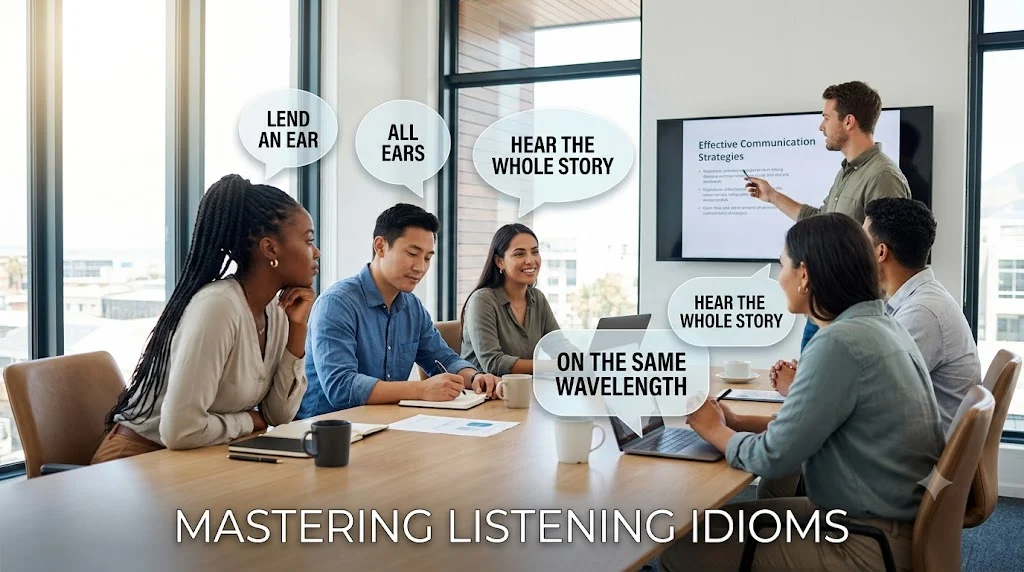
Mastering listening idioms helps you describe paying attention, understanding others, and responding thoughtfully in natural English.Expressions like all ears, lend an ear, and fall on deaf ears make your conversations sound more fluent and engaging.
We communicate constantly, but how often do we truly listen? In English, the concept of listening goes far beyond the simple act of hearing. It’s about attention, understanding, agreement, and sometimes, the amusing lack thereof. While we often use the verb “listen,” the language is rich with colorful idioms that paint a much more vivid picture of how we receive and process information.
Instead of just saying “I’m listening,” you can express your undivided attention, hint that you don’t quite agree, or even gently point out that someone isn’t making sense. These idioms add nuance, emotion, and personality to your conversations, making your English sound far more natural and engaging.
In this comprehensive guide, we will explore a wide array of idioms related to listening and hearing. You’ll learn:
- The meanings of over 25 essential listening idioms.
- The specific contexts in which they are used.
- Formal, casual, and creative examples to model.
- How to avoid common mistakes and use them with confidence.
Let’s dive into the fascinating world of expressions that make listening a dynamic and expressive part of the English language.
Quick Summary Table: Listening Idioms at a Glance
| SituationKey Idioms | |
|---|---|
| Giving Full Attention | All ears, Lend an ear, Be all ears |
| Understanding/Comprehending | Get the picture, Catch my drift, Tune in |
| Agreement & Harmony | On the same wavelength, Singing the same tune |
| Disagreement/Disregard | Turn a deaf ear, Fall on deaf ears, Not hear a word |
| Listening for Information | Keep your ear to the ground, Listen up |
| Subtle/Secret Listening | Eavesdrop, Walls have ears |
| Foolish/Unreasonable Situations | Drive me foolish, Out of your mind, Go nuts |
| Reactions & Chaos | Lose it, Like a mad house, All over the place |
👂 Idioms for Giving Full Attention
When you want to assure someone that you are completely focused on what they are saying, these are your go-to expressions.
1. All Ears
This is one of the most common and straightforward idioms for showing active attention.
- Meaning: To be listening eagerly and attentively.
- When People Use It: When someone is about to share important news, a story, or a secret. It signals that you are ready and receptive.
- Alternative Expression: Listening intently.
Examples:
- Formal: “Please, go ahead with your proposal. I’m all ears.”
- Casual: “You got a promotion? Tell me everything, I’m all ears!”
- Creative: “The children were all ears as the teacher began the magical tale.”
2. Lend an Ear
This idiom is slightly more active and compassionate than “all ears.” It implies a willingness to listen, especially to someone’s problems or concerns.
- Meaning: To listen sympathetically to someone.
- When People Use It: Often used when someone is upset, needs advice, or just needs to vent.
- Alternative Expression: Offer a listening ear.
Examples:
- Formal: “If you need someone to talk to, I am here to lend an ear.”
- Casual: “My best friend always lends an ear when I’m having a bad day.”
- Creative: “The wise old man was known for lending an ear to all who sought his counsel.”
3. Hark (Archaic but Fun)
While “hark” itself is archaic, the idiom “hark back to” is still used to mean “to return to or remember a previous subject.
- Meaning: To remember or refer back to an earlier time or subject.
- When People Use It: When making a comparison to something in the past.
- Alternative Expression: “It’s reminiscent of…”
Examples:
- Casual: “His style of music harks back to the rock ‘n’ roll of the 1950s.”
- Creative: “The design of the new building harks back to a more elegant architectural era.”
4. Be All Ears (Variation)
While “all ears” is the most common form, emphasizing the verb “to be” can add extra weight to your promise of attention.
- Meaning: To be completely ready and willing to listen.
- When People Use It: A more emphatic way to say you’re listening.
- Alternative Expression: “I’m captivated.”
Examples:
- Casual: “And then what happened? I’m all ears!”
- Creative: “The audience was all ears, hanging on the speaker’s every word.”
💡 Idioms for Understanding & Comprehension
Listening is only half the battle; the other half is understanding what you’ve heard. These idioms show that you’re “getting it.
5. Get the Picture
This idiom is a colorful way to ask if someone understands a broader situation or concept.
- Meaning: To understand a situation, especially when it involves more than just the surface-level facts.
- When People Use It: After explaining something complicated, you might check, “Do you get the picture?”
- Alternative Expression: “Do you understand?”
Examples:
- Formal: “The data suggests a clear trend. Do you get the picture?”
- Casual: “Look, he’s not a good guy. Do you get the picture?”
- Creative: “The author’s descriptions were so vivid that I could immediately get the picture of the rainy, deserted street.”
6. Catch My Drift
This idiom often implies that you are saying something indirectly or hinting at a deeper meaning.
- Meaning: To understand the general meaning or intention of what someone is implying.
- When People Use It: When you want to be polite or discrete, or when you think the person already knows the context.
- Alternative Expression: “Do you know what I mean?”
Examples:
- Casual: “I think we should take a different approach, if you catch my drift.”
- Creative: “Her eyes widened. ‘Ah,’ she said, ‘I catch your drift.'”
7. Tune In
This idiom is borrowed from the world of radio and television, making it a perfect metaphor for focused listening.
- Meaning: To become aware of something or to start paying close attention.
- When People Use It: Often used when someone is about to share something insightful or important. You can also “tune in” to a podcast or a feeling.
- Alternative Expression: “Pay attention.”
Examples:
- Formal: “We must tune in to the needs of our clients to provide the best service.”
- Casual: “Tune in next week for the season finale!”
- Creative: “He was quiet, trying to tune in to the subtle sounds of the forest.”
🤝 Idioms for Agreement & Harmony
These idioms show that you are not just listening, but that you are also on the same page as the speaker.
8. On the Same Wavelength
This idiom suggests a perfect, often unspoken, mutual understanding between two or more people.
- Meaning: Thinking in a similar way and understanding each other well.
- When People Use It: When ideas flow easily in a conversation, and there’s a natural harmony.
- Alternative Expression: “On the same page.”
Examples:
- Formal: “The team was on the same wavelength, leading to a highly productive brainstorming session.”
- Casual: “We’re always on the same wavelength. I don’t even have to explain anything.”
- Creative: “They worked in silence, yet they were completely on the same wavelength.”
9. Singing the Same Tune
Similar to “on the same wavelength,” this idiom implies agreement and a shared opinion.
- Meaning: To agree with someone.
- When People Use It: When people have a common goal or viewpoint.
- Alternative Expression: “On the same page.”
Examples:
- Formal: “All departments are now singing the same tune regarding the new strategy.”
- Casual: “Finally! For once, everyone is singing the same tune.”
- Creative: “The choir of politicians were, for that one moment, singing the same tune.”
🙉 Idioms for Disagreement or Disregard
These expressions are used when someone is not listening, ignoring what’s being said, or even purposefully choosing not to hear.
10. Turn a Deaf Ear
This idiom describes the act of deliberately ignoring someone or something.
- Meaning: To refuse to listen to or consider something.
- When People Use It: When someone is giving unwanted advice or making a plea that is being ignored.
- Alternative Expression: “Ignore.”
Examples:
- Formal: “The management chose to turn a deaf ear to the employees’ complaints.”
- Casual: “I told him to clean his room, but he just turned a deaf ear.”
- Creative: “The lonely voice in the wilderness was destined to be turned a deaf ear to.”
11. Fall on Deaf Ears
This idiom is similar to “turn a deaf ear,” but here, the fault lies with the recipient of the message, not the listener. The advice or request is not heard or is ignored.
- Meaning: To be ignored or disregarded.
- When People Use It: When you’ve tried to communicate, but feel like no one is listening.
- Alternative Expression: “Be ignored.”
Examples:
- Formal: “All our warnings about the risks seemed to fall on deaf ears.”
- Casual: “I asked them to be quiet, but my pleas disregarded.”
- Creative: “Her words, full of passion and truth, disregarded ears, lost in the roar of the crowd.”
12. Not Hear a Word
This can be used literally (e.g., you didn’t hear someone because it was too loud) but also idiomatically to mean you were completely ignoring or not comprehending what was said.
- Meaning: To not be paying attention or to be too distracted to listen.
- When People Use It: When someone asks you a question and you realize you were daydreaming.
- Alternative Expression: “I zoned out.”
Examples:
- Casual: “I’m sorry, I didn’t hear a word of what you just said. I was miles away.”
- Creative: “He could speak for hours, but she wouldn’t hear a word of his explanations, so lost in her own world.”
🔎 Idioms for Listening for Information
These idioms show a proactive, investigative kind of listening, where you are trying to gather information or clues.
13. Keep Your Ear to the Ground
This idiom paints the picture of someone lying on the ground to listen for approaching riders—a classic metaphor for staying informed.
- Meaning: To stay alert and watchful for signs of new developments.
- When People Use It: In business, politics, or social settings where knowing what’s happening is an advantage.
- Alternative Expression: “Stay informed.”
Examples:
- Formal: “As a business analyst, he always keeps his ear to the ground to spot emerging market trends.”
- Casual: “Keep your ear to the ground about job openings. I’ll let you know if I hear anything.”
- Creative: “The spy kept his ear to the ground, listening for any whisper of the enemy’s plans.”
14. Listen Up
This is a direct and often used command to get people’s attention. It’s less about the act of hearing and more about preparing to receive an important announcement.
- Meaning: A command to pay attention and start listening.
- When People Use It: By teachers, drill sergeants, or anyone about to make an important announcement to a group.
- Alternative Expression: “Attention, everyone!”
Examples:
- Formal: “Listen up, everyone. The new safety protocols will be implemented tomorrow.”
- Casual: “Okay, listen up! The next round of drinks is on me.”
- Creative: “The captain’s voice boomed over the intercom: ‘Listen up, crew! We have a situation.'”
🤫 Idioms for Subtle or Secret Listening
These idioms deal with the not-so-innocent side of listening—eavesdropping and secrets.
15. Eavesdrop
This is a direct, non-idiomatic word, but it’s the perfect term for this category. It means to secretly listen to a private conversation.
- Meaning: To listen secretly to what other people are saying.
- When People Use It: When describing someone who is listening in on a conversation not meant for them.
- Alternative Expression: “To listen in.”
Examples:
- Formal: “It is considered rude and unprofessional to eavesdrop on your colleagues’ private calls.”
- Casual: “I couldn’t help but eavesdrop on their conversation at the next table.”
- Creative: “She crept closer to the door to eavesdrop on the hushed voices inside.”
16. Walls Have Ears
This is a warning phrase, reminding people to be careful about what they say in private, as someone might be listening.
- Meaning: Be careful what you say, as there may be people listening secretly.
- When People Use It: Used in a conspiratorial or secretive context, often when someone is about to reveal sensitive information.
- Alternative Expression: “Be discreet.”
Examples:
- Formal: “Let’s continue this discussion in the boardroom. The walls have ears here.”
- Casual: “Shh! Not so loud. The walls have ears.”
- Creative: “The plotters spoke in hushed, urgent tones, ever-mindful that the very walls had ears.”
🤯 Idioms for “Crazy” Reactions
While our primary focus is on listening, the idioms for expressing extreme, unusual, or “crazy” behavior often overlap with intense listening experiences. We hear something so shocking that we “lose our minds” or “go nuts.” Let’s explore some of the most powerful ones from this category.
17. Go Nuts
- Meaning: To become extremely excited, angry, or wild.
- When People Use It: For sudden, emotional reactions to news, a performance, or a frustrating event.
- Alternative Expression: “Lose control.”
Examples:
- Casual: “The crowd went nuts when the band walked on stage.”
- Creative: “He went nuts when he heard the news.”
18. Lose It
- Meaning: To lose one’s composure or emotional control.
- When People Use It: When someone breaks down in anger, laughter, or tears.
- Alternative Expression: “Snap.”
Examples:
- Casual: “I almost lost it when they told me my flight was cancelled.”
- Creative: “Under the immense pressure, she felt herself beginning to lose it.”
19. Flip Out
- Meaning: To react to something in a sudden, crazy, or emotional way.
- When People Use It: Overreactions, shock, or intense excitement.
- Alternative Expression: “Freak out.”
Examples:
- Casual: “Don’t flip out, but I accidentally scratched your car.”
- Creative: “His mother flipped out when she saw his new tattoo.”
20. Out of Your Mind
- Meaning: Acting irrationally or astonishingly.
- When People Use It: When someone does or says something that seems illogical.
- Alternative Expression: “Crazy.”
Examples:
- Casual: “You’re out of your mind if you think that will work.”
- Creative: “The idea was so brilliant it seemed almost out of his mind.
21. Drive Someone Crazy
- Meaning: To annoy, frustrate, or overwhelm someone greatly.
- When People Use It: For irritating and persistent problems.
- Alternative Expression: “Irritate intensely.”
Examples:
- Casual: “The constant beeping sound is driving me crazy.”
- Creative: “The unsolvable riddle drove him crazy, occupying his every thought.”
22. Like a Mad House
- Meaning: A place that is very chaotic, noisy, and out of control.
- When People Use It: To describe a busy, messy, or frantic environment.
- Alternative Expression: “A zoo.”
Examples:
- Casual: “The office was a madhouse this morning with everyone preparing for the presentation.”
- Creative: “The carnival was like a mad house, a whirlwind of noise and color.”
23. All Over the Place
- Meaning: Disorganized, chaotic, or lacking a clear direction.
- When People Use It: To describe someone’s thoughts, ideas, or a messy room.
- Alternative Expression: “Scattered.”
Examples:
- Casual: “Sorry, my thoughts are all over the place today.”
- Creative: “The evidence was all over the place, leading the detective down several confusing paths.”
24. Run Around Like a Headless Chicken
- Meaning: To act in a panicked, disorganized, and frantic manner.
- When People Use It: To describe someone who is very stressed and busy but not being effective.
- Alternative Expression: “Panic.”
Examples:
- Casual: “We were running around like headless chickens trying to get everything ready.”
- Creative: “With the deadline approaching, the office was a flurry of people running around like headless chickens.”
25. Crack Up
- Meaning: To lose emotional control, either by laughing hysterically or breaking down under pressure.
- When People Use It: In humorous or stressful situations.
- Alternative Expression: “Break down” or “burst out laughing.”
Examples:
- Casual: “His joke made me crack up.”
- Creative: “The immense stress finally caused him to crack up.”
🎯 How to Use Listening Idioms Naturally in 2026
Mastering idioms is about more than just memorizing definitions. It’s about weaving them into your speech with confidence and accuracy.
Match the Tone & Context
The most crucial rule is to consider the formality of the situation.
- Formal Settings (Workplaces, Academic Papers, Official Speeches):
- Use more neutral or professional idioms.
- Example: Good: “I recommend we tune in to the current market demands.”
- Example: Bad: “Let’s get on the same wavelength, man.”
- Example: Good: “The team is singing the same tune on this project.”
- Example: Bad: “We’re all ears, dude, go ahead.”
- Casual Settings (With Friends, Family, in Informal Writing):
- This is where the most colorful idioms shine.
- Good: “Hey, catch my drift? I don’t want to go there.”
- Good: “Are you kidding? I was all ears! Tell me more.”
Understand the Nuance
Don’t just use the first idiom that comes to mind. Each has a slightly different flavor.
- “All ears” is your eager student.
- “Lend an ear” is your compassionate friend.
- “Turn a deaf ear” is your stubborn relative.
- “Keep your ear to the ground” is your savvy colleague.
Use Sparingly for Impact
A well-placed idiom is like a perfect seasoning—it enhances the dish. Too much of it ruins the meal. Drop them naturally in conversation rather than trying to use one in every sentence. This sounds forced and unnatural.
⚠️ Common Mistakes to Avoid
Even experienced speakers can misuse idioms. Here are the most common pitfalls:
- Using the Wrong Idiom: Don’t say “I’m all ears” when you mean “that joke cracked me up.” One signals attention, the other signals breaking into laughter.
- Misunderstanding the Meaning: “Singing the same tune” means agreeing, not singing a song together. Using it to describe a harmonious musical performance is a literal, incorrect use.
- Literal Translation: Many learners try to translate idioms directly from their native language, which often doesn’t work. Always learn the specific meaning of an English idiom.
- Overusing in Professional Writing: While some idioms like “on the same page” are accepted in business, too many can make your writing seem unprofessional. Know your audience.
🚀 Practice Method
Learning a new idiom is a process. Here’s how to make it stick:
- Learn in Context: Don’t just read the definition. Read the examples. Hear it used in a podcast or a movie. Understanding the context is key.
- Associate with a Person or Situation: Associate “turn a deaf ear” with that one boss who never listens, or “lend an ear” with your kindest friend.
- Write 3 Personal Sentences: This is where the magic happens. Instead of copying the examples, think of a real situation in your own life where you could have used the idiom.
- Bad Practice: “The students were all ears.” (Boring, not personal).
- Good Practice: “When my grandmother told her stories about her childhood, I was all ears.”
- Use Them in Conversation: The ultimate test. The next time a friend tells you a story, say, “I’m all ears.” This is how you build natural fluency.
FAQs
1. What is the most common idiom for “listening”?
The most common and universally understood idiom is “all ears.” It’s safe to use in almost any context.
2. Are listening idioms formal or informal?
Most listening idioms are informal and better suited for conversational English. However, some like “tune in” or “on the same wavelength” are acceptable in business or semi-formal settings.
3. Can I use “lend an ear” at work?
Yes, “lend an ear” can be used in a professional setting, but it carries a compassionate tone. You might use it with a colleague who is going through a difficult time.
4. What’s the difference between “turn a deaf ear” and “fall on deaf ears”?
“Turn a deaf ear” implies the listener is actively refusing to hear. “Fall on deaf ears” implies the speaker’s message is being ignored by a passive or disinterested audience.
5. How can I remember all these idioms?
The best way is through active practice. Use them in your daily journal, write short stories, and consciously try to use at least one new idiom in conversation each day.
Conclusion
Idioms are the spice of the English language. They add color, depth, and a touch of humanity to our communications. From eagerly being “all ears” to purposefully “turning a deaf ear,” these expressions are essential for sounding like a native speaker and truly connecting with those around you.
Mastering them is not about memorization but about immersion and practice. The world of English idioms is vast, but by starting with these listening idioms, you are building a strong and expressive foundation for more natural and engaging conversations in 2026 and beyond.
Now, you’re well-equipped to understand and use these idioms confidently. Keep practicing, and soon, you’ll be communicating with a richness and fluency that goes beyond simple words.
Read More Related Articles:
- Idioms for Amazing | Expressions to Describe Something Incredible In 2026
- Idioms for Personality | Expressing Character Traits Naturally In English In 2026
- Idioms for Family | Expressing Love, Loyalty & Belonging Naturally In 2026

Tyler Zone is an American writer at IdiomCrafter.com, who enjoys exploring the meaning behind everyday phrases. He focuses on making idioms simple and relatable for readers of all backgrounds. In his free time, he likes discovering new expressions and how people use them in daily life.