Quick Answer
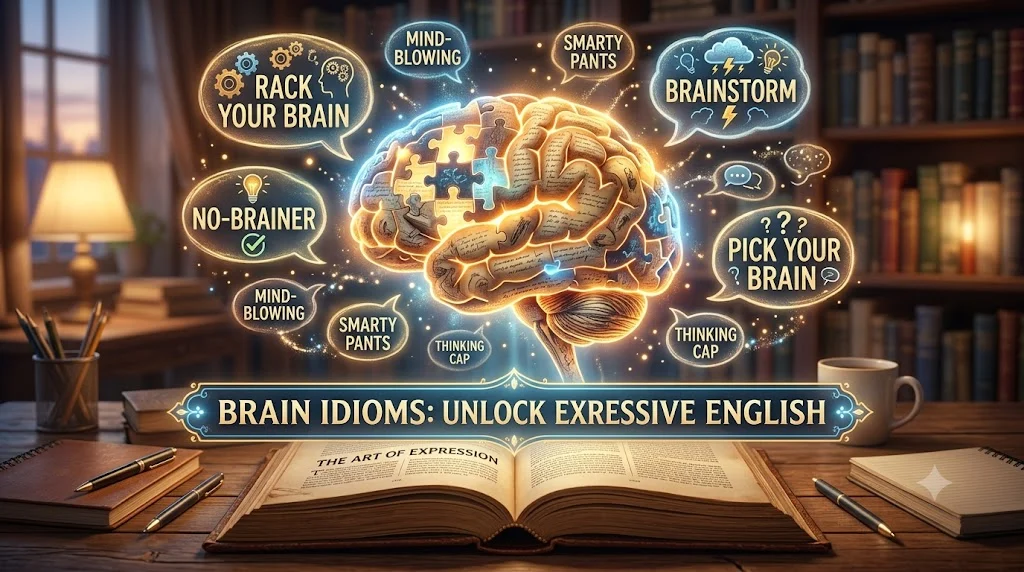
Brain idioms are English expressions that describe intelligence, thinking, memory, decision-making, and mental abilities in a figurative way.Common examples include pick someone’s brain, rack your brain, brainstorm, use your head, and have something on the brain.
The human brain is the most fascinating, complex, and powerful organ in our body. It controls how we think, feel, remember, and process information. Because the brain plays such a central role in our lives, the English language has naturally developed an incredible collection of idioms and expressions built around this word . These brain idioms allow us to express everything from sudden inspiration to mental exhaustion, from sharp intelligence to momentary forgetfulness often with humor, emotion, and vivid imagery that plain language simply cannot match.
Instead of saying, “I’m thinking hard,” you can say, “I’m racking my brain.” Instead of calling a decision obvious, you can call it a “no-brainer.” These phrases don’t just convey meaning; they paint pictures, evoke emotions, and make conversations more engaging and memorable.
This comprehensive guide explores over 30 powerful brain idioms, their real meanings, practical usage examples, and tips for incorporating them naturally into your daily vocabulary. Whether you are a language learner aiming to sound more native-like, a writer looking to add color to your work, or a professional wanting to communicate more effectively, this guide will help you understand and master these expressive phrases.
What Are Brain Idioms?
Brain idioms are expressions that use the word “brain” or relate to mental processes, thinking, intelligence, and cognitive states . These idioms draw from the brain’s role as the center of thought, memory, and reasoning to create phrases that are both vivid and widely understood.
Unlike the literal meaning of the word “brain” the organ inside your skul hese idioms use the brain as a metaphor for your mind, intellectual capacity, or cognitive experience. For example, when someone says “I need to pick your brain,” they are not suggesting anything literal or surgical. Instead, they are using the brain as a symbol for knowledge and ideas .
Brain idioms appear frequently in everyday conversations, literature, movies, and even professional settings. They make language more colorful and precise, often adding a touch of humor or exaggeration that makes communication more engaging .
Idioms for Smart Thinking and Intelligence
These brain idioms are used to describe intelligence, cleverness, and quick thinking. They can be used as compliments, descriptions, or even playful teasing depending on context.
1. All Brawn and No Brain
Meaning: This phrase describes someone who is physically strong but lacks intelligence or mental sharpness .
When to Use: It is often used humorously or critically to describe someone who relies on physical strength over mental capability.
Examples:
- Formal: “Despite his impressive athletic abilities, he’s often dismissed as all brawn and no brain by his colleagues.”
- Casual: “My cousin can lift twice his weight, but he’s all brawn and no brain when it comes to solving problems.”
- Creative: “The superhero was all brawn and no brain, smashing through walls without a second thought about the consequences.”
2. Have a Brain Like a Sponge
Meaning: To learn or absorb information very quickly and easily .
When to Use: This is a positive expression used to compliment someone’s ability to pick up new skills or knowledge.
Examples:
- Formal: “Our new intern has a brain like a sponge; she mastered the complex software in just two days.”
- Casual: “My little brother has a brain like a sponge he remembers every single fact about dinosaurs after watching one documentary.”
- Creative: “The classroom was filled with young students whose brains were like sponges, soaking up every word the teacher spoke.
3. Have a Mind Like a Steel Trap
Meaning: To have an exceptionally good memory and the ability to think clearly and logically .
When to Use: This is used to describe someone who remembers everything and rarely forgets details.
Examples:
- Formal: “The lawyer has a mind like a steel trap, recalling every detail of the case from years ago.”
- Casual: “Don’t worry about forgetting the directions; Sarah has a mind like a steel trap.”
- Creative: “His mind was a steel trap, snapping up information and holding it tight forever.”
4. Brainy
Meaning: Very intelligent or smart .
When to Use: This is a simple, straightforward adjective to describe someone who is academically or intellectually gifted.
Examples:
- Formal: “The scholarship committee selected the brainy candidate with a perfect academic record.”
- Casual: “My sister is so brainy; she always helps me with my math homework.”
- Creative: “The brainy girl quietly solved the puzzle while the rest of the class still struggled to understand the instructions.”
5. Brainbox / Brainiac
Meaning: A very intelligent person; a genius .
When to Use: These are informal and sometimes playful terms for someone who is exceptionally smart.
Examples:
- Formal: “The research team was led by a brainbox from MIT who had previously solved complex engineering problems.”
- Casual: “I wish I was a brainiac like her; she never fails a test.”
- Creative: “The computer club was full of brainiacs who could code circles around anyone else.”
6. Brains over Beauty
Meaning: This phrase emphasizes that intelligence and intellectual capability are more important than physical appearance .
When to Use: It is often used to express a value system that prioritizes mental attributes over superficial qualities.
Examples:
- Formal: “The company’s hiring philosophy is brains over beauty; they prioritize intellectual skills in every candidate.”
- Casual: “I’d rather date someone smart than just good-looking brains over beauty!”
- Creative: “In the world of ideas, it was always brains over beauty, where sharp minds were celebrated above all else.”
Idioms for Creative Thinking and Ideas
These expressions focus on generating new ideas, sudden inspiration, and collaborative thinking.
7. Brainstorm
Meaning: To produce many ideas quickly, often as part of a group activity .
When to Use: It is common in business meetings, classroom settings, and any collaborative environment where creativity is needed.
Examples:
- Formal: “We need to brainstorm potential marketing strategies for the product launch.”
- Casual: “Let’s brainstorm ideas for the party this weekend.”
- Creative: “The team gathered around the whiteboard, ready to brainstorm until they stumbled upon the perfect idea.”
8. Brainchild
Meaning: An original idea, invention, or creation that someone has developed .
When to Use: This phrase is used to give credit to the person behind a particular project or concept.
Examples:
- Formal: “The innovative software was the brainchild of a young developer from our technology team.”
- Casual: “This entire campaign is Lisa’s brainchild; she came up with everything.”
- Creative: “The museum exhibition was the brainchild of a dreamer who wanted to bring history to life.”
9. Brainwave
Meaning: A sudden, brilliant idea or inspiration .
When to Use: This is used to describe that “aha!” moment when a solution appears seemingly out of nowhere.
Examples:
- Formal: “During the conference, I had a brainwave about how we could solve the supply chain problem.”
- Casual: “I was taking a shower when I had a brainwave about my essay topic.”
- Creative: “Like a flash of lightning, the brainwave struck him, and he knew exactly what he had to do.”
10. Brain Spark
Meaning: A quick, clever idea that comes to mind suddenly .
When to Use: This is a more modern, informal expression for a sudden moment of clarity.
Examples:
- Formal: “His presentation included a brain spark that completely changed the direction of our discussion.”
- Casual: “I had a brain spark in the middle of class and figured out the answer.”
- Creative: “She stared at the blank page until a tiny brain spark ignited her creativity.”
11. Brainstorming Session
Meaning: A dedicated meeting or time period for generating ideas together .
When to Use: It is a common term in professional and academic settings.
Examples:
- Formal: “We have scheduled a brainstorming session for Monday morning to discuss the upcoming project.”
- Casual: “Let’s grab some coffee and have a brainstorming session for your story.”
- Creative: “The brainstorming session felt like a storm of ideas, with each person adding more energy to the mix.”
Idioms for Hard Thinking and Memory
These idioms describe the mental effort required to remember, solve problems, or understand complex ideas.
12. Rack Your Brain
Meaning: To try very hard to think of or remember something .
When to Use: This is used when you are struggling to recall information or solve a difficult problem.
Examples:
- Formal: “The investigator racked his brain to remember any detail that could help solve the case.”
- Casual: “I racked my brain for hours trying to remember where I put my keys.”
- Creative: “He racked his brain until it ached, but the answer remained frustratingly out of reach.”
13. Use Your Brain
Meaning: To think carefully before making a decision or solving a problem .
When to Use: This can be encouraging or slightly critical, depending on tone.
Examples:
- Formal: “We encourage all employees to use their brains when approaching complex tasks.”
- Casual: “Come on, use your brain! The answer is right in front of you.”
- Creative: “She knew it was time to use her brain and figure a way out of the predicament.”
14. Wrap Your Brain Around Something
Meaning: To try to understand something that is difficult or complex .
When to Use: This is used when you are grappling with a concept that is hard to comprehend.
Examples:
- Formal: “It took me a while to wrap my brain around the new accounting software, but I eventually understood it.”
- Casual: “I can’t wrap my brain around quantum physics; it’s too confusing.”
- Creative: “She struggled to wrap her brain around the paradox, which seemed to defy all logic.”
15. Brain Teaser
Meaning: A puzzle or question designed to make you think hard .
When to Use: This is often used to describe fun yet challenging mental exercises.
Examples:
- Formal: “The logic test included several brain teasers to assess problem-solving ability.
- Casual: “I love solving brain teasers; they keep my mind sharp.”
- Creative: “The riddle was a perfect brain teaser, sending them on a wild mental chase.”
16. Brain Work
Meaning: Mental effort or concentration required for thinking and studying .
When to Use: This describes the cognitive effort involved in completing a task.
Examples:
- Formal: “Writing this thesis has required significant brain work and long hours.”
- Casual: “This crossword puzzle is real brain work!”
- Creative: “Her brain work was evident in the meticulous, well-researched article she produced.”
Idioms for Mental Exhaustion and Confusion
These expressions describe states of mental fatigue, confusion, or being overwhelmed.
17. Brain is Fried / My Brain Is Fried
Meaning: To be mentally exhausted and unable to think clearly, often after overwork .
When to Use: This is a casual expression used when you have been studying or working too hard.
Examples:
- Formal: “After six hours of data analysis, my brain was completely fried.”
- Casual: “I can’t do any more math; my brain is fried!”
- Creative: “He stared blankly at the screen, his brain thoroughly fried from the marathon coding session.”
18. Brain Fog
Meaning: A feeling of confusion, lack of focus, or inability to think clearly .
When to Use: This often describes a temporary state caused by lack of sleep, stress, or illness.
Examples:
- Formal: “The medication she is taking may cause brain fog as a side effect.”
- Casual: “I have such bad brain fog today; I keep forgetting things.”
- Creative: “The fog of exhaustion crept into his brain, clouding every thought and judgment.”
19. Brain Overload
Meaning: A feeling that your brain is too full of information or problems to process .
When to Use: This describes a state of being overwhelmed by too much input.
Examples:
- Formal: “Employees often experience brain overload during peak project periods.”
- Casual: “I have so many assignments due that I’m experiencing brain overload.”
- Creative: “Every new fact, every piece of information added to her brain overload until she could barely think straight.”
20. Brain Stuck
Meaning: Inability to think clearly or move forward with a task .
When to Use: This describes a mental block where you cannot proceed.
Examples:
- Formal: “I feel like my brain got stuck on this particular coding problem.”
- Casual: “I keep staring at the paper, but my brain is stuck.”
- Creative: “His brain was stuck on the same problem, like a broken record that wouldn’t stop playing.”
21. Fry Your Brain
Meaning: To make yourself mentally exhausted through intense thinking .
When to Use: This is similar to “brain is fried” but often implies a cause.
Examples:
- Formal: “Excessive data analysis can fry your brain if you do not take regular breaks.”
- Casual: “Don’t fry your brain over this test; you’ve studied enough.”
- Creative: “He knew the constant pressure would fry his brain if he didn’t find a way to relax.”
Idioms for Easy Decisions and Obvious Choices
These idioms describe things that are simple, straightforward, and require minimal thought.
22. No-Brainer
Meaning: A decision or choice that is very easy to make because it is so obvious .
When to Use: This is used when one option is clearly superior or the correct choice is immediately apparent.
Examples:
- Formal: “Choosing the more cost-effective supplier was a no-brainer for the procurement team.”
- Casual: “Getting free tickets to the concert was a no-brainer!”
- Creative: “The decision to accept the offer was a no-brainer, as it opened doors she had always dreamed of.”
Idioms for Information and Advice
These expressions involve seeking knowledge, asking for guidance, or sharing ideas.
23. Pick Someone’s Brain
Meaning: To ask someone for information, advice, or their ideas about something .
When to Use: This is used when you want to consult an expert or someone with more knowledge about a topic.
Examples:
- Formal: “I would love to pick your brain about your experience in the industry.”
- Casual: “Can I pick your brain about the best restaurants in town?”
- Creative: “He sought out the old professor to pick his brain, hoping to absorb decades of wisdom.”
24. Pick Someone’s Brain Apart
Meaning: To ask someone many questions to understand their thinking deeply .
When to Use: This is a more intensive version of “pick your brain,” used when you need comprehensive information.
Examples:
- Formal: “The journalist picked apart the candidate’s brain during the interview.”
- Casual: “My little sister picked my brain apart after I came home from the trip.
- Creative: “They picked apart his brain, leaving no thought unexplored and no detail unexamined.”
Idioms for Mental Lapses and Forgetfulness
These idioms describe temporary moments of forgetfulness, silliness, or lack of focus.
25. Brain Fart
Meaning: A temporary moment where you cannot think clearly or forget something obvious .
When to Use: This is a very informal, humorous way to explain a momentary mental lapse.
Examples:
- Formal: (Rarely used formally) “I experienced a brief memory lapse during the presentation.”
- Casual: “I had a brain fart and forgot my own phone number!”
- Creative: “In the middle of his speech, a brain fart struck, and he stood speechless for a moment.”
26. Scatterbrained
Meaning: A forgetful, disorganized, or unfocused person .
When to Use: This is used to describe someone who often loses things, forgets appointments, or cannot concentrate.
Examples:
- Formal: “He is known to be scatterbrained, often missing important deadlines.”
- Casual: “I’m so scatterbrained today; I left my wallet at home.”
- Creative: “Her scatterbrained nature meant she had a trail of forgotten umbrellas and misplaced keys wherever she went.”
27. Birdbrain
Meaning: A silly or unintelligent person .
When to Use: This is an informal and often playful insult, referring to the small size of a bird’s brain.
Examples:
- Formal: (Not used formally)
- Casual: “Don’t be such a birdbrain; you left the door unlocked again!”
- Creative: “The comedian played the character of a lovable birdbrain who always got into trouble.”
Idioms for Preoccupation and Obsession
These idioms describe thoughts that dominate your mind and refuse to go away.
28. Have Something on the Brain
Meaning: To think about something constantly or to be obsessed with a particular topic .
When to Use: This is used when you cannot stop thinking about something, whether positive or negative.
Examples:
- Formal: “Financial stability has been on his brain ever since he started his own business.”
- Casual: “My son has video games on the brain; it’s all he talks about.”
- Creative: “The melody was stuck on his brain, playing on a loop day and night.”
29. One-Track Mind
Meaning: When someone is obsessed with a particular topic and can only think about that one thing .
When to Use: This is often used to describe someone who is focused on one specific interest to the exclusion of everything else.
Examples:
- Formal: “His one-track mind for profit made it difficult for him to consider other business factors.”
- Casual: “Teenage boys often have a one-track mind when it comes to sports.”
- Creative: “All he could think about was the upcoming race; his one-track mind was filled with nothing else.”
30. Live Rent-Free in Someone’s Head
Meaning: Something that occupies your mind constantly, often in an obsessive or annoying way .
When to Use: This is a modern, informal expression that has become very popular in recent years.
Examples:
- Formal: “The negative feedback from the review continues to live rent-free in her mind.”
- Casual: “That song lives rent-free in my head; I can’t stop humming it.”
- Creative: “Her words lived rent-free in his head, a constant presence he couldn’t shake off.”
Brain Drain and Other Serious Idioms
These brain idioms address more serious topics like the loss of intellectual talent or the influence of ideas.
31. Brain Drain
Meaning: The emigration or loss of intelligent, well-educated people from a particular place .
When to Use: This is used in discussions about economics, politics, and social issues.
Examples:
- Formal: “The country is suffering from a severe brain drain as top scientists move abroad for better opportunities.”
- Casual: “There’s been a brain drain from our university since they cut the research budget.”
- Creative: “The small town experienced a brain drain as its brightest young minds left for the city, never to return.”
32. Brainwash
Meaning: To persuade or manipulate someone into adopting a new set of beliefs, often by using methods that control their thinking .
When to Use: This is a serious term used to describe extreme influence, sometimes in contexts of cults, propaganda, or advertising.
Examples:
- Formal: “There are concerns that internet algorithms are used to brainwash users into specific ideologies.”
- Casual: “Don’t let the advertising brainwash you into buying things you don’t need.”
- Creative: “The totalitarian regime tried to brainwash its citizens, rewriting history and controlling every thought.”
Modern and Slang Brain Idioms for 2026
Language constantly evolves, and new brain-related expressions have gained popularity in recent years, especially online and among younger generations.
33. Big Brain Energy
Meaning: To act or speak in a way that shows exceptional intelligence, cleverness, or insight .
When to Use: This is a modern, playful way to compliment someone’s smart move or idea.
Examples:
- Formal: (Usually informal) “That was a move with real big brain energy.”
- Casual: “She saved us all with that plan that’s big brain energy.”
- Creative: “The creative director brought pure big brain energy to the campaign, turning a simple idea into something brilliant.”
34. Brain Rot
Meaning: The cognitive fog or mental decline that some associate with excessive internet scrolling and consuming low-quality online content .
When to Use: This word was popularized online and is often used humorously to describe the effects of too much social media.
Examples:
- Formal: “Experts warn of the potential for brain rot from excessive consumption of short-form video content.”
- Casual: “I feel like I have brain rot after spending three hours on social media.”
- Creative: “He emerged from the internet rabbit hole, his brain suffering from rot and his head filled with useless memes.”
35. Brain Dump
Meaning: To write down everything you know or all your thoughts about a topic without organizing them .
When to Use: This is often a technique used to clear your mind or prepare for a project.
Examples:
- Formal: “Before starting the project, we recommend doing a brain dump to capture all your initial ideas.”
- Casual: “I did a brain dump of everything I need to do this week.”
- Creative: “She took a pen and paper, performing a brain dump that released the chaos inside onto the page.”
How to Use Brain Idioms Naturally
Using idioms effectively isn’t just about knowing what they mean; it’s about using them in the right context and with the right frequency. Here are some practical tips:
Match the Situation:
Not all brain idioms are appropriate for all settings. For example, “brain fart” is too casual for a boardroom, while “brain drain” would be perfect for a discussion about the economy. “Brainstorm” is widely accepted in both formal and informal professional contexts. Understanding the tone of your conversation is crucial.
Know Your Audience:
Younger colleagues might appreciate expressions like “brain rot” or “big brain energy” in a casual chat, but an older audience or a more formal setting might require more traditional expressions. When in doubt, stick with well-established idioms like “rack your brain” or “pick your brain.
Use Idioms Sparingly:
Idioms are effective because they are colorful and expressive, but using too many in a single conversation can make your speech sound forced or unnatural. One well-placed idiom is more impactful than a dozen crammed into every sentence. They are the spice of language, not the main meal.
Practice with Creative Sentences:
To truly internalize these idioms, try creating sentences that are personal and vivid. Instead of “I did a lot of brain work,” try “My brain was fried after that seven-hour study session.” The more you connect idioms to real experiences, the more naturally they will come to you.
Common Mistakes to Avoid
Even advanced English speakers can make mistakes with idioms. Here are some pitfalls to watch out for:
Using the Wrong Preposition:
Some idioms require specific prepositions, and changing them can make the phrase sound incorrect. For example, it is “rack your brain,” not “rack at your brain.” It is “pick someone’s brain,” not “pick from someone’s brain.”
Mixing Metaphors:
A classic mistake is mixing two idioms together, creating a nonsensical phrase. Avoid combining expressions, such as saying “I need to rack and pick your brain.” Keep the idioms separate and complete.
Using Offensive Idioms in Serious Contexts:
Phrases like “birdbrain” can be insulting. Use them only in playful, casual contexts with people who understand your intent. Avoid using any idiom that belittles intelligence in professional or sensitive settings.
Forgetting the Context:
“Brain rot” can be a fun way to describe a lazy afternoon, but using it to describe a serious cognitive condition would be inappropriate. Always match the severity of the idiom to the seriousness of the situation.
Practice Exercises
To help you master these idioms, try these exercises:
1: Fill in the Blanks
- After five hours of studying, I have a serious case of ____________________.
- Choosing the new plan is a ____________________; it is clearly the best option.
- Can I ____________________ your brain about the best way to prepare for the exam?
- My grandfather has a mind like a ____________________; he never forgets a story.
- The country is experiencing a ____________________ as its top talent moves overseas.
2: Create Your Own Sentences
Write sentences using each of these idioms:
- Brainstorm
- Brainchild
- Fry your brain
- Wrap your brain around
- On the brain
3: Identify the Idiom
What does “I can’t wrap my brain around this math problem” mean? Write down the meaning and then write another sentence using the same idiom.
FAQs
1. What are the most common brain idioms?
The most frequently used brain idioms include “rack your brain,” “pick your brain,” “brainstorm,” “no-brainer,” and “have something on the brain.” These expressions appear regularly in both spoken and written English .
2. Are brain idioms formal or informal?
Most brain idioms are informal and best suited for casual conversation. However, some idioms like “brainstorm,” “no-brainer,” and “brain drain” are widely accepted in professional and academic settings .
3. Can I use brain idioms in professional emails?
Yes, but choose carefully. Idioms like “brainstorm” and “pick your brain” are common in professional emails. However, avoid overly casual ones like “brain fart” or “birdbrain” in a formal message.
4. How can I remember brain idioms more easily?
Connect them to real situations in your mind. For instance, picture the last time you struggled to remember a name that is “racking your brain.” Visualizing the idiom’s meaning can make it stick. Practicing in conversation also helps tremendously.
5. Do native English speakers use brain idioms often?
Yes! Brain idioms are a staple of everyday English. Native speakers use them to express mental effort, inspiration, intelligence, and forgetfulness in a relatable and often colorful way .
Conclusion
Brain idioms are a testament to the creativity and expressiveness of the English language. They allow us to articulate complex mental states from the agony of forgetting a name to the excitement of a sudden idea with clarity, emotion, and often a touch of humor. Whether you are “racking your brain” over a difficult problem, experiencing a “brainwave” of inspiration, or describing a “no-brainer” decision, these expressions make your communication more vivid and engaging.
By learning and practicing these idioms, you can elevate your language skills, sound more natural, and connect better with native speakers. Remember to match your idioms to the situation, use them appropriately, and have fun experimenting with them in your daily conversations. Language is a living, breathing thing, and brain idioms are one of the most dynamic and colorful parts of it.
So go ahead pick someone’s brain, brainstorm new ideas, and don’t worry if you experience the occasional brain fart. It is all part of the beautiful complexity of the human mind and the incredible way we speak about it.
Read More Related Articles:
- Idioms for Clear | Expressing Understanding, Transparency & Obviousness In 2026
- Idioms for Peace | Expressing Calm, Harmony & Resolution In 2026
- Idioms for Simple | Express Clarity & Ease In 2026

Tyler Zone is an American writer at IdiomCrafter.com, who enjoys exploring the meaning behind everyday phrases. He focuses on making idioms simple and relatable for readers of all backgrounds. In his free time, he likes discovering new expressions and how people use them in daily life.