Quick Answer
Idioms for “stupid people” are colorful expressions used to describe foolish, unintelligent, slow-thinking, or careless behavior often in a humorous, sarcastic, or casual way.
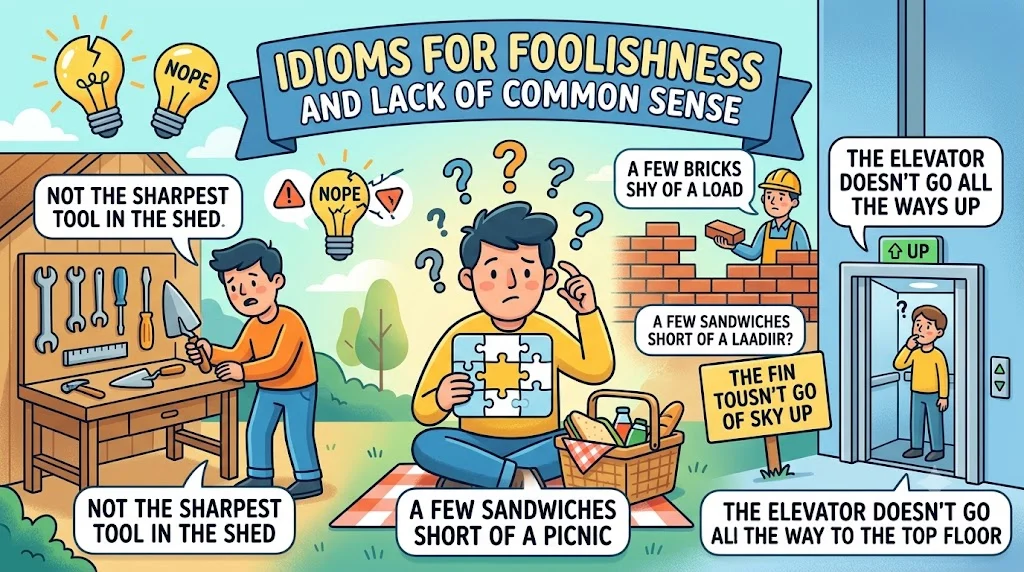
Examples: not the sharpest tool in the shed, a few sandwiches short of a picnic, have rocks in your head
We all encounter moments in life where words like “stupid” or “dumb” just don’t capture the full picture. Maybe someone made an incredibly poor decision, or perhaps a person consistently fails to grasp the simplest concepts. In these situations, the English language offers something far more colorful and expressive than a single blunt word.
Idioms for stupidity have existed in English for centuries. They carry humor, sarcasm, and cultural wisdom all at once. When someone says “he’s not the sharpest tool in the shed,” you immediately understand the situation without anyone being overtly rude. These expressions soften the criticism while making the message perfectly clear.
These idioms are especially useful in storytelling, comedy writing, casual conversations, and even professional commentary when used carefully. They allow you to describe a lack of intelligence or poor judgment without sounding harsh or offensive in most contexts.
In this guide, you will learn:
Powerful idioms for describing stupid or foolish people
Real meanings and the situations where they apply
Formal, casual, and creative examples for each
Practical tips for using them naturally and respectfully
Common mistakes to avoid when using these expressions
Let’s explore the most expressive idioms that bring language to life when describing foolishness and lack of good judgment.
Quick Summary Table
| Situation | Idioms |
|---|---|
| General lack of intelligence | Not the sharpest tool in the shed, Dim bulb |
| Poor judgment or decision-making | Have rocks in your head, Take leave of your senses |
| Slow thinking or understanding | Thick as a brick, Not the brightest bulb |
| Foolish or silly behavior | A few sandwiches short of a picnic, Daft as a brush |
| Confused or lost | Not all there, Missing a few screws |
| Careless or thoughtless actions | Act without thinking, Jump in with both feet |
Idioms for General Lack of Intelligence
Some idioms are used broadly to describe someone who consistently lacks intelligence or common sense in everyday situations. They can range from mildly humorous expressions to sharper ways of describing poor thinking.
1. Not the Sharpest Tool in the Shed
This is one of the most widely recognized idioms for describing someone who is not very intelligent. It uses the image of a dull tool that cannot perform its job effectively.
Meaning: Not very intelligent or clever
When People Use It: When describing someone who regularly makes poor decisions or struggles to understand simple things
Alternative Expression: Not very bright
Examples:
Formal: He is, to put it diplomatically, not the sharpest tool in the shed.
Casual: Don’t ask him to handle it. He’s not exactly the sharpest tool in the shed.
Creative: Among the tools hanging in life’s workshop, his blade had long since lost its edge.
2. Dim Bulb
This idiom compares a person’s mind to a light bulb that does not shine brightly. It suggests someone who lacks mental sharpness or takes longer to understand things.
Meaning: A person who is slow witted or not very intelligent
When People Use It: Informal conversations about someone’s lack of mental sharpness
Alternative Expression: Not very smart
Examples:
Formal: The candidate proved to be something of a dim bulb during the interview process.
Casual: He’s a nice guy, but honestly, he’s a bit of a dim bulb.
Creative: His thoughts flickered weakly where others blazed with clarity.
3. Not the Brightest Bulb in the Box
A variation of the dim bulb expression, this idiom extends the metaphor by imagining a box of bulbs where one shines less brightly than the others.
Meaning: One of the least intelligent people in a group
When People Use It: Comparative situations where someone clearly stands out for their lack of intelligence
Alternative Expression: The least clever of the group
Examples:
Formal: Among the applicants, he was clearly not the brightest bulb in the box.
Casual: Bless his heart, he’s not the brightest bulb in the box.
Creative: In a room full of brilliant lights, his corner remained quietly dim.
Usage Insight: These idioms work especially well when you want to describe someone’s intelligence without being aggressively rude about it.
Idioms for Poor Judgment or Decision Making
Sometimes foolishness is less about intelligence and more about consistently making poor choices or showing terrible judgment.
4. Have Rocks in Your Head
This vivid idiom suggests that instead of a functioning brain, a person has rocks sitting inside their head, making useful thought almost impossible.
Meaning: To make extremely poor decisions or show terrible judgment
When People Use It: When someone does something that seems completely unreasonable or illogical
Alternative Expression: Use terrible judgment
Examples:
Formal: Anyone who agrees to those terms must have rocks in their head.
Casual: You sold your car for that price? You’ve got rocks in your head!
Creative: Where wisdom should have settled, only stones remained.
5. A Few Sandwiches Short of a Picnic
One of the most humorous idioms in English, this expression creates the image of someone arriving at a picnic without all the necessary sandwiches.
Meaning: Slightly foolish, not quite mentally complete, or making poor decisions
When People Use It: Lighthearted or humorous criticism of someone’s thinking
Alternative Expression: Not quite all there
Examples:
Formal: His proposal suggested he might be a few sandwiches short of a picnic.
Casual: She agreed to that deal? She’s a few sandwiches short of a picnic.
Creative: He arrived at life’s picnic enthusiastic but oddly underprepared.
6. Not Have the Sense God Gave a Goose
This old fashioned idiom suggests that someone lacks even the basic common sense that an animal might naturally possess. The comparison is deliberately humorous and cutting.
Meaning: Lacking even basic common sense
When People Use It: When someone does something so foolish that it seems to defy basic logic
Alternative Expression: Have no common sense
Examples:
Formal: He clearly does not have the sense that one might expect from a person in his position.
Casual: That boy doesn’t have the sense God gave a goose.
Creative: Even the birds circling overhead seemed to understand what he could not.
Idioms for Slow Thinking or Understanding
These idioms describe people who take a long time to understand things or consistently struggle to grasp concepts that others find simple.
7. Thick as a Brick
This straightforward British idiom compares a person’s mental capacity to a brick, an object not particularly known for intelligence or flexibility.
Meaning: Extremely slow to understand or learn
When People Use It: When someone cannot grasp a concept despite repeated explanations
Alternative Expression: Very slow to understand
Examples:
Formal: Despite repeated explanations, he remained as thick as a brick.
Casual: I’ve told him three times. He’s thick as a brick.
Creative: Explanations poured over him like water over stone, absorbed by nothing.
8. Slow on the Uptake
A gentler idiom that describes someone who is slow to understand or respond to new information. It suggests delayed understanding rather than a complete lack of intelligence.
Meaning: Slow to understand something
When People Use It: When someone takes much longer than expected to grasp a concept or situation
Alternative Expression: Take a long time to understand
Examples:
Formal: He is competent in many areas but tends to be slow on the uptake.
Casual: She eventually got it, but she’s always a bit slow on the uptake.
Creative: Understanding reached him eventually, arriving like the last train of the evening.
9. Can’t See Past the End of Your Nose
This idiom describes someone with an extremely limited perspective who cannot think beyond the most immediate information in front of them.
Meaning: Unable to think broadly or see beyond immediate circumstances
When People Use It: When someone fails to consider obvious consequences or the larger context
Alternative Expression: Shortsighted in thinking
Examples:
Formal: His planning suffered because he simply could not see past the end of his nose.
Casual: He can’t see past the end of his nose when it comes to these things.
Creative: The horizon stretched endlessly before him, yet he only ever watched his feet.
Usage Insight: These idioms are especially effective in storytelling and character descriptions when you want to show mental limitations without stating them bluntly.
Idioms for Foolish or Silly Behavior
Some people are not necessarily unintelligent but consistently behave in ways that are foolish, silly, or thoughtless enough to leave others shaking their heads.
10. Daft as a Brush
A cheerful British idiom that describes someone who behaves in a silly or foolish way. The word daft means silly or foolish, while the comparison to a brush creates an amusing image.
Meaning: Very silly or foolish in behavior
When People Use It: Affectionate or light criticism of someone’s silly actions
Alternative Expression: Very silly
Examples:
Formal: His antics during the presentation were, frankly, daft as a brush.
Casual: Oh, he’s daft as a brush, but we love him for it.
Creative: He moved through the world with the cheerful, uncalculating sweep of a brush.
11. Not Have a Clue
A very common and versatile expression that describes someone who has absolutely no understanding of what is happening or what they are supposed to be doing.
Meaning: Completely unaware or ignorant about something
When People Use It: When someone is obviously clueless in a particular situation
Alternative Expression: Have no idea
Examples:
Formal: He presented the report confidently but clearly did not have a clue.
Casual: She doesn’t have a clue what she’s doing.
Creative: He navigated confidently through territory he had never once mapped.
12. Make a Complete Fool of Yourself
This idiom describes behaving so foolishly in public or in front of others that you embarrass yourself through your own lack of judgment or awareness.
Meaning: Behave in a way that makes others see you as foolish
When People Use It: When someone’s behavior is embarrassingly unintelligent or inappropriate
Alternative Expression: Embarrass yourself completely
Examples:
Formal: His remarks at the conference caused him to make a complete fool of himself.
Casual: He made a complete fool of himself at the party.
Creative: He handed the audience his dignity without realizing he had done so.
Idioms for Confused or Lost Behavior
Sometimes foolishness is not a permanent trait. It can appear as a moment of confusion when someone seems genuinely lost even in simple situations.
13. Not All There
A gentle and somewhat sympathetic idiom suggesting that someone’s full mental faculties are not present or functioning as expected.
Meaning: Not mentally sharp or fully present in thinking
When People Use It: When someone seems confused, distracted, or mentally absent
Alternative Expression: Not fully focused
Examples:
Formal: During the meeting, he seemed simply not all there.
Casual: I don’t know, lately he just seems not all there.
Creative: His mind occupied a room no one else could enter or fully see.
14. Missing a Few Screws
This mechanical metaphor suggests that a person is like a machine with missing parts, unable to function correctly because something essential is absent.
Meaning: Slightly foolish, unstable in thinking, or acting strangely
When People Use It: Humorous descriptions of eccentric or foolish behavior
Alternative Expression: A little strange or foolish
Examples:
Formal: His logic in the proposal suggested he might be missing a few screws.
Casual: That guy is definitely missing a few screws.
Creative: He functioned daily, but certain essential things had never been tightened into place.
15. Lost the Plot
This modern and widely used idiom suggests that someone has completely lost track of reality, logic, or the basic understanding of a situation. It is particularly common in British English.
Meaning: To become confused, act irrationally, or completely misunderstand a situation
When People Use It: When someone’s behavior or logic makes absolutely no sense
Alternative Expression: Completely lost
Examples:
Formal: The director appeared to have lost the plot entirely by the third quarter.
Casual: He’s totally lost the plot, hasn’t he?
Creative: Somewhere in the middle of his own story, he forgot which character he was meant to be.
Idioms for Careless or Thoughtless Actions
These idioms describe people who act without thinking, rushing into situations without considering the possible consequences of their choices.
16. Jump in With Both Feet
This idiom describes someone who rushes into a situation without taking enough time to think it through, often creating problems that careful planning could have avoided.
Meaning: To act without thinking carefully first
When People Use It: Impulsive decisions or careless actions
Alternative Expression: Rush in without thinking
Examples:
Formal: He jumped in with both feet before fully understanding the implications.
Casual: She always jumps in with both feet without thinking first.
Creative: He leaped before the ground had even confirmed it would hold him.
17. Not Think Things Through
This straightforward expression describes the habit of making decisions or taking actions without properly considering all the factors and possible consequences.
Meaning: Fail to consider the full consequences of an action
When People Use It: When someone makes an avoidable mistake through a lack of thought
Alternative Expression: Act without planning
Examples:
Formal: The failure resulted from a tendency not to think things through.
Casual: He never thinks things through before he acts.
Creative: He planted seeds in soil he had never stopped to examine.
18. Bite Off More Than You Can Chew
This widely used idiom describes someone who takes on more than they are capable of handling, usually because they overestimate their abilities or fail to consider their limitations.
Meaning: Take on more than you can manage or handle
When People Use It: When someone fails because they took on too much without thinking realistically
Alternative Expression: Overcommit beyond your abilities
Examples:
Formal: He clearly bit off more than he could chew with that project.
Casual: She’s bitten off way more than she can chew again.
Creative: He filled his plate generously, then stared at it with growing dread.
Idioms for Stubborn Ignorance
Some people are not just unaware of their foolishness. They actively resist learning or refuse to accept obvious truths, combining stubbornness with poor judgment.
19. Bury Your Head in the Sand
This vivid idiom describes someone who refuses to acknowledge obvious problems or facts right in front of them.
Meaning: Refuse to acknowledge obvious truths or problems
When People Use It: When someone deliberately ignores clear information or refuses to face reality
Alternative Expression: Refuse to face reality
Examples:
Formal: Management continued to bury its head in the sand despite clear warning signs.
Casual: He’s just burying his head in the sand about the whole situation.
Creative: He built a comfortable darkness and called it peace of mind.
20. You Cannot Teach an Old Dog New Tricks
This classic proverb describes someone who is too set in their ways to learn new things, change habits, or accept new methods.
Meaning: Some people are too stubborn or fixed in their habits to learn or change
When People Use It: When someone repeatedly refuses to adopt new ideas or methods
Alternative Expression: Too stubborn to change
Examples:
Formal: Resistance to the new system seemed to prove the old saying that you cannot teach an old dog new tricks.
Casual: He’ll never change his ways. You know what they say about old dogs.
Creative: His habits had calcified over the years into something resembling certainty.
21. Talk to a Brick Wall
This expressive idiom describes the experience of trying to explain something to someone who simply will not listen or understand, no matter how clearly you communicate.
Meaning: Try to communicate with someone who refuses to listen or understand
When People Use It: Frustration with stubborn or unresponsive people
Alternative Expression: Waste your breath
Examples:
Formal: Attempting to reason with him was like talking to a brick wall.
Casual: Explaining it to her is like talking to a brick wall.
Creative: His words scattered and fell, finding no surface willing to receive them.
Idioms for Overconfident Stupidity
Perhaps the most frustrating kind of foolishness occurs when someone lacks good judgment but remains completely confident in their own opinions.
22. Know It All
While not a traditional idiom in the strictest sense, this expression is deeply embedded in everyday English. It describes someone who believes they know everything and often refuses to accept advice or correction.
Meaning: A person who believes they know everything and ignores others’ input
When People Use It: Describing arrogant, overconfident, and often misguided people
Alternative Expression: Overconfident and ignorant
Examples:
Formal: His know it all attitude created tension throughout the team.
Casual: Nobody likes working with a know it all.
Creative: He moved through every room as though he had already read its ending.
23. Penny Wise and Pound Foolish
This classic idiom describes someone who is careful and sensible with small matters but makes surprisingly poor decisions when it comes to larger or more important issues.
Meaning: Careful with small things but foolish with larger and more important decisions
When People Use It: Describing poor priorities or misplaced judgment
Alternative Expression: Shortsighted about what truly matters
Examples:
Formal: The company’s approach was decidedly penny wise and pound foolish.
Casual: He saved money on the cheap parts and lost a fortune overall. Penny wise, pound foolish.
Creative: He counted every leaf while the forest quietly disappeared around him.
24. Cutting Off Your Nose to Spite Your Face
A dramatic idiom that describes doing something foolish that ends up harming yourself more than anyone else, usually because of stubbornness or a misguided desire for revenge.
Meaning: Doing something harmful to yourself in an attempt to hurt or spite someone else
When People Use It: Describing self defeating foolishness or decisions that ultimately cause personal harm
Alternative Expression: Hurt yourself trying to hurt others
Examples:
Formal: Rejecting the offer was simply cutting off his nose to spite his face.
Casual: She turned down the job just to prove a point. Classic cutting off your nose to spite your face.
Creative: In his determination to wound others, he forgot to protect himself.
How to Use Idioms for Stupid People Naturally
Using idioms related to stupidity or foolishness can make your language far more expressive and engaging, but only if you approach them with the right tone, timing, and level of care. The goal is always to sound natural and appropriate for the situation, not to genuinely hurt or humiliate anyone.
Match the Situation
Not all idioms for stupidity carry the same weight. Some are gentle and even affectionate, while others carry a sharper edge. Choosing the right one for the right moment is essential.
For lighthearted or affectionate teasing among friends: daft as a brush, a few sandwiches short of a picnic
For genuine frustration with someone’s poor judgment: have rocks in your head, talk to a brick wall
For describing habitual foolishness: not the sharpest tool in the shed, not the brightest bulb
Insight: Think of these idioms as tools with different weights. Use a light one when humor is appropriate and a heavier one only when the situation truly calls for directness.
Keep Tone in Mind
This is where many people go wrong. The same idiom can sound funny in one context and genuinely unkind in another. In professional settings, some of these expressions can come across as dismissive or even offensive.
For example, saying “he’s thick as a brick” in a casual conversation with a close friend reads as humorous. Saying the same thing in a workplace review or public setting would be inappropriate and potentially harmful to someone’s reputation.
Pro Tip: In formal or professional environments, opt for neutral language. Save idioms for casual conversations, creative writing, comedy, or storytelling where the intent is clear and the relationship is appropriate.
Use Sparingly
Like all idioms, these expressions lose their power when overused. If you call everything and everyone foolish using a string of idioms in every sentence, your language starts to feel exaggerated and loses all impact.
Instead, choose one strong expression that captures exactly what you want to say and let it do the work.
Golden Rule: One well-chosen idiom lands far more effectively than five crowded into a single conversation.
Common Mistakes to Avoid
Even experienced English speakers make errors when using idioms related to stupidity. Here are the most important pitfalls to watch out for:
Using these idioms to describe genuine mental health conditions
Many idioms for stupidity emerged long before modern understanding of mental health and cognitive differences. Using them to describe someone with a genuine learning disability, cognitive condition, or mental illness is harmful and inappropriate. These idioms are for describing behavior and choices, not medical conditions.
Confusing playful teasing with genuine insult
There is a meaningful difference between using “daft as a brush” affectionately between friends and calling someone “thick as a brick” in a public or professional setting. Always consider your relationship with the person and the audience present.
Applying them incorrectly based on misunderstood meaning
Some of these idioms are easy to misapply. “Penny wise and pound foolish” for example does not simply mean cheap. It specifically describes making a small smart choice that leads to a larger foolish outcome. Using it in the wrong context will confuse your listener.
Overusing them to appear clever
There is an unfortunate irony in overusing idioms about stupidity to the point where your own speech becomes confused and excessive. Use them sparingly and with clear purpose.
Practice Method That Actually Works
Learning idioms for stupidity is not about memorizing a list. It is about understanding each expression so well that you can reach for it naturally in real conversation or writing.
Learn Three Idioms at a Time
Do not try to absorb all twenty-five at once. Pick three idioms, understand their meanings, learn the situations they fit, and practice them until they feel natural. Then move on to three more.
Connect Each Idiom to a Real Memory or Story
The most powerful way to remember an idiom is to attach it to something real. Think of a person you know or a situation you have witnessed that perfectly fits each expression. That personal connection will make the idiom far easier to recall and use.
Write One Creative Sentence for Each
Basic sentences help you understand. Creative sentences help you remember. Instead of writing “he is not the sharpest tool in the shed,” try something more vivid: “In a workshop full of gleaming instruments, he had long since lost his edge and nobody had noticed.”
The more emotional and visual your example sentence is, the more effectively the idiom will stick in your memory.
Use Them in Real Conversations
Even small, low-stakes uses in everyday conversation build confidence. Start with the gentler, more humorous idioms in casual situations and notice how people respond. Over time, your instinct for when and how to use them will sharpen naturally.
Memory Trick: Picture the literal image the idiom creates. A dim bulb. A brick. A picnic with missing sandwiches. Visual memory is far stronger than word memory alone.
FAQs
1. What does it mean to call someone stupid with an idiom?
Idioms for stupid people are expressions used to describe foolish behavior, poor judgment, slow understanding, or lack of common sense in a colorful and often humorous way rather than using the blunt word “stupid” directly.
2. Are these idioms offensive?
Some can be, depending on context, tone, and the relationship between speaker and listener. Lighter expressions like “a few sandwiches short of a picnic” are generally harmless and humorous. Heavier ones like “thick as a brick” can feel rude in certain settings. Always consider your audience.
3. Can I use these idioms in professional writing?
Most of these idioms are informal and should generally be avoided in formal professional contexts. However, some gentler expressions can appear in creative nonfiction, humor writing, and editorial commentary when used carefully.
4. Are these idioms used in American and British English?
Yes, though some are more common in one variety than the other. “Thick as a brick” and “daft as a brush” are predominantly British. “Not the sharpest tool in the shed” and “have rocks in your head” are common in American English. Many others are used across both.
5. How do I remember which idiom to use when?
Connect each idiom to the specific emotion or situation it captures. Idioms for slow thinking feel different from idioms for poor judgment or stubborn ignorance. Once you attach each expression to a clear context or personal memory, reaching for the right one in conversation becomes natural.
Conclusion
Idioms for stupid people offer some of the richest, most colorful expressions in the English language. Rather than relying on a single blunt word, these expressions bring personality, humor, and cultural depth to your communication. They allow you to describe foolishness, poor judgment, slow thinking, careless behavior, and stubborn ignorance with precision and creativity.
The key to using them well is straightforward: understand the meaning behind each idiom, match it to the right situation, consider your tone and audience carefully, and practice using them until they feel natural in your speech and writing.
Whether you are writing a story, having a casual conversation, or crafting commentary with a humorous edge, these idioms give your language a texture and expressiveness that plain vocabulary simply cannot match. Once you begin reaching for them naturally, your English will feel richer, more alive, and genuinely more human.
Read More Related Articles:
- Idioms for Stress | Powerful Expressions to Describe Pressure Naturally In 2026
- 25 Idioms for Smile | Express Warmth and Emotion Naturally In 2026
- Idioms for Soccer | Powerful Expressions to Score in English In 2026

Loganx River is a passionate writer at IdiomCrafter.com, where he explores the meanings and stories behind everyday expressions. He enjoys breaking down complex phrases into simple, easy-to-understand ideas for readers. When he’s not writing, he spends his time reading and collecting interesting sayings from different cultures.