Quick Answer
Idioms for a crazy person are colorful expressions used to describe someone who behaves unusually, wildly, or unpredictably. Common examples include off your rocker, out of your mind, and a few sandwiches short of a picnic.
Language is a living thing. It breathes, evolves, and adapts to the way we experience the world around us. And when it comes to describing extreme behavior, unpredictable reactions, or overwhelming emotions, ordinary words simply don’t do justice. That’s where idioms step in.
We all encounter moments that leave us speechless. The colleague who suddenly erupts in frustration. The friend who dances with uncontrollable energy at a party. The driver who swerves through traffic with reckless abandon. In these moments, saying “he’s crazy” feels flat, uninspired, and inadequate.
Idioms for crazy behavior give your language color, depth, and emotional resonance. They help you paint vivid pictures with words, allowing others to feel the intensity of what you’re describing rather than just hearing about it.
This comprehensive guide explores the rich landscape of idiomatic expressions used to describe wild, unusual, and extreme behavior. You’ll discover over 25 powerful idioms, understand their precise meanings, learn when and how to use them naturally, and avoid common pitfalls that make even advanced speakers sound awkward.
Whether you’re an English learner trying to sound more native, a writer seeking creative expressions, or simply someone who wants to communicate more vividly, this guide will transform how you talk about “crazy” behavior.
Let’s dive into the fascinating world of idioms that bring extreme human behavior to life.
Idioms for Sudden Emotional Outbursts
When Reactions Explode Without Warning
Human emotions can be unpredictable. One moment everything is calm, and the next, something triggers an intense reaction that seems to come from nowhere. These idioms capture that sudden shift from composure to chaos.
1. Go Nuts
Meaning: To become extremely excited, angry, or emotionally overwhelmed in an uncontrolled way.
This is one of the most versatile idioms for describing sudden, intense reactions. The word “nuts” suggests a loss of stability, but the idiom can be used for both positive and negative outbursts.
When to Use:
- Unexpected surprises (both good and bad)
- Sporting events with dramatic moments
- Situations where someone’s patience finally breaks
Real-World Examples:
Casual Context:
“When she opened the gift box and saw the concert tickets, she went absolutely nuts. I’ve never seen anyone that happy before.”
Professional Context:
“The boardroom went nuts when the CEO announced the record-breaking quarterly results. Even the most reserved executives were cheering.”
Creative Example:
“The stadium erupted into a frenzy of sound and movement as the underdog team scored the winning goal. Twenty thousand fans went nuts in unison, their collective energy shaking the very foundations of the old arena.”
Subtlety Alert:
“Go nuts” can sound too casual in formal writing. Consider “became highly animated” or “displayed extreme enthusiasm” for professional contexts.
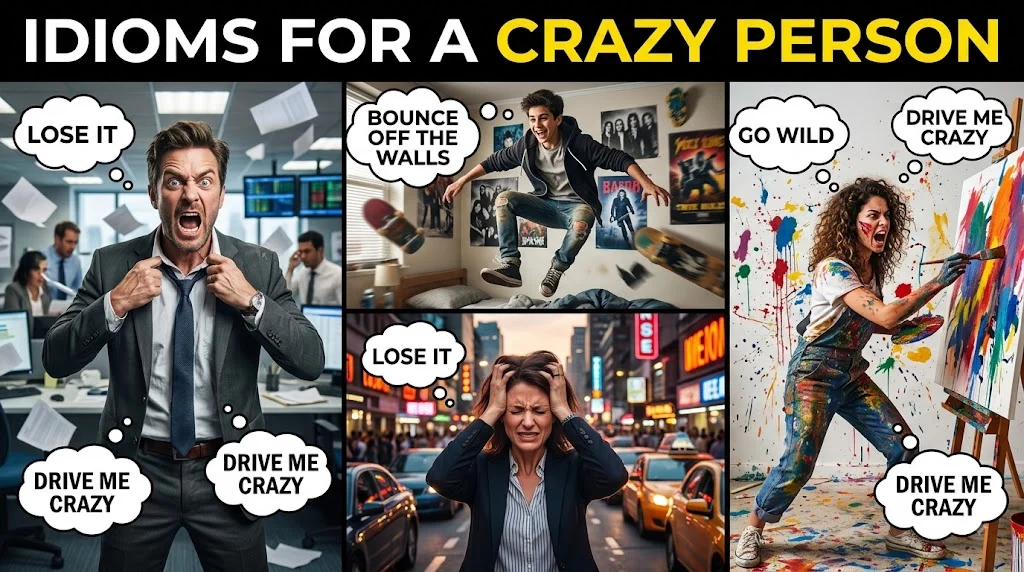
2. Lose It
Meaning: To lose emotional control, often resulting in outbursts of anger, crying, or laughter.
This idiom captures the moment when someone’s carefully maintained composure shatters completely. It’s a favorite because it’s concise yet powerfully descriptive.
When to Use:
- Breaking points after prolonged stress
- Uncontrollable laughter at inappropriate times
- Situations where someone “snaps”
Real-World Examples:
Everyday Conversation:
“I was so exhausted after working three double shifts that I completely lost it when my manager asked me to stay late again.”
In Writing:
“The pressure of the investigation finally took its toll. Under the relentless questioning, Detective Morrison lost it, slamming his fist on the table and storming out of the interrogation room.”
Humor Context:
“I lost it when I walked into the office and saw everyone wearing ridiculous hats for ‘casual Friday.’ My coffee went everywhere.”
Pro Tip:
“Lose it” is often used with intensifiers like “completely,” “totally,” or “almost” to emphasize the degree of emotional breakdown.
3. Flip Out
Meaning: To react with extreme emotion, often in an exaggerated or theatrical way.
Flip out” suggests a sudden change in state, like flipping a switch. The reaction is usually dramatic and attention-grabbing.
When to Use:
- Overreactions that seem disproportionate
- Unexpected shocking news
- Situations where someone “makes a scene”
Real-World Examples:
Social Situations:
“My grandmother flipped out when she found out we were moving to another state. She started crying, yelling, and refused to speak to us for three days.”
In Media:
“The celebrity flipped out when paparazzi surrounded her car, screaming and throwing her designer bag at the photographers.”
Everyday Scenario:
“Don’t flip out, but I accidentally spilled coffee on your new white sofa.”
Cultural Note:
“Flip out” is slightly less intense than “go nuts” and can sometimes be used in a playful or teasing way among friends.
4. Blow a Gasket
Meaning: To become extremely angry and lose control, often suddenly.
The imagery comes from engine mechanics. When a car’s gasket blows, everything stops working properly. Similarly, when a person blows a gasket, their emotional system completely fails.
When to Use:
- Anger that comes out of nowhere
- Situations where someone’s temper finally explodes
- Describing someone who “snapped”
Real-World Examples:
Workplace Context:
“My boss completely blew a gasket when he discovered the project had been delayed by three weeks. I could hear him yelling from across the entire floor.”
Family Situations:
“Dad blew a gasket when he saw the teenager’s dented car in the driveway. The repairs were going to cost more than the car was worth.”
Narrative Example:
“The normally patient teacher blew a gasket when she caught the students cheating again. Her voice rose to a pitch that silenced every child in the room.”
Similar Expressions:
- Blow your top
- Blow your stack
- Lose your temper
5. Freak Out
Meaning: To become extremely upset, anxious, or excited about something.
Freak out” is a modern idiom that captures both anxiety and excitement. It’s particularly common among younger speakers.
When to Use:
- Anxiety attacks or panic moments
- Overwhelming excitement about good news
- Unexpected situations that cause distress
Real-World Examples:
Anxiety Context:
I totally freaked out when I realized I’d left my passport at home, and my flight was boarding in twenty minutes.
Excitement Context:
“She freaked out with happiness when her boyfriend proposed. She couldn’t stop crying and laughing at the same time.”
Everyday Use:
“No need to freak out about the presentation. You’ve prepared well, and you know your material inside out.”
Usage Tip:
“Freak out” can be used as both a verb phrase and as a noun phrase “a freak-out.”
Idioms for Irrational or Unbelievable Behavior
When Actions Defy All Logic
Some behaviors are so far outside normal expectations that they seem completely irrational. These idioms help you describe actions that make others question your sanity.
6. Out of Your Mind
Meaning: Acting in a way that seems completely irrational or unreasonable; sometimes used to express amazement.
This idiom can be used critically (questioning someone’s judgment) or admiringly (acknowledging something incredible).
When to Use:
- Questioning risky decisions
- Expressing disbelief about someone’s choices
- Describing extraordinary achievement
Real-World Examples:
Questioning Judgment:
“Are you out of your mind? There’s no way you should quit your stable job to become a full-time streamer without any savings.”
Admiring Boldness:
“Running a marathon in the desert heat? You’re out of your mind, but I’m genuinely impressed.”
Self-Deprecating:
“I must be out of my mind to agree to organize this huge family reunion all by myself.”
Formal Alternative:
“His decision to invest his entire retirement fund in cryptocurrency seems to reflect questionable judgment.”
7. Stark Raving Mad
Meaning: Completely and obviously crazy or irrational.
This is a dramatic expression that emphasizes the extremity of someone’s madness. “Stark” means complete or absolute, and “raving” suggests someone talking wildly.
When to Use:
- Extreme examples of irrational behavior
- Dramatic or literary contexts
- Emphasizing how absurd something is
Real-World Examples:
Describing Ideas:
“His proposal to build a hotel on a volcanic island is stark raving mad. The board should reject it immediately.”
Describing People:*
“My elderly neighbor is stark raving mad. Last week, he threatened to call the police because my cat looked at him funny.”
In Writing:
“To suggest that the company could survive without any cost-cutting measures was stark raving mad. The numbers simply didn’t add up.”
Tone Warning:
This phrase is quite dramatic and should be reserved for situations where extreme madness is genuinely being described. It can seem overly theatrical in casual conversation.
8. Off Your Rocker
Meaning: Not thinking clearly; slightly crazy or irrational.
“Rocker” refers to a rocking chair, suggesting someone whose mind has “rocked” right off its balance. It’s an informal, often humorous way to question someone’s sanity.
When to Use:
- Making fun of silly decisions
- Light-hearted criticism
- Expressing disbelief in an informal way
Real-World Examples:
Informal Criticism:
“You paid how much for those sneakers? You’re completely off your rocker, mate!”
Humorous Context:
“My brother is off his rocker. He genuinely believes that aliens built the pyramids and that he can communicate with them through his toaster.”
Self-Correction:
“I must have been off my rocker when I agreed to go camping in January. It’s freezing out there.”
Cultural Variation:
This expression is more common in British English but is well understood in American English too.
9. Mad as a Hatter
Meaning: Completely insane or extremely eccentric.
This idiom has fascinating origins. In the 19th century, hat makers used mercury to process felt, and mercury poisoning caused tremors and erratic behavior. Thus, “mad as a hatter” literally described people who had been driven mad by their profession.
When to Use:
- Describing extremely eccentric people
- Adding whimsical or literary flavor
- When you want a less aggressive “crazy” idiom
Real-World Examples:
Descriptive Context:
“My great-aunt is as mad as a hatter. She has seventy-three cats, each with its own name and custom-made outfit.”
Literary Example:
“The eccentric professor was known throughout the university as being mad as a hatter. He wore mismatched socks, lectured to empty rooms, and was frequently found talking to the plants in the greenhouse.”
Everyday Use:
“You’d have to be mad as a hatter to think that plan would work in this economy.”
Pop Culture Note:
The Mad Hatter from Lewis Carroll’s Alice’s Adventures in Wonderland popularized this idiom in modern culture.
10. Have a Screw Loose
Meaning: To be slightly crazy or behave in a strange way.
The imagery suggests that something is wrong with a person’s mental machinery. A screw has come loose, and things aren’t working quite right anymore.
When to Use:
- Describing odd or unusual behavior
- Light-hearted criticism
- When you don’t want to be too harsh
Real-World Examples:
Casual Observation:
“My neighbor definitely has a screw loose. I saw him mowing his lawn at midnight in his pajamas.”
Self-Awareness:*
“I must have a screw loose. I just volunteered to organize the office holiday party for the third year in a row.”
In Conversation:
“Does your boss have a screw loose? That deadline is completely unreasonable.”
Similar Expressions:
- Have bats in the belfry
- Have a few cards short of a deck
Tone Note:
This idiom is generally humorous rather than offensive, but as with all “crazy” idioms, be mindful of your audience and context.
Idioms for Frustration and Annoyance
When Others Drive You “Crazy”
Sometimes “crazy” doesn’t describe the person acting oddly but rather how others make you feel. These idioms express the frustration of dealing with people and situations that test your patience.
11. Drive Someone Crazy
Meaning: To annoy, frustrate, or irritate someone greatly.
This is perhaps the most common “crazy” idiom in everyday use. It’s direct, clear, and widely understood across all English-speaking regions.
When to Use:
- Expressing irritation with people or situations
- Describing minor annoyances
- General frustration
Real-World Examples:
Everyday Annoyance:
“This constant construction noise outside my window is driving me crazy. I haven’t slept properly in weeks.”
Relationship Context:*
“My roommate drives me crazy with his habit of leaving dirty dishes in the sink for days.”
Situational:*
“The slow internet connection is driving everyone crazy during this important video conference.”
Alternative Forms:
- Drive me up the wall
- Drive me around the bend (British)
- Drive me insane
12. Do Someone’s Head In
Meaning: To annoy or frustrate someone to a high degree.
This British expression has grown in popularity worldwide. It suggests that the irritation is so intense that it affects your head and thinking.
When to Use:
- British or international English contexts
- Expressing extreme frustration
- Informal conversations
Real-World Examples:
Annoying Situations:*
“The constant notifications from my phone do my head in. I can’t concentrate on anything for more than five minutes.”
People:*
“My sister’s constant questions really do my head in. She never stops asking about things that aren’t any of her business.”
Work Context:*
“The endless paperwork and bureaucracy do everyone’s head in at this company. We spend more time filing forms than actually working.”
13. Get on Someone’s Nerves
Meaning: To irritate or annoy someone repeatedly.
This is a gentle but clear expression of irritation. It suggests that someone’s behavior is slowly wearing down your patience.
When to Use:
- Expressing irritation in a polite way
- Describing ongoing annoyances
- When you don’t want to be too aggressive
Real-World Examples:
Polite Complaint:
“I hate to complain, but my colleague’s loud chewing really gets on my nerves during lunch.”
Ongoing Irritation:*
“It really gets on my nerves when people leave shopping carts in the middle of the parking lot.”
Self-Awareness:*
“I know I’m being unreasonable, but the way she taps her pen on the desk really gets on my nerves.”
Intensifiers:
- “Really gets on my nerves”
- “Honestly gets on my nerves”
14. Make My Blood Boil
Meaning: To make someone extremely angry or frustrated.
This is a powerful metaphor suggesting that the irritation is so intense that it physically heats your blood.
When to Use:
- Strong anger or frustration
- Moral outrage
- Injustice or unfair treatment
Real-World Examples:
Injustice Context:*
“The way they treated that poor customer makes my blood boil. No one should be spoken to like that.”
Political Context:*
“The politician’s blatant dishonesty makes my blood boil. How can he get away with saying such obvious lies?”
Personal:*
“It makes my blood boil when people don’t even bother to say thank you after you’ve gone out of your way to help them.”
Similar Expressions:
- Make my blood pressure rise
- Get my hackles up
- Make my teeth grind
15. Drive Up the Wall
Meaning: To frustrate or annoy someone to the point where they feel trapped or desperate.
The imagery suggests that someone is so annoying that they’re pushing you to the wall with no escape.
When to Use:
- Extreme frustration
- Feeling trapped or stuck
- Situations where you’ve run out of patience
Real-World Examples:
Family Context:*
“The kids are driving me up the wall with their constant fighting. I need a break from all this noise.”
Work Context:*
“This slow computer is driving me up the wall. It takes ten minutes just to open an email.”
Everyday Annoyance:*
“These phone calls from telemarketers drive me up the wall. I’ve asked them to stop calling fifty times.”
Intensified Version:
“Driving me absolutely up the wall”
Idioms for Energetic and Excited Behavior
When “Crazy” Means Fun
Not all “crazy” behavior is negative. Sometimes it describes high energy, excitement, and pure joy. These idioms capture the positive side of going a little wild.
16. Bounce Off the Walls
Meaning: To be extremely energetic, usually in a way that seems uncontrollable or hyperactive.
The image is vivid. A person with so much energy they’re literally bouncing off the walls. This idiom is most commonly used to describe children but works for adults too.
When to Use:
- Describing hyperactive children
- Expressing high energy levels
- Excited anticipation
Real-World Examples:
Children Context:*
“It was impossible to get the kids to sleep after the party. They were bouncing off the walls with all that sugar and excitement.”
Adult Context:*
“The entire office was bouncing off the walls when we learned we’d won the huge contract. People were actually running around and high-fiving.”
Anticipation:*
“I’ve been bouncing off the walls all week waiting for my best friend to arrive from Australia.”
17. Go Wild
Meaning: To become extremely excited, energetic, or enthusiastic.
This is a simple, direct, and very common idiom for describing excitement. It’s appropriate for everything from concert crowds to personal achievements.
When to Use:
- Celebrations and parties
- Sporting events
- Personal achievements
- General excitement
Real-World Examples:
Concert Context:*
“The crowd went absolutely wild when the band finally took the stage after a two-hour delay.”
Celebration:*
“When I got the acceptance letter from my dream university, I went wild and ran around the house screaming.”
Workplace:*
“The sales team went wild when they crushed their quarterly targets.”
18. Like a Maniac
Meaning: To behave in an extremely energetic, uncontrolled, or enthusiastic way.
“Maniac” is a strong word, but in this context, it often describes passionate, unbridled energy rather than actual mental illness.
When to Use:
- Describing intense energy or enthusiasm
- Expressing determination
- Describing frantic activity
Real-World Examples:
Positive Energy:*
“She worked like a maniac to finish the project on time, putting in sixteen-hour days for two weeks straight.”
Negative Energy:*
“The driver was speeding down the highway like a maniac, weaving in and out of traffic at dangerous speeds.”
Party Context:*
“They danced like maniacs until the sun came up, completely exhausted but absolutely thrilled.”
Tone Warning:
This can be offensive in some contexts, especially when referring to actual mental health conditions. Use carefully.
19. Full of Beans
Meaning: To have lots of energy and enthusiasm.
This is a wonderfully quirky idiom from British English. It’s a positive way to describe someone who’s energetic and ready to go.
When to Use:
- Describing children or pets
- Expressing high spirits
- Informal enthusiasm
Real-World Examples:
Child Energy:*
“My son is full of beans this morning. He’s been running around the house since six o’clock without a moment’s rest.”
Work Context:*
“Despite the early start, the new intern is full of beans. She’s already contributed great ideas to the morning meeting.”
Self-Description:*
“I’m feeling full of beans today. Let’s go do something adventurous!”
20. Run Around Like a Headless Chicken
Meaning: To act in a panicked, disorganized, frantic way.
This humorous idiom compares panicked behavior to the frenzied movement of a chicken whose head has been removed. It’s graphic but vividly descriptive.
When to Use:
- Disorganized panic
- Frantic activity without direction
- Situations where someone is overwhelmed
Real-World Examples:
Disorganization:*
“The team was running around like headless chickens the day before the product launch. Nobody knew what anyone else was doing.”
Panic Context:*
“My mother was running around like a headless chicken trying to get everything ready for the dinner party.”
Self-Awareness:*
“I was running around like a headless chicken trying to find my keys when I was already late for work.”
Similar Expressions:
- Running in circles
- Running around like crazy
- Going in circles
Idioms for Chaos and Confusion
When Everything Feels “Crazy”
Sometimes the whole situation is crazy, not just the people in it. These idioms describe environments and circumstances that feel overwhelming, chaotic, or completely disorganized.
21. Like a Mad House
Meaning: Extremely chaotic, noisy, and disorganized.
This idiom describes a physical space that has become completely uncontrollable. It’s often used for homes with children, busy offices, or chaotic events.
When to Use:
- Describing chaotic environments
- Busy workplaces
- Homes with lots of activity
Real-World Examples:
Home Context:*
“With six children and three dogs, our house is like a mad house during the holidays. You can’t hear yourself think.”
Work Context:*
“The office was like a mad house on the day of the press conference. Phones were ringing, people were running around, and nothing was going according to plan.”
Event Context:*
“The airport terminal was like a mad house during the holiday travel rush. Lines stretched for miles, and everyone was stressed.”
22. All Over the Place
Meaning: Disorganized, scattered, or chaotic; lacking clear direction or structure.
This expression can describe physical spaces, plans, thoughts, or performance that’s inconsistent and unfocused.
When to Use:
- Describing disorganized work
- Scattered thoughts
- Inconsistent performance
- Cluttered physical spaces
Real-World Examples:
Work Quality:*
“His presentation was all over the place. He jumped from topic to topic without any logical flow.”
Thoughts:*
“My thoughts are all over the place today. I can’t seem to concentrate on anything for more than a few minutes.”
Physical Space:*
“I can’t find anything in my office. My files and papers are all over the place.”
23. Craziness
Meaning: A situation or atmosphere characterized by chaos, excitement, or extreme behavior.
This is a modern, casual way to describe situations that feel overwhelming or intensely energetic. It’s the noun form of “crazy” and is commonly used in everyday speech.
When to Use:
- Describing chaotic situations
- Expressing overwhelm
- Talking about busy periods
Real-World Examples:
Work Context:*
“The craziness of the holiday season in retail is something you can’t prepare for. Everything is moving at double speed.”
Social Context:*
“I love the craziness of the city. There’s always something happening, always somewhere to go.”
Self-Expression:*
“The last few weeks have been absolute craziness. I need a vacation.”
24. It’s a Zoo
Meaning: A situation or place is chaotic, disorganized, and loud, like a zoo.
This idiom compares chaotic human environments to the loud, busy, and unpredictable atmosphere of a zoo.
When to Use:
- Describing noisy, active places
- Expressing overwhelm at busy environments
- Informal or casual contexts
Real-World Examples:
Public Places:*
“The shopping mall was a zoo during the holiday sales. You couldn’t walk without bumping into someone.”
School Context:*
“The school cafeteria is an absolute zoo at lunchtime. You can hear the noise from down the hallway.”
Home Context:*
“Our house is a zoo on Saturday mornings with the kids, the dog, and everyone coming and going.”
25. Throw Up Your Hands
Meaning: To express despair, frustration, or give up because a situation feels crazy or uncontrollable.
This physical gesture of raising hands in surrender perfectly captures the feeling of giving up on a chaotic situation.
When to Use:
- Expressing frustration
- Giving up on organizing chaos
- Describing overwhelming situations
Real-World Examples:
Exhaustion:*
“After trying to organize the chaotic office for months, I finally threw up my hands and decided to just let people work however they wanted.”
Frustration:*
“We’ve tried every possible solution, but nothing works. It’s time to throw up our hands and accept that this project isn’t going to be done on time.”
Resignation:*
“I threw up my hands and gave up on trying to make dinner. The kitchen was such a mess, we ordered pizza instead.”
Idioms for Mental Struggle
When Your Own Mind Feels Crazy
Sometimes the “crazy” feeling is internal. These idioms describe personal struggles with stress, anxiety, and the feeling of losing mental control.
26. Lose Your Mind
Meaning: To become mentally unstable, overwhelmed, or unable to think clearly.
This is a stronger, more serious version of “lose it.” It suggests a deeper level of mental struggle.
When to Use:
- Extreme stress
- Emotional overload
- Describing moments of mental breakdown
Real-World Examples:
Stress Context:*
“I feel like I’m losing my mind with all these deadlines and responsibilities. I can barely keep track of what day it is.”
Overload:*
“She was so overwhelmed by the constant demands of her job that she thought she might lose her mind.”
Exaggerated Context:*
“If I hear one more complaint from these customers, I’m going to lose my mind.”
27. Crack Up
Meaning: To lose emotional control, either by breaking down (crying, yelling) or by laughing uncontrollably.
This is a fascinating idiom because it covers two opposite emotional states. Context is everything.
When to Use:
- Emotional breakdowns
- Uncontrollable laughter
- Stress situations
Real-World Examples:
Stress Breakdown:*
“He cracked up under the pressure of the demanding schedule. He started crying and couldn’t stop for an hour.”
Laughter Context:*
“Her hilarious story about her clumsy cat really cracked me up. I couldn’t stop laughing.”
Mixed Meaning:*
“Be careful in his presence, you might crack up from the stress or from his terrible jokes. Both are equally likely.”
28. Not All There
Meaning: Not fully mentally present or focused; slightly distracted or disoriented.
This is a gentle expression suggesting that someone’s mind is elsewhere.
When to Use:
- Describing distraction
- Expressing concern for someone’s mental state
- Gentle criticism
Real-World Examples:
Distraction:*
“I’m sorry, I’m not all there today. I didn’t sleep well last night and my brain feels foggy.”
Subtle Insult:*
“The new manager seems nice enough, but sometimes I wonder if he’s not all there. He forgets names within seconds of being introduced.”
Concern:*
“My grandmother is getting older and sometimes she’s not all there. There are moments when she doesn’t recognize people she’s known for years.”
29. Out of Your Head
Meaning: Completely irrational, acting without any logic or good judgment.
This expression suggests that someone’s thoughts are so unreasonable that they’ve left their head.
When to Use:
- Expressing disbelief
- Questioning decisions
- Informal contexts
Real-World Examples:
Disbelief:*
“You’re out of your head if you think I’m going to lend you money again after you never paid me back last time.”
Questioning:*
“Is he out of his head? That plan is completely impossible with our current resources.”
Self-Awareness:*
“I must be out of my head to be doing this. But I’m going to do it anyway.”
30. Take Leave of Your Senses
Meaning: To act in a completely irrational, insane way.
This is a more formal, literary expression for losing rational thought.
When to Use:
- Formal writing
- Dramatic situations
- Expressing strong disapproval
Real-World Examples:
Formal Context:*
“The board’s decision to invest in the failing company seemed to indicate they had taken leave of their senses.”
Dramatic Context:*
“In that terrifying moment, it seemed the entire world had taken leave of its senses and descended into chaos.”
Personal:*
“When he decided to quit his job without any backup plan, his friends worried he’d taken leave of his senses.”
Culturally Significant Idioms
Expressions with Fascinating Origins
Some idioms carry cultural and historical weight. Understanding their origins adds depth to your usage.
31. Mad as a March Hare
Meaning: Extremely eccentric, unpredictable, or crazy.
This expression comes from the observation that hares behave oddly during mating season in March. It was popularized by Lewis Carroll’s Alice’s Adventures in Wonderland.
When to Use:
- Descriptive writing
- Creating a whimsical tone
- Historical or literary contexts
Real-World Examples:
Literary Context:*
The English countryside was populated by eccentric characters, mad as March hares, each with their own peculiar habits and beliefs.
Descriptive:*
His behavior was as unpredictable as a March hare. Nobody could ever guess what he’d do next.”
32. Mad as a Wet Hen
Meaning: Extremely angry or upset.
This idiom compares angry behavior to the irritated state of a hen when she’s been caught in the rain and her feathers are wet.
When to Use:
- Describing extreme anger
- Colorful, vivid descriptions
- Informal contexts
Real-World Examples:
Descriptive:*
“When she discovered the dent on her new car, she was as mad as a wet hen.”
Conversational:*
“My boss was mad as a wet hen when he found out the project was behind schedule.”
33. Have Bats in the Belfry
Meaning: To be slightly crazy or odd.
“Belfry” refers to a bell tower, and bats flying around inside would suggest something isn’t quite right. This is a charmingly old-fashioned expression.
When to Use:
- Creating old-fashioned or whimsical tone
- Making light of eccentricity
- Descriptive writing
Real-World Examples:
Descriptive:*
“My great-grandfather was a charming old man with bats in the belfry. He believed the fairies lived at the bottom of his garden.”
Literary:*
“The village was full of characters who seemed to have bats in the belfry, giving it a magical, otherworldly atmosphere.”
The Evolution of “Crazy” Language
How Idioms Change Over Time
Language isn’t static. It evolves, adapts, and reflects the changing attitudes of society. Understanding this evolution helps you use idioms more effectively.
The Shift in Usage
Over the decades, how we talk about “crazy” behavior has changed significantly:
Historical Context:
- Older idioms like “mad as a hatter” had literal origins in occupational hazards.
- Victorian-era expressions were often euphemistic or indirect.
Modern Shift:
- Greater awareness of mental health means some older idioms are fading.
- New expressions like “go nuts” or “freak out” have replaced more clinical terms.
- Younger speakers are adopting even more casual phrasing.
Common Idioms Related to “Crazy” and Their Evolution
| Idiom | Original Use | Modern Use |
|---|---|---|
| Mad as a hatter | Literal: hat makers affected by mercury | Crazy or eccentric |
| Run around like a headless chicken | Graphic: decapitated chicken running | Frantic, disorganized action |
| Off your rocker | Rocking chair = unbalanced | Acting irrationally |
| Lose your mind | Mental illness | Emotional overload |
| Bounce off the walls | Physical impossibility | High energy, excitement |
Phrases to Avoid in Professional Contexts
Some “crazy” idioms can cause offense or seem unprofessional:
Avoid These:
- “He’s completely mad” (sounds insensitive)
- “She’s lost her mind” (can suggest mental instability)
- “He belongs in a straightjacket” (extremely offensive)
Better Alternatives:
- “He’s making unusual choices”
- “She seems overwhelmed”
- “That decision appears risky”
Practical Tips for Using Idioms Naturally
Speaking Like a Native
Learning idioms is one thing. Using them naturally is another. Here’s how to integrate them smoothly into your speech.
✔ Match Your Audience
The key to natural idiom use is understanding your audience:
Formal Settings (Business, Academia):
- Use neutral expressions like “overwhelmed” or “overly emotional”
- Avoid “crazy” idioms entirely in professional writing
- Example: “The team is experiencing high stress levels” vs. “The team is going crazy”
Informal Settings (Friends, Family):
- Freely use idioms for “crazy”
- Be expressive and creative
- Example: “This is driving me up the wall”
Mixed Settings (Colleagues you know well):
- Use moderate idioms like “driving me crazy
- Save extreme idioms for private conversations
✔ Practice in Context
The best way to learn idioms is to practice using them in context:
Scenario 1: Describing a Chaotic Day
“Today has been absolute craziness. First, my car wouldn’t start. Then the meeting ran three hours late. Finally, my boss added five new projects to my plate. I feel like I’m losing my mind!”
Scenario 2: Describing Excitement
“The concert was incredible! The crowd was bouncing off the walls and going wild. I’ve never been so excited in my life.”
Scenario 3: Expressing Frustration
“My computer keeps freezing, and it’s driving me crazy. I can’t get any work done.”
✔ Create Personal Associations
Memorizing idioms is easier when you connect them to personal experiences:
| Idiom | Personal Connection |
|---|---|
| Go nuts | Remembering the time you won concert tickets |
| Drive me crazy | Think about your noisy neighbor |
| Bounce off the walls | Picture kids after a party |
| Lose it | Remember when you broke your phone |
✔ Avoid Overusing Idioms
One well-placed idiom is more powerful than ten forced ones:
Overuse (Unnatural):
“I was going nuts, losing my mind, flipping out, and bouncing off the walls all at once.”
Natural:
“I was completely losing my mind with stress.”
Better:
“The stress was driving me crazy.”
Idioms in Popular Culture
How Media Shapes Language
Popular culture has a powerful influence on how idioms develop and spread.
Movies and Television
Countless films and shows have popularized “crazy” idioms:
“One Flew Over the Cuckoo’s Nest”
- “Cuckoo” became shorthand for crazy
- “Cuckoo’s nest” = mental institution
“The Shining”
- “All work and no play makes Jack a dull boy”
- “Going crazy” in isolation
“Fight Club”
- “The first rule of Fight Club is…”
- Explored the “crazy” side of modern life
Music and “Crazy” Lyrics
Music has always embraced “crazy” themes:
- “Crazy” by Patsy Cline
- “Crazy in Love” by Beyoncé
- “Crazy” by Gnarls Barkley
These songs have kept idioms in public consciousness.
Social Media Influence
Modern digital culture has created new expressions:
- “Bruh moment” = crazy situation
- “Unhinged” = acting out of control
- “Unwell” = doing something wild
Teaching Idioms to Others
How to Help Friends and Students
If you’re teaching English or helping someone learn, here’s how to explain “crazy” idioms effectively.
Explaining Context
Rule 1: Show, Don’t Tell
- Give real-world examples
- Show both positive and negative usage
Rule 2: Explain Tone
- Formal vs. informal
- When to use, when to avoid
Rule 3: Practice, Practice, Practice
- Create dialogues
- Role-play scenarios
- Use flashcards with pictures
Sample Lesson Plan
Step 1: Introduction
Explain that “crazy” has many meanings.
Step 2: Group by Emotion
- Anger: blow a gasket, lose it
- Excitement: go wild, bounce off the walls
- Frustration: drive me crazy, get on my nerves
Step 3: Practice Dialogues
Example Dialogue:
Person A: “You look exhausted. What happened?”
Person B: “The kids were bouncing off the walls all day. It drove me crazy!”
Person A: “I can imagine. That would drive me up the wall too.”
Common Questions
Answering the Most Common Queries
What Does “Crazy” Mean in Idioms?
“Crazy” in idioms can mean many things depending on context:
- Excitement: “The crowd went wild” = Very excited
- Frustration: “This is driving me crazy” = Irritating
- Irrationality: “He’s out of his mind” = Acting foolishly
- Chaos: “It’s like a mad house here” = Very disorganized
Are These Idioms Offensive?
It depends on context:
Potentially Offensive (Use with caution):
- “Stark raving mad”
- “Have bats in the belfry”
- “Out of your mind”
Acceptable (Generally safe):
- “Drive me crazy”
- “Go nuts”
- “Get on my nerves”
Best Practice:
Use idioms to describe situations or mild behavior. Never use them to mock someone with genuine mental health issues.
How Do I Remember All These Idioms?
Memory Techniques:
Method 1: Visual Association
- “Blow a gasket” → picture an engine exploding
- “Bounce off the walls” → picture someone bouncing off walls
Method 2: Thematic Grouping
- Anger: blow a gasket, lose it, drive up the wall
- Excitement: go wild, bounce off the walls, full of beans
Method 3: Use Them Regularly
- Practice with a language partner
- Write sentences daily
Regional Variations
English Idioms Around the World
Different English-speaking countries have their own “crazy” idioms.
British English Idioms
“Do my head in”
“This constant noise is doing my head in.”
“Round the bend”
“He’s completely round the bend.”
“Barmy”
“What a barmy idea!”
“Up the wall”
“The kids are driving me up the wall.”
American English Idioms
“Off the wall”
“That was an off-the-wall suggestion.”
“Out there”
“His ideas are pretty out there.”
“Wacko”
“He’s a complete wacko.”
Australian English Idioms
“Strewth”
“Strewth, that’s crazy!”
“Galah”
“You’re a real galah” (crazy person)
“Bushfire”
“This place is a bushfire!” (chaos)
Creative Writing with “Crazy” Idioms
Enhancing Your Narratives
Idioms can make your creative writing more vivid and engaging.
Using Idioms in Dialogue
Dialogue Example:
“I can’t take this anymore,” she yelled, slamming her fist on the table. “These endless meetings are driving me absolutely crazy.”
Better:
“I can’t take this anymore,” she yelled, slamming her fist on the table. “These endless meetings are driving me absolutely crazy. I feel like I’m bouncing off the walls.”
Even Better:
“I can’t take this anymore,” she yelled, slamming her fist on the table. “These endless meetings are driving me absolutely crazy. I feel like I’m bouncing off the walls. If one more person uses the phrase ‘circle back,’ I’m going to lose my mind.”
Writing Descriptive Passages
Basic Description:
The office was very busy and chaotic.
Better:
The office was a mad house, with people running around like headless chickens.
Best:
The office had descended into a full-blown mad house by three in the afternoon. Desperate employees ran around like headless chickens, frantically searching for missing files while their phones buzzed unanswered. The entire place was bouncing off the walls with nervous energy.
The Future of “Crazy” Idioms
How Language Continues to Evolve
Language is never static. Here’s how “crazy” idioms might evolve:
Emerging Expressions
Digital Age Idioms:
- “Brain is buffering” (temporarily confused)
- “Loading…” (can’t process)
- “Error 404” (mind not found)
Social Media Expressions:
- “Unhinged” (acting out of control)
- “Unwell” (doing something extreme)
- “Bruh moment” (crazy situation)
Gaming Culture:
- “Lagging” (mentally slow)
- “Glitching” (acting weirdly)
- “Respawn” (try again after failing)
Sustainability of Traditional Idioms
Some idioms will survive, others will fade:
Enduring:
- Drive me crazy
- Lose it
- Go nuts
Fading:
- Mad as a hatter
- Have bats in the belfry
- Take leave of your senses
Mental Health Sensitivity
As society becomes more aware of mental health, language adapts:
- More careful about using “crazy” to describe people
- Greater emphasis on describing behavior (not labeling people)
- Neutral alternatives gaining popularity
More Sensitive Alternatives:
- “I’m feeling overwhelmed” rather than “I’m going crazy”
- “That’s unusual” rather than “That’s crazy”
- “High energy” rather than “crazy energy”
Conclusion
Mastering idioms for “crazy” behavior opens up a new dimension of expression in English. These colorful, vivid expressions help you communicate emotions, situations, and personalities with incredible precision and power.
From the frustration of being “driven crazy” to the pure joy of “going wild,” these idioms capture the full spectrum of human experience. They add warmth to casual conversations, depth to creative writing, and personality to everyday speech.
But true mastery comes from understanding not just the words, but the context, the tone, and the audience. Use these idioms wisely, practice them regularly, and they’ll become an effortless part of your natural language.
Remember the golden rule: the most powerful idiom is the one that fits the moment perfectly. Choose wisely, speak naturally, and let your language come alive with the richness that only idioms can provide.
The world of English idioms is vast, colorful, and endlessly fascinating. Each expression carries centuries of cultural evolution, and by using them, you become part of that living tradition. So go ahead, practice these idioms, make mistakes, learn from them, and most importantly, enjoy the process of becoming a more expressive, fluent, and confident English speaker.
When you truly master these idioms, you’ll be able to express the full range of human experience, from the calmest moments to the most chaotic, from gentle annoyance to wild joy. Your language will feel more alive, more authentic, and more connected to the rich tapestry of English-speaking culture.
And remember: in the wonderful, chaotic, beautiful world of language, being a little “crazy” with your expression is often a very good thing indeed.
Read More Related Articles:

Urban Hunter is an American writer at IdiomCrafter.com, with a keen interest in how language shapes everyday conversations. She enjoys turning common expressions into engaging and easy-to-follow reads. Outside of writing, she spends time exploring new words and their hidden meanings.