Quick Answer
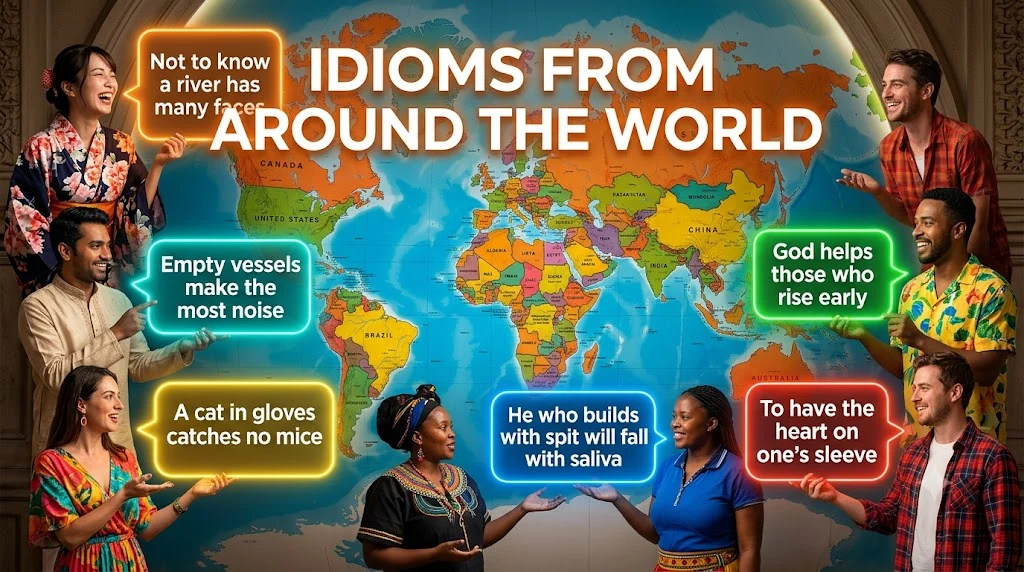
Idioms from around the world are unique expressions that reflect the culture, history, and traditions of different countries. Learning these idioms helps you understand how people express everyday ideas, emotions, and experiences in natural, colorful ways across languages and cultures.
Language is more than just words; it is a reflection of culture, history, and the collective experiences of a people. Nowhere is this more evident than in the idioms and proverbs we use. A friend in the United States might say a task will be done “when pigs fly,” to express impossibility. If you translate this phrase literally into another language, you are likely to get blank stares or confused laughter.
Learning idioms is a significant step toward fluency. It is the difference between mechanically translating words and truly “thinking” in that language. Furthermore, idioms offer a unique window into the soul of a culture, revealing what a society values, fears, and finds humorous. This article explores a collection of fascinating idioms from across the globe, showing how different cultures express universal concepts like surprise, annoyance, and amazement in their own unique ways.
A World of Words: Idioms by Region
While the English language is rich with idioms like “it’s raining cats and dogs” or “break a leg,” every language has its own collection of colorful, often baffling, sayings. Let’s take a journey around the world to explore some of these linguistic gems .
European Expressions
- Germany: The German idiom “Ich verstehen nur Bahnhof” literally translates to “I only understand the train station.” It is used to say, “I don’t understand a thing about what that person is saying” . This phrase originated during the Weimar Republic era when soldiers returning from WWI would only talk about the train station where they would be arriving home, effectively ignoring the current conversation.
- Dutch: If something is very expensive, you might say in English that it “costs an arm and a leg.” In Dutch, they say “Het kost me een rib uit mijn lijf,” which means “It costs me a rib from my body” .
- Polish: To say someone has no ear for music, you might ask in Polish, “Słoń nastąpił ci na ucho?” which means “Did an elephant stomp on your ear?” . This immediately conveys a lack of musical talent in a humorous, self-deprecating way.
- Swedish: For a comforting phrase, the Swedes say, “Det är ingen ko på isen,” meaning “There’s no cow on the ice.” This is a way of saying, “Don’t worry,” as a cow on thin ice would be a significant problem .
Asian Wisdom
- Chinese (Mandarin): The Chinese idiom 杯弓蛇影 (bēi gōng shé yǐng) means “seeing the reflection of a bow in a cup and thinking it’s a snake.” It is used to describe someone who is overly suspicious and worrying about things that don’t exist .
- Japanese: To describe someone who is pretending to be nice, the Japanese say they are 猫をかぶる (Neko o kaburu), which translates to “to wear a cat on one’s head” . While cats are often seen as cute in Japan, the phrase suggests a more cunning person hiding their true nature.
- Korean: The Korean expression 당근이지! (dang-geun i-ji) means “It’s a carrot!” It is used to say that something is obvious .
- Thai: For something that will never happen, the Thai phrase is ชาติหน้าตอนบ่าย ๆ (Chāti h̄n̂ā txn b̀āy), meaning “One afternoon in your next reincarnation” . This is a uniquely Buddhist way of saying “not a chance.”
Unique Global Perspectives
- Arabic: يد واحدة ماتسقفش (Eid wahda matsa’afsh) means “One hand doesn’t clap.” It is the equivalent of the English saying, “It takes two to tango,” highlighting that cooperation is necessary for success .
- Brazilian Portuguese: The phrase Empurrar com a barriga means “To push something with your belly.” It is used to describe the act of procrastinating or putting off an important task .
- Serbo-Croatian: To describe someone who is not very smart, you might say they are Lud ko struja, which translates to “As wild as electricity” .
- Zulu: The Zulu idiom Uthanda ukubukwa njengesiyephu translates to “He likes to be looked at like a long-hairy goat,” which means someone is a show-off who likes to have all of the attention .
The Power of Culture
Looking at idioms from around the world reveals that while our languages and cultures differ, we share many of the same human experiences. Whether it is the frustration of not understanding (Germany), the thrill of good fortune (Dutch), or the joy of a great party (Serbo-Croatian), there is an idiom out there for it.
These sayings are more than just fun phrases. They are a linguistic fingerprint of a culture. Using them correctly is a sign of deep cultural understanding and linguistic competence. When you learn a foreign idiom and use it in conversation with a native speaker, it is a significant achievement that will often be met with appreciation.
For example, many cultures use specific items from their environment to form expressions. In Chile, telling someone “Mira cómo saltó el maní” (Look how far the peanut jumped) is a way to tell a nosy person to mind their own business . In China, “inflating a cow” is a colorful way to describe someone who is bragging or blowing something out of proportion .
Idioms from Around the World
Idioms are more than colorful expressions—they are a window into the history, traditions, and everyday life of different cultures. Although every language has its own unique sayings, many idioms express the same universal ideas, such as love, success, patience, hard work, and friendship. Learning idioms from around the world not only expands your vocabulary but also helps you understand how people from different cultures communicate and think.
Popular Idioms from Around the World
| Country/Language | Idiom | Literal Translation | Meaning |
|---|---|---|---|
| Spain | Estar en la luna | To be on the moon | To be distracted or daydreaming |
| France | Avoir le cafard | To have the cockroach | To feel sad or depressed |
| Germany | Ich verstehe nur Bahnhof | I only understand train station | I don’t understand anything |
| Italy | In bocca al lupo | Into the wolf’s mouth | Good luck |
| Japan | 猫の手も借りたい (Neko no te mo karitai) | I would even borrow a cat’s paw | Extremely busy |
| China | 对牛弹琴 (Duì niú tán qín) | Playing the lute to a cow | Explaining something to someone who won’t understand |
| Brazil | Chutar o balde | Kick the bucket | Give up or stop caring (different from the English meaning) |
| Russia | Вешать лапшу на уши | Hang noodles on someone’s ears | To deceive or fool someone |
| English | Break the ice | — | To make people feel more comfortable in a new situation |
Idioms About Luck and Success
Many cultures have unique ways of wishing someone good fortune. While the wording differs, the purpose is often the same—to encourage confidence and celebrate success.
In Bocca al Lupo (Italy)
Literally meaning “into the wolf’s mouth,” this phrase is the Italian equivalent of wishing someone good luck before an important event.
Mucha Mierda (Spain)
Literally translated as “a lot of manure,” this theatrical expression is traditionally used to wish performers success before they go on stage.
Break a Leg (English)
A famous English idiom used to wish performers good luck without actually saying “good luck.
These expressions show how different cultures have developed creative traditions for encouraging others before important moments.
Idioms About Work and Busy Life
Every culture has expressions for describing hard work and hectic schedules.
Borrow a Cat’s Paw (Japan)
This idiom means being so busy that you would even accept help from a cat.
Playing the Lute to a Cow (China)
Used when someone explains something to a person who cannot or will not understand it.
Burn the Midnight Oil (English)
An idiom describing working or studying late into the night.
Although these idioms use completely different imagery, they all describe common everyday experiences shared around the world.
Idioms About Thoughts and Emotions
People experience the same emotions everywhere, but each language expresses them differently.
To Be on the Moon (Spain)
Describes someone who is distracted, absent-minded, or lost in thought.
To Have the Cockroach (France)
A colorful French expression meaning to feel sad, gloomy, or depressed.
Hang Noodles on Someone’s Ears (Russia)
A humorous idiom meaning to deceive someone or tell lies.
These expressions demonstrate how cultural imagery can make ordinary emotions much more memorable.
Why Learn Idioms from Different Cultures?
Learning international idioms offers more than vocabulary—it provides insight into different ways of thinking and communicating. It can help you:
- Understand cultural traditions and expressions.
- Improve your conversational English and figurative language skills.
- Appreciate similarities and differences between languages.
- Communicate more naturally with people from diverse backgrounds.
- Make language learning more enjoyable and memorable.
Tips for Learning International Idioms Naturally
Learn the Meaning Before the Literal Words
Many idioms make little sense when translated word for word. Focus on understanding what the expression means rather than what each individual word says.
Learn the Cultural Context
Knowing where an idiom comes from makes it much easier to remember and use correctly.
Compare Similar Idioms
Look for equivalent expressions across different languages. You’ll often discover that different cultures describe the same idea using completely different images.
Practice with Real Examples
Read books, watch movies, listen to podcasts, and use idioms in conversation to become familiar with how native speakers naturally use them.
Use Idioms Appropriately
Not every idiom fits every situation. Some are formal, others are informal, and many are specific to particular regions or cultures. Learning when to use an idiom is just as important as learning what it means.
FAQs
1. What are idioms from around the world?
Idioms from around the world are unique expressions used in different languages and cultures. While their literal meanings may seem unusual, they convey ideas, emotions, and experiences in ways that are natural to native speakers.
2. Why do different countries have different idioms?
Idioms often develop from a country’s history, traditions, folklore, geography, and daily life. As a result, each culture creates expressions that reflect its unique experiences and values.
3. Can idioms be translated word for word?
Not usually. Most idioms have figurative meanings, so a literal translation may not make sense. Instead, translators often use an equivalent idiom or explain the intended meaning.
4. How can learning international idioms improve my English?
Learning idioms from different cultures helps you understand how figurative language works, improves your vocabulary, and gives you a deeper appreciation of cultural differences in communication.
5. Are there similar idioms in different languages?
Yes. Many languages have idioms that express the same idea using different words or imagery. For example, expressions about hard work, patience, love, and success often have cultural equivalents even if the wording is completely different.
Conclusion
Exploring idioms from around the world is a fascinating way to appreciate the creativity and diversity of human language. From the literal translations of phrases like “I only understand train station” in German to the image of a “frog in a sock” in Australia, these expressions are a testament to the power of language to capture our shared human experiences .
In English, Idioms from Around the World are particularly dynamic, offering everything from expressions of sheer excitement to deep annoyance. While regional idioms give us insight into specific cultures, the need to communicate intense emotions like joy, anger, and confusion is universal. As you continue your language learning journey, embracing these colorful expressions will not only make your English sound more natural and engaging, but also open a window into the heart of the culture .
Read More Related Articles:
- Idioms for Heart | Express Love, Courage, Sadness & Emotion In 2026
- Idioms for Nature | Expressing the Natural World Beautifully In 2026
- Idioms for Green | Expressing Growth, Envy & Inexperience In 2026

Tyler Zone is an American writer at IdiomCrafter.com, who enjoys exploring the meaning behind everyday phrases. He focuses on making idioms simple and relatable for readers of all backgrounds. In his free time, he likes discovering new expressions and how people use them in daily life.