Quick Answer
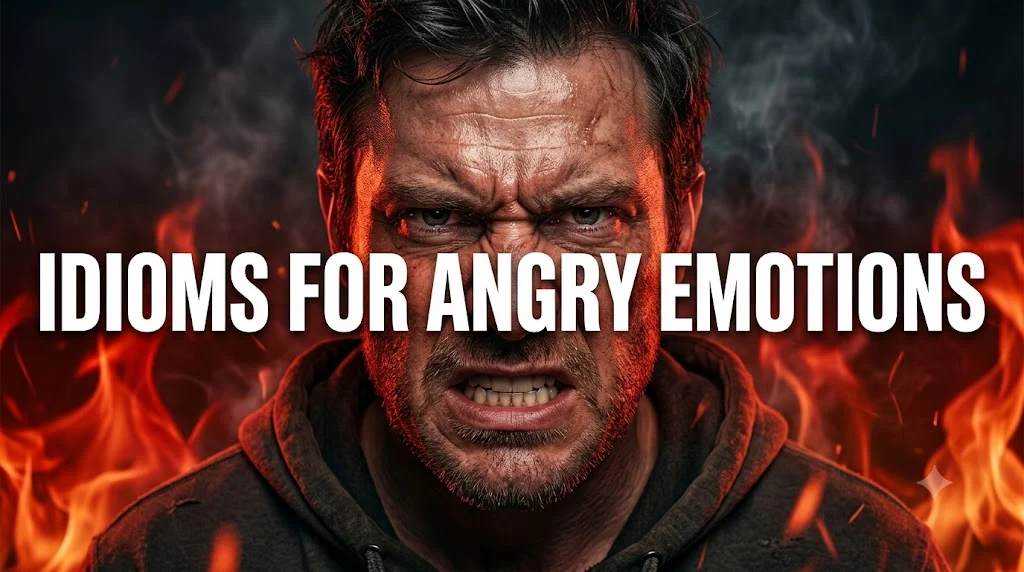
Idioms for angry emotions are colorful expressions used to describe rage, frustration, irritation, and loss of temper often in a vivid, dramatic, or deeply relatable way.Examples: blow your top, see red, lose your cool
Anger is one of the most powerful human emotions and the English language has no shortage of ways to describe it. But saying “I was angry” over and over again? That gets boring fast. It lacks punch. It lacks personality.
That’s exactly where idioms come in.
When someone says “he blew his top” or “she was about to lose her cool,” you don’t just understand the emotion you feel it. Idioms carry weight, tone, and color that plain words simply can’t match. They make your language more alive, more expressive, and far more engaging.
Whether you’re venting about a rough day, writing a story with an explosive character, or just trying to sound more natural in English conversations idioms for angry emotions are the secret weapon you need.
In this guide, you’ll learn:
- The most powerful and widely used idioms for anger
- Real meanings and the situations they fit best
- Formal, casual, and creative example sentences
- Practical tips to use these idioms naturally without sounding forced
- Common mistakes to avoid
Let’s dive into the world of expressive anger idioms and transform the way you communicate strong emotions.
Quick Summary Table
| Situation | Idioms |
|---|---|
| Sudden anger outburst | Blow your top, Hit the roof |
| Deep, intense rage | See red, Boiling with anger |
| Irritation and annoyance | Get under your skin, Rub the wrong way |
| Loss of patience | Reach the boiling point, Lose your cool |
| Hidden or simmering anger | Slow burn, Stewing in anger |
| Extreme frustration | At your wit’s end, Fed up |
| Anger at injustice | See red, Get hot under the collar |
Idioms for Sudden Anger Outbursts
Sometimes anger doesn’t build slowly it explodes without warning.
1. Blow Your Top
This is one of the most vivid and widely used idioms for expressing a sudden, uncontrolled burst of anger.
Meaning: To suddenly become very angry and lose your temper When People Use It: Unexpected bad news, shocking behavior, or a breaking point Alternative Expression: Explode with anger
Examples: Formal: The manager blew his top when he discovered the error in the final report. Casual: She totally blew her top when she saw what he did to her car. Creative: Patience, stacked thin for months, finally blew its top like a long-dormant volcano.
2. Hit the Roof
A dramatic idiom that paints a picture of someone so angry they practically launch themselves upward.
Meaning: To become extremely angry, often loudly and suddenly When People Use It: When someone reacts to bad news or a major mistake Alternative Expression: Go through the roof
Examples: Formal: The director hit the roof upon reviewing the unauthorized expenditures. Casual: My dad hit the roof when he saw my report card. Creative: The moment the truth came out, he hit the roof and the whole house shook with his fury.
3. Fly Off the Handle
This idiom suggests a reaction that spins wildly out of control fast and uncontrolled.
Meaning: To suddenly lose your temper without much warning When People Use It: Overreactions or emotionally sensitive situations Alternative Expression: Snap
Examples: Formal: He tends to fly off the handle during high-pressure negotiations. Casual: Don’t fly off the handle just listen to what I have to say. Creative: Without a word of warning, he flew off the handle, and the room went completely silent.
Usage Insight: These idioms work best in storytelling or casual recounting of events. They capture raw, explosive moments of anger perfectly.
Idioms for Deep, Intense Rage
Not all anger is quick. Some sits deep, burning slow and fierce beneath the surface.
4. See Red
A powerful and well-known idiom that links anger with the color most associated with passion and rage.
Meaning: To become so angry that you can’t think clearly or act rationally When People Use It: Moments of deep betrayal or extreme provocation Alternative Expression: Lose all control
Examples: Formal: When the false accusation was made public, she saw red and demanded an immediate retraction. Casual: I literally saw red when he lied to my face again. Creative: The injustice of it all made her see red everything blurred into one burning shade of fury.
5. Boiling with Anger
This idiom uses the imagery of heat and pressure like water in a pot about to overflow.
Meaning: To feel intensely angry, with emotion building up inside When People Use It: Situations of sustained, deep frustration Alternative Expression: Seething
Examples: Formal: The community was boiling with anger following the government’s announcement. Casual: I’m boiling with anger right now I can’t even speak. Creative: Underneath his calm face, he was boiling with anger, every second tightening the lid on the pressure inside.
6. Burning with Rage
A more poetic and intense idiom that conveys a deep, consuming anger.
Meaning: Feeling overwhelmed with fierce, consuming anger When People Use It: Situations of personal betrayal or injustice Alternative Expression: Consumed by anger
Examples: Formal: She left the courtroom burning with rage at the unfair verdict. Casual: He was burning with rage and couldn’t even look at them. Creative: She walked away burning with rage, each step a quiet declaration of war.
Memory Tip: Think of deep rage idioms as involving fire or heat the more intense the image, the deeper the anger.
Idioms for Irritation and Annoyance
“Angry” doesn’t always mean explosive. Sometimes it’s that slow, crawling irritation that wears you down.
7. Get Under Your Skin
A quietly powerful idiom for irritation that builds up without an obvious trigger.
Meaning: To annoy or bother someone in a persistent, hard-to-shake way When People Use It: Repeated small annoyances, difficult people, or unresolved tension Alternative Expression: Bother deeply
Examples: Formal: His condescending tone in every meeting had really gotten under her skin. Casual: That comment really got under my skin I can’t stop thinking about it. Creative: She couldn’t explain why his words got under her skin, but they stayed there, like a splinter she couldn’t reach.
8. Rub the Wrong Way
An idiom for when someone’s behavior instinctively irritates you, even without a clear reason.
Meaning: To annoy or irritate someone, often from the very beginning When People Use It: Personality clashes or first impressions gone wrong Alternative Expression: Rub someone up the wrong way
Examples: Formal: From the very first interaction, his attitude rubbed the team the wrong way. Casual: I don’t know why, but she just rubs me the wrong way. Creative: Some people don’t do anything obviously wrong they just rub you the wrong way, like sandpaper on sunburned skin.
9. Have a Bone to Pick
A slightly more confrontational idiom used when someone wants to address something that has been bothering them.
Meaning: To have a complaint or disagreement with someone that needs to be discussed When People Use It: Unresolved conflict or built-up irritation Alternative Expression: Have an issue with someone
Examples: Formal: The senior partner made it clear she had a bone to pick with the associate regarding the case. Casual: Hey, I have a bone to pick with you about what happened yesterday. Creative: He walked into the room with a bone to pick and left with both sides finally understanding each other.
Idioms for Loss of Patience
There’s a particular kind of anger that comes from waiting too long, tolerating too much, or being pushed past your limit.
10. Reach the Boiling Point
The moment when patience gives out entirely and anger takes over.
Meaning: To reach the limit of your patience and be on the verge of an emotional outburst When People Use It: Long-standing conflicts, ongoing problems, or repeated offenses Alternative Expression: Snap
Examples: Formal: Negotiations had reached the boiling point, and both sides were close to walking away. Casual: I’ve reached my boiling point I can’t take this anymore. Creative: For weeks she had stayed quiet, but tonight she had finally reached the boiling point, and silence was no longer an option.
11. Lose Your Cool
A widely used idiom for when someone loses their calm and composed demeanor under pressure or anger.
Meaning: To stop being calm and become visibly angry or upset When People Use It: Stressful situations, public confrontations, emotional triggers Alternative Expression: Lose your temper
Examples: Formal: Despite the provocative questioning, the spokesperson did not lose her cool during the press briefing. Casual: Don’t lose your cool in front of the kids let’s talk about this later. Creative: He had promised himself he wouldn’t lose his cool, but one word from her shattered every resolution he had made.
12. At Your Wit’s End
This idiom goes beyond anger it’s the point where frustration meets helplessness.
Meaning: To be so frustrated and exhausted that you no longer know what to do When People Use It: Situations where all solutions have failed and patience is completely gone Alternative Expression: Completely fed up
Examples: Formal: The school administration was at its wit’s end dealing with the ongoing disciplinary issues. Casual: I’m at my wit’s end with this project nothing is working. Creative: She had tried everything, and still nothing changed. She was at her wit’s end, running on empty and running out of hope.
Usage Insight: These idioms are perfect when conveying a slow breaking of patience ideal for relatable, emotional storytelling.
Idioms for Hidden or Simmering Anger
Not all anger is loud or visible. Some of the deepest anger burns quietly hidden just below the surface.
13. Slow Burn
A cinematic and modern idiom for anger that builds gradually but powerfully.
Meaning: A feeling of anger or frustration that intensifies slowly over time When People Use It: When someone suppresses their feelings but continues to grow angrier Alternative Expression: Stewing
Examples: Formal: His dissatisfaction with the management had been a slow burn for over a year before he finally resigned. Casual: This whole situation has been a slow burn for me I didn’t say anything, but I was furious. Creative: Love turned to a slow burn of resentment not dramatic, not sudden, just a quiet fire that refused to go out.
14. Stewing in Anger
A vivid idiom that imagines anger as something you sit inside, soaking in its heat.
Meaning: To dwell on something that makes you angry, unable to let it go When People Use It: Prolonged grudges or unresolved situations Alternative Expression: Brooding
Examples: Formal: Rather than confronting the issue, he spent the evening stewing in anger over the perceived slight. Casual: She’s still stewing in anger over what he said at dinner. Creative: He sat alone, stewing in anger, replaying every wrong word, every careless act, until the room itself felt warm with his fury.
15. Hold a Grudge
When anger is silent but never forgotten this idiom captures long-lasting emotional resentment.
Meaning: To remain angry with someone for a long time without forgiving them When People Use It: After betrayal, disappointment, or unresolved conflict Alternative Expression: Keep resentment
Examples: Formal: It is professionally counterproductive to hold a grudge against a colleague after a disagreement has been resolved. Casual: She’s been holding a grudge against him since last year she won’t even say his name. Creative: He told everyone he had moved on, but the grudge he held was a heavy stone he carried everywhere, even into his dreams.
Idioms for Extreme Frustration
Sometimes anger and frustration merge into one overwhelming force that feels impossible to contain.
16. Fed Up
One of the most relatable idioms in the English language and one of the most universally understood.
Meaning: To be completely tired of something or someone to the point of anger When People Use It: Ongoing problems, repeated behavior, or situations that never improve Alternative Expression: Sick and tired
Examples: Formal: The employees made it clear during the meeting that they were fed up with the inconsistent communication from upper management. Casual: I’m so fed up with making excuses for people who don’t deserve them. Creative: She had smiled through too many broken promises, and now she was simply, quietly, completely fed up.
17. Up in Arms
This idiom suggests a group or individual ready to fight back emotionally or literally.
Meaning: Extremely angry and ready to protest or take action When People Use It: Injustice, unfair decisions, or collective outrage Alternative Expression: Outraged
Examples: Formal: The local residents were up in arms over the sudden changes to the neighborhood development plan. Casual: Everyone’s up in arms about the new policy it makes no sense. Creative: The community rose up in arms, not with weapons but with voices loud enough to shake the walls of city hall.
18. Bent Out of Shape
A casual but expressive idiom for someone who is deeply upset and can’t seem to calm down.
Meaning: Very annoyed, upset, or angered by something When People Use It: Overreactions or genuine frustration Alternative Expression: Really bothered
Examples: Formal: There is no need to get bent out of shape over a minor procedural delay. Casual: Why are you so bent out of shape about this? It’s not that serious. Creative: She was so bent out of shape over the cancellation that even three days later, the disappointment still sat heavy in her chest.
Idioms for Anger at Injustice
Some of the most powerful anger comes from witnessing or experiencing something deeply unfair.
19. Get Hot Under the Collar
A classic idiom that describes someone becoming visibly flustered and angry often in response to something they find outrageous.
Meaning: To become angry or flustered, often in a public or professional setting When People Use It: Debates, confrontations, or moments of perceived injustice Alternative Expression: Get worked up
Examples: Formal: The senator got visibly hot under the collar when the journalist questioned the integrity of the committee. Casual: He always gets hot under the collar when someone questions his decisions. Creative: She never raised her voice but the flush in her cheeks and the stiffness in her jaw said she was getting hot under the collar, and everyone in the room noticed.
20. Blood Boiling
A vivid physical metaphor for the kind of anger that feels like it’s heating you from the inside out.
Meaning: To feel extreme anger, especially at something unjust or deeply offensive When People Use It: Injustice, cruelty, or deeply offensive behavior Alternative Expression: Enraged
Examples: Formal: The documentary about the exploitation of workers made her blood boil. Casual: Watching that interview made my blood boil how can someone say that? Creative: Reading the headlines, she felt her blood begin to boil slowly not dramatically, not suddenly, just the quiet, steady heat of someone who has seen this story before.
21. Have a Short Fuse
An idiom that describes someone who becomes angry very quickly, with very little provocation needed.
Meaning: To have a tendency to get angry easily and quickly When People Use It: Describing someone’s personality or temperament Alternative Expression: Quick-tempered
Examples: Formal: It’s important to communicate carefully with him as he is known to have a rather short fuse in stressful situations. Casual: Don’t bring that up around her she has a really short fuse about it. Creative: He had a short fuse and he knew it every small spark had the potential to become something neither of them could take back.
Idioms for Subtle or Controlled Anger
Sometimes the most powerful anger is the kind that stays controlled cold, quiet, and deliberate.
22. Keep a Lid On It
An idiom for deliberately suppressing or controlling anger before it overflows.
Meaning: To keep your anger or strong emotions under control When People Use It: Situations requiring restraint, professionalism, or patience Alternative Expression: Hold it together
Examples: Formal: Despite the provocation, she managed to keep a lid on her emotions throughout the hearing. Casual: I’m trying to keep a lid on it, but this situation is testing every nerve I have. Creative: He kept a lid on it all day, smiling and nodding, while beneath the surface the pressure grew with every passing hour.
23. Tight-Lipped with Fury
A descriptive idiom that paints a picture of someone so angry they can barely speak.
Meaning: To be extremely angry but expressing it through silence rather than outburst When People Use It: Cold, controlled anger often more intimidating than loud outbursts Alternative Expression: Silent rage
Examples: Formal: She returned to the meeting tight-lipped with fury, unwilling to give her opponents the satisfaction of a reaction. Casual: He was tight-lipped with fury I knew better than to say another word. Creative: Her silence was louder than any argument. She sat tight-lipped with fury, and somehow that was the most frightening response of all.
24. Seething
A powerful one-word idiom that conveys deep, barely contained anger.
Meaning: To feel intense anger that is controlled but clearly visible beneath the surface When People Use It: Moments of extreme but restrained fury Alternative Expression: Fuming
Examples: Formal: She was seething after being passed over for the promotion yet again. Casual: I’m seething right now just let me calm down before we talk. Creative: She smiled politely and thanked him for his time, but inside she was seething a calm, cold kind of fury that burns longer than any fire.
25. Cold Fury
The most chilling form of anger not hot and explosive, but ice-cold and deliberate.
Meaning: A very controlled but deeply intense form of anger that is often more dangerous than an outburst When People Use It: Moments of extreme calm in the face of profound anger or betrayal Alternative Expression: Icy rage
Examples: Formal: She addressed the board with cold fury, each word measured and precise, leaving no room for misunderstanding. Casual: He didn’t yell. He didn’t cry. He just looked at them with cold fury and walked away. Creative: Cold fury was a different beast entirely not fire, but ice; not noise, but the kind of silence that settles in after the storm has already decided what it will do.
How to Use Idioms for Angry Emotions Naturally
Knowing an idiom is one thing. Using it naturally at the right moment, with the right tone is where real fluency lives. Here’s how to get there.
Match the Situation
Not all anger idioms are interchangeable. Some are loud, some are quiet, some are physical, and some are deeply emotional. Choosing the right one changes everything.
For sudden outbursts: blow your top, fly off the handle For deep, simmering rage: slow burn, stewing in anger For frustration and exhaustion: fed up, at your wit’s end For public or professional anger: get hot under the collar, keep a lid on it
Insight: The best idiom doesn’t just describe the anger it reveals something about how the person is expressing it and why.
Keep Tone in Mind
Anger idioms carry different levels of intensity and formality. Using the wrong one in the wrong setting can undermine your message.
In professional or formal writing, lean toward controlled-anger idioms: seething, cold fury, at your wit’s end. In casual conversations and storytelling, expressive idioms work perfectly: lost your cool, blew your top, saw red. In creative writing, mix both vivid imagery with emotional restraint creates powerful contrast.
Pro Tip: When in doubt about formality, the safer option is always a softer or more neutral expression. Save the most dramatic idioms for moments that truly call for them.
Use Sparingly
This is the golden rule of idiom usage more is not better. A single, well-chosen idiom lands far harder than five thrown together in the same sentence.
Instead of: “She saw red, blew her top, flew off the handle, and was boiling with anger…” Try: “She saw red and nothing that came after was calm.”
One powerful idiom, placed at the right moment, is more memorable than a dozen used carelessly.
Common Mistakes to Avoid
Even confident English speakers make these mistakes when using anger idioms. Being aware of them puts you ahead.
Using intense anger idioms for minor irritations. Saying you “saw red” because someone was five minutes late feels exaggerated and weakens the idiom’s impact. Save the powerful ones for genuinely powerful moments.
Mixing idioms that contradict each other in tone. Using a cold, controlled idiom right next to a hot, explosive one can confuse the reader or listener about what kind of anger is being expressed.
Using informal idioms in formal or professional writing. Phrases like “he blew his top” or “I flew off the handle” are better suited to storytelling and casual speech than business communication or academic writing.
Forgetting that some anger idioms can sound judgmental. Describing someone as having “a short fuse” or “always losing their cool” can come across as critical of their character. Use these thoughtfully and with awareness of context.
Overusing the same idiom. Repeating “saw red” in every paragraph of a story, for example, dulls the emotional impact. Vary your expressions to keep the reader engaged.
Practice Method
Learning idioms isn’t about memorizing a list it’s about making them part of how you think and speak. Here’s the method that actually works.
Learn 3 Idioms Daily
Don’t try to learn 25 at once. Pick three, understand their meaning and tone, and focus on those for the day. Quality of understanding beats quantity of vocabulary every time.
Use Them in Real Conversations
Even if it feels unnatural at first, try slipping one idiom into your daily conversations or written messages.
“This traffic is really getting under my skin.” “I was completely fed up by the end of that meeting.”
The more natural they feel in your mouth or on paper, the more effortlessly they’ll come to you.
Write One Creative Sentence for Each
Don’t settle for the obvious. Push yourself to write a sentence that is visual, emotional, and specific.
Instead of: “He was angry.” Try: “He was seething every word he spoke landed with the quiet precision of someone who had already decided exactly how this would end.”
The more alive and personal your example, the faster the idiom sticks in your long-term memory.
Memory Trick: Link each idiom to a real moment in your life or a character in a story you love. Personal connection turns vocabulary into instinct.
FAQs
1. What are idioms for angry emotions used for?
They are used to describe various types of anger from mild irritation to explosive outrage in a more vivid, expressive, and natural way than plain vocabulary allows.
2. Are anger idioms appropriate in formal writing?
Some are. Controlled-anger idioms like “seething,” “cold fury,” and “at your wit’s end” work in semi-formal and even formal contexts. Highly casual ones like “blew your top” or “flew off the handle” are best kept for storytelling and spoken conversation.
3. Can I use these idioms in creative writing?
Absolutely in fact, creative writing is where anger idioms shine brightest. They add emotional texture, character depth, and rhythmic variety to your prose.
4. Do anger idioms ever sound offensive?
In some contexts, yes. Describing someone’s anger in terms of their mental state or inherent temperament (like implying they always “have a short fuse”) can feel judgmental. Always consider the relationship and setting before using such expressions.
5. How do I stop forgetting idioms after I learn them?
Practice is the only real answer. Writing personal, emotionally resonant example sentences and using idioms in real conversations even once a day will lock them into your memory far more effectively than passive review.
Conclusion
Idioms for angry emotions give your language something that plain words simply can’t depth, intensity, personality, and truth. Whether you are expressing a slow burn of frustration, a sudden explosion of temper, a quiet cold fury, or the helpless exhaustion of being completely fed up, there is an idiom that captures it with precision and power.
The key to using them well is never about using more it’s about choosing better. One carefully placed idiom at the right emotional moment says more than ten clumsy ones scattered through a paragraph.
So start small. Learn a few. Use them in real life. Write with them. And watch the way people respond when your words stop just describing emotion and start making people feel it.
Your language doesn’t have to be loud to be powerful. Sometimes it just has to be exactly right.
Read More Related Articles:
- Idioms for Heart | Express Love, Courage, Sadness & Emotion In 2026
- Idioms for Nature | Expressing the Natural World Beautifully In 2026
- Idioms for Green | Expressing Growth, Envy & Inexperience In 2026

Tyler Zone is an American writer at IdiomCrafter.com, who enjoys exploring the meaning behind everyday phrases. He focuses on making idioms simple and relatable for readers of all backgrounds. In his free time, he likes discovering new expressions and how people use them in daily life.