Quick Answer
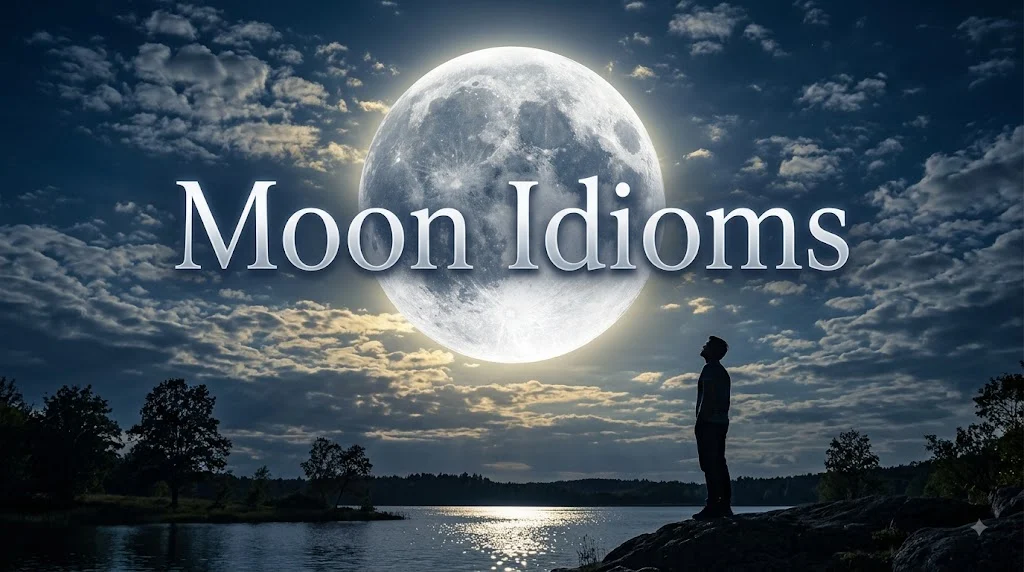
Moon idioms are colorful expressions that use the moon to describe dreams, beauty, ambition, distance, and impossible wishes. Common examples include “over the moon,” “once in a blue moon,” and “shoot for the moon.”
The moon has captivated humanity since the dawn of time. It has inspired poets, guided travelers, influenced calendars, and found its way into countless languages and cultures. In English, the moon has given rise to a rich collection of idioms and expressions that color our everyday speech in ways we often don’t stop to consider.
Moon idioms are not just linguistic curiosities; they reflect how we perceive the world, our emotions, and the passage of time. When we say someone is “over the moon,” we aren’t literally placing them on the lunar surface. Instead, we’re tapping into centuries of cultural associations between the moon and joy, rarity, mystery, and even madness.
This comprehensive guide explores the most fascinating moon idioms in the English language. You’ll learn their meanings, origins, cultural variations, and practical usage. Whether you’re a language learner, a writer, or simply curious about the expressions you use daily, this exploration of moon idioms will illuminate your understanding of English in a whole new way.
Understanding Moon Idioms: Why the Moon?
Before diving into specific expressions, it’s worth understanding why the moon features so prominently in English idioms. The moon is universal visible to everyone, regardless of culture or geography. It’s constant yet changing, distant yet intimate, bright yet mysterious .
The moon’s phases provide a natural metaphor for change, cycles, and the passage of time. Its inaccessibility makes it a symbol of impossible goals or rare occurrences. Its beauty inspires romantic expressions. Even its pale light has given us words like “moonshine” to describe something that looks real but is only an illusion.
Understanding these underlying associations helps you grasp why moon idioms carry such specific emotional and cultural weight. Let’s explore the most important ones in detail.
The Most Common Moon Idioms and Their Meanings
1. Over the Moon
Meaning: Extremely happy, delighted, or pleased about something.
Origin: This idiom dates back to the 16th century and likely originated from the nursery rhyme “Hey Diddle Diddle,” which features a cow jumping over the moon. The phrase became popular in the 20th century, particularly in British English .
Usage Examples:
- “She was over the moon when she received the job offer.”
- “He’s been over the moon since his team won the championship.”
- “I was over the moon to hear that you’re coming to visit.”
When to Use It:
This is one of the most versatile and positive moon idioms. Use it whenever you want to express genuine, enthusiastic happiness about a specific event or piece of news. It’s appropriate in both casual and semi-formal contexts.
Cultural Note:
While used throughout the English-speaking world, “over the moon” is particularly common in British English and has a slightly more formal feel than saying “really happy.
2. Once in a Blue Moon
Meaning: Very rarely; almost never.
Origin: A “blue moon” is an astronomical phenomenon where a second full moon occurs within a single calendar month. This happens approximately once every 2.7 years, which is where the rarity comes from . However, some sources suggest the term may have earlier origins with different meanings.
Usage Examples:
- “I only see my old school friends once in a blue moon.”
- “He eats meat once in a blue moon because he’s mostly vegetarian.”
- “That kind of opportunity comes along once in a blue moon.”
When to Use It:
Use this idiom when you want to emphasize the infrequency of an event. It’s slightly more colorful than saying “rarely” or “hardly ever.”
Interesting Fact:
The phrase has been in use since at least 1528, making it one of the older moon idioms still in common use .
3. Ask for the Moon / Cry for the Moon
Meaning: To make unreasonable demands or ask for something impossible to achieve.
Usage Examples:
- “Please don’t ask for the moon we’re working on a tight budget.”
- He’s always asking for the moon even though his parents work so hard.”
- “You’re crying for the moon if you expect me to finish this by tomorrow.”
When to Use It:
Use this when someone’s expectations are unrealistic, particularly when they’re demanding something that simply cannot be provided .
Alternative Version:
“Promise the moon” is the opposite expression, used when someone makes extravagant promises they can’t possibly keep.
4. Promise the Moon
Meaning: To make extravagant, unrealistic promises that are unlikely to be fulfilled.
Usage Examples:
- “Politicians often promise the moon during election campaigns.”
- “He promised her the moon when they got married, but none of it happened.”
- “Don’t promise the moon to clients if you can’t deliver.”
When to Use It:
This idiom is perfect for describing situations where someone is over-promising, whether in personal relationships, business, or politics.
5. Shoot for the Moon / Reach for the Moon
Meaning: To aim for a very ambitious goal, even if it seems difficult or impossible to achieve.
Origin: This phrase is closely associated with the famous quote often attributed to Norman Vincent Peale: “Shoot for the moon. Even if you miss, you’ll land among the stars” .
Usage Examples:
- “Her parents encouraged her to shoot for the moon when choosing a career.”
- “Even if it seems impossible, you should always reach for the moon.”
- “He’s shooting for the moon with his dream of becoming a professional athlete.”
When to Use It:
This is an inspirational idiom, perfect for encouraging ambition and high aspirations in yourself or others.
Cultural Significance:
The Space Race of the 1960s gave this idiom additional resonance, as reaching the moon became a symbol of humanity’s greatest achievement .
6. Many Moons Ago
Meaning: A long time ago; in the distant past.
Usage Examples:
- “I met her many moons ago, back in high school.”
- “That photo was taken many moons ago.”
- “I last rode a bicycle many moons ago, so I might be a bit wobbly.”
When to Use It:
This is a poetic way to refer to the past, particularly for memories or events that happened years ago .
Cultural Note:
The use of “moons” to measure time reflects ancient calendars that tracked lunar months. This makes the idiom feel both old-fashioned and timeless.
7. Love Someone to the Moon and Back
Meaning: To love someone very, very much; an expression of deep and boundless affection.
Usage Examples:
- “She tells her children every night that she loves them to the moon and back.”
- “He gave her a card that read ‘I love you to the moon and back’ for their anniversary.”
- “I love you to the moon and back you mean everything to me.”
When to Use It:
This is a romantic and affectionate expression, used primarily with loved ones children, partners, or close family members.
Why This Works:
The idiom emphasizes distance and impossibility: the moon is far away, and loving someone “to the moon and back” suggests a love that travels great distances and back again, emphasizing its depth and commitment .
8. Bark at the Moon / Howl at the Moon
Meaning: To complain or protest in a way that accomplishes nothing; to do something that wastes energy on an unchangeable situation.
Usage Examples:
- “He keeps barking at the moon about his job, but he won’t try to change it.”
- “Complaining about the weather is like barking at the moon.”
- “Don’t howl at the moon you can’t change the rules.”
When to Use It:
Use this when someone is expending energy on futile complaints rather than taking constructive action .
Cultural Note:
This idiom draws on the image of a dog howling at the moon a futile act because the moon cannot respond or change anything. The “moon dog” was described as early as the 1660s in reference to a dog that howls at the moon .
9. Think Someone Hung the Moon
Meaning: To think someone is the best, most wonderful, or perfect person; to admire someone greatly.
Usage Examples:
- “Lynette thinks her father hung the moon because he can always answer her questions.”
- “He thinks his girlfriend hung the moon he’s absolutely smitten.”
When to Use It:
This is a sweet, affectionate idiom used when someone is deeply admired, especially by children toward parents or by romantic partners.
What It Means:
To “hang the moon” is an impossible task, so thinking someone did it is the highest possible praise.
10. The Moon on a Stick
Meaning: To want everything, including things that are impossible to have; demanding perfection or total satisfaction.
Usage Examples:
- “He’s so demanding he wants the moon on a stick.”
- “Some parents try to give their children the moon on a stick.”
When to Use It:
This British idiom is used when someone’s expectations are completely unrealistic, often in a slightly humorous way .
11. Moonshine
Meaning: Illegally distilled or smuggled liquor; also, nonsensical or foolish talk.
Origin: The term was first recorded in 1785 to describe illicit liquor, likely because it was produced and transported by moonlight to avoid detection .
Usage Examples:
- “The authorities discovered a moonshine operation in the mountains.”
- “His claims are pure moonshine there’s no truth to any of it.”
When to Use It:
The “illicit liquor” meaning is most common in American English, while the “nonsense” meaning is more universal.
12. The Moon Is Made of Green Cheese
Meaning: An expression used to indicate that something is impossible, foolish, or obviously false.
Usage Examples:
- “You think you’ll get that promotion after insulting the boss? Right, and the moon is made of green cheese.”
- “He claims he’s descended from royalty? Sure, and the moon is made of cheese.”
When to Use It:
This is a sarcastic expression used to dismiss an outlandish claim. It’s often paired with “and” to emphasize disbelief .
The Many Faces of Moon Idioms: Categories and Themes
Happiness and Joy
- Over the moon: Extremely happy
- Overjoyed: Not a moon idiom but captures the same feeling
Rarity and Infrequency
Impossible or Unreasonable Demands
- Ask for the moon: Demand the impossible
- Promise the moon: Make unrealistic promises
- The moon on a stick: Want everything
- Cry for the moon: Long for the unattainable
Ambition and Aspiration
- Shoot for the moon: Aim high
- Reach for the moon: Set ambitious goals
Time and Memory
- Many moons ago: A long time ago
- The old moon in the new moon’s arms: A description of earthshine on the lunar surface
Love and Affection
- Love to the moon and back: Deep, boundless love
Futility and Complaints
- Bark at the moon: Complain uselessly
- Howl at the moon: Make a futile request
Foolishness and Nonsense
- Moonshine: Illegitimate liquor or nonsense
- The moon is made of green cheese: An absurd claim
- Mooncalf: A shapeless fleshy mass; derogatory term
Appearance and Nature
- Moon face: A round face (not a compliment)
- Moonglow: Soft moonlight
- Moonglade: A track of moonlight on water
Moon Idioms in Different Contexts
In Everyday Conversation
Moon idioms are perfect for adding color to casual conversation. They’re generally informal and widely understood by native speakers.
Example Dialogue:
- “How’s your new job going?”
- “I’m absolutely over the moon about it! My boss is great, and my colleagues are wonderful.”
- “That’s fantastic! I’m so happy for you.”
- “We should celebrate once in a blue moon occasions like this.”
In Professional Settings
While some moon idioms are too informal for business writing, others work well in professional contexts, especially when used sparingly.
Appropriate Professional Use:
- “To promise the moon to our investors would be irresponsible.”
- “We should shoot for the moon with this project, but we need realistic milestones.”
- “A client asking us to double our output without increasing resources is asking for the moon.”
Less Appropriate:
- “I was over the moon about the quarterly results” (better in internal communication than client-facing documents)
In Writing and Literature
Moon idioms are excellent tools for creative writing. They create vivid imagery and emotional resonance .
Examples:
- “She stood at the window, mooning over her lost cat, her reflection a pale ghost in the glass” .
- “The proposal was moonshine beautiful to behold but offering nothing real to hold onto.”
Cultural and Historical Context of Moon Idioms
The Moon and Madness
The association between the moon and madness is ancient, reflected in words like “lunatic” (from Luna, the Roman goddess of the moon). Some moon idioms carry this historical connection .
Moonstruck: First recorded around 1670, this refers to someone acting witless or irrational another reference to the link between lunacy and lunar .
To Moon: First appearing in 1836, this means wandering about as if in a daze, reflecting the dreamy, disconnected state associated with moonlight .
The Moon in Different Cultures
While this guide focuses on English idioms, it’s fascinating to see how other cultures express similar ideas :
French:
- “Être dans la lune” (to be in the moon) means to have your head in the clouds, to daydream.
German:
- “Er lebt hinter dem Mond” (he lives behind the moon) means he has no idea what’s happening in the world.
Polish:
- “Spadł z księżyca” (to fall from the moon) means behaving strangely.
Arabic:
- “قمر 14” (moon of 14) refers to a beautiful woman the 14th of the lunar month being when the moon is fullest and most beautiful.
Mandarin:
- 月有陰晴圓缺” (the moon is dark, bright, round, or missing a piece) expresses that life is uncertain, not all plain sailing.
Rutooro (Uganda):
- “Oli mumanzi nka kwezi” (you’re as brave as the Moon) is a compliment for someone very brave.
The Evolution of Moon Expressions
The history of moon idioms reflects changing technology and culture :
- Moonshot: First recorded in 1958, a year before the first unmanned probe flew past the moon.
- Moonwalk: First used in 1966, before Neil Armstrong’s famous step.
- Moonrace: Began in 1963, capturing the competitive spirit of the Space Age.
- Moondoggle: Coined in the 1960s by skeptics who questioned the financial benefits of space exploration.
These modern expressions sit alongside much older idioms like “blue moon” (1528) and “mooncalf” (1560s), showing how language evolves while retaining connections to its past .
Practical Tips for Using Moon Idioms
Match the Situation
Not all moon idioms work in all contexts. Consider:
For expressing happiness:
- Personal: “I was over the moon.”
- Professional: “We were extremely pleased.”
- Casual: “We were so happy.”
For describing rarity:
- Personal: “We meet once in a blue moon.”
- Professional: “We rarely meet.”
- Casual: “It hardly ever happens.”
Consider Your Audience
Moon idioms are generally understood by native English speakers, but some are more widely recognized than others:
Universally understood:
- Over the moon
- Once in a blue moon
- Many moons ago
Less common or regional:
- The moon on a stick (British)
- Mooncalf (archaic)
- Moonshine (American, for illicit liquor)
Use Them Sparingly
As with any idioms, overusing moon expressions can make your speech or writing feel forced. A single well-placed idiom is more effective than several crammed into one sentence.
Natural use: “I was over the moon when I got the job. It’s once-in-a-blue-moon opportunity.”
Overuse: “I was over the moon, jumping for joy like a cow that jumped over the moon, thinking I’d landed a once-in-a-blue-moon moonshot opportunity. I couldn’t believe my moon-made-of-green-cheese luck.”
Practice Through Real Situations
The best way to learn moon idioms is to use them in authentic contexts. Try these prompts:
- Describe a recent happy event using “over the moon.”
- When was the last time you did something “once in a blue moon”?
- What goal are you currently “shooting for the moon” with?
- Has someone ever “promised you the moon”? What happened?
- Who do you love “to the moon and back”?
Common Mistakes and How to Avoid Them
Confusing Similar Idioms
Mistake: Using “ask for the moon” when you mean “shoot for the moon.”
Correction: “Ask for the moon” is negative (unreasonable demands). “Shoot for the moon” is positive (ambitious goals).
Mistake: Using “bark at the moon” to describe expressing anger.
Correction: “Bark at the moon” specifically describes futile complaining, not just any expression of anger.
Misunderstanding the Tone
Mistake: Using “moonshine” to describe alcohol without knowing its illegal connotation.
Correction: Moonshine specifically refers to illegally distilled liquor. If you mean any alcohol, use a different term.
Mistake: Calling someone “moon-faced” without realizing it’s a minor insult.
Correction: “Moon face” describes a round face and is not a compliment .
Using Outdated or Uncommon Expressions
Some moon idioms are rare or archaic. While a native speaker might know them, they might not be understood by learners:
Rare/Archaic:
- Mooncalf
- Moonglade
- Moon dog
- Casting beyond the moon
Common and Useful:
- Over the moon
- Once in a blue moon
- Many moons ago
- Promise/ask for the moon
- Shoot for the moon
Moon Idioms in Action: Extended Examples
In a Personal Letter
Dear Sarah,
I hope this letter finds you well. It feels like many moons ago since we last caught up properly! When I heard you got that promotion, I was over the moon for you. You worked so hard for it, and I always knew you were capable of shooting for the moon and achieving your goals.
Life has been busy here too the new house is slowly coming together, and the kids are growing so fast. They’re at that age where they ask for the moon constantly, wanting everything they see, but they also fill my heart with so much joy. I love them to the moon and back, even when they’re challenging.
We don’t see each other once in a blue moon, but it’s not often enough. Let’s plan something soon.
All the best,
Emma
In a Professional Email
Dear Team,
As we plan our Q3 strategy, I want us to shoot for the moon. This is a once-in-a-blue-moon opportunity to transform how we approach our market. While the goals might seem like asking for the moon, I believe our track record shows we can achieve remarkable things when we work together.
However, I want to be realistic about our capabilities. I’m not promising the moon to stakeholders instead, I want us to deliver concrete, measurable results. Let’s aim high but stay grounded in what we can actually achieve.
Best regards,
Michael
In Creative Writing
The old man stood on the cliff edge, moonlight painting silver streaks across his weathered face. She had left him many moons ago, but he still came here every night, howling at the moon like a lonely dog. Some called him moonstruck, others simply said he was losing his mind.
He didn’t care. To him, the moon was a witness to his love a love that had once been so bright he’d thought he could reach up and pull it down from the sky. He’d promised her the moon back then, and he’d meant every word. Now he was left with only memories, pale as moonshine on the restless sea below.
“I love you to the moon and back,” he whispered to the darkness, watching the moon’s reflection shatter and reform on the waves. “And back again.”
In a Dialogue
Maya: “I can’t believe you’re not excited about the trip!”
Leo: “I am excited. I’m over the moon about it, actually. But I’m also nervous it’s such a huge commitment.”
Maya: “We’ve been planning this for ages. It’s a once-in-a-blue-moon opportunity!”
Leo: “I know, I know. My parents think I’m crazy. They asked if I’ve lost my mind, and my dad called it a moondoggle. But this is what I’ve always wanted, Maya. This is my chance to shoot for the moon.”
Maya: “And you’ll land among the stars. Isn’t that what they say?”
Leo: “That’s what I’m hoping.”
Conclusion
Moon idioms are a treasure trove of linguistic expression, connecting us to centuries of human fascination with our nearest celestial neighbor. From expressions of joy to complaints about futility, from ambitious goals to rare occurrences, these idioms color our language in ways that feel both timeless and immediate.
As you practice using these expressions, remember that idioms are more than vocabulary items they’re cultural artifacts. They carry with them the weight of history, the beauty of metaphor, and the richness of human emotion.
Whether you’re over the moon about a personal achievement, waiting for a once-in-a-blue-moon opportunity, or shooting for the moon in your career, these expressions will help you communicate with greater nuance and style.
Key Takeaways:
- Over the moon is your go-to expression for extreme happiness
- Once in a blue moon captures rare events perfectly
- Shoot for the moon encourages ambition and high goals
- Ask for the moon and promise the moon deal with unrealistic expectations
- Many moons ago adds a poetic touch to memories
- Love to the moon and back expresses deep affection
- Bark at the moon describes futile complaints
- Moonshine has two distinct meanings: illicit liquor and nonsense
Read More Related Articles:
- Idioms for Amazing | Expressions to Describe Something Incredible In 2026
- Idioms for Personality | Expressing Character Traits Naturally In English In 2026
- Idioms for Family | Expressing Love, Loyalty & Belonging Naturally In 2026

Urban Hunter is an American writer at IdiomCrafter.com, with a keen interest in how language shapes everyday conversations. She enjoys turning common expressions into engaging and easy-to-follow reads. Outside of writing, she spends time exploring new words and their hidden meanings.