Quick Answer
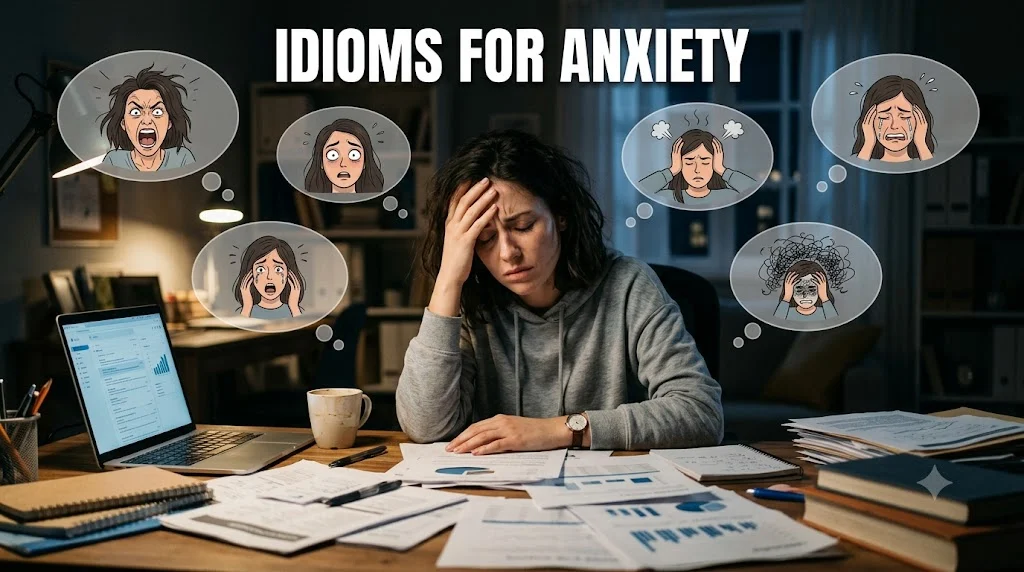
Idioms for “anxiety” are vivid expressions used to describe worry, fear, nervousness, and stress in a relatable and natural way.
Examples include: butterflies in your stomach, on edge, and bundle of nerves.
We all experience anxiety at some point in our lives. Whether it’s before a job interview, during an important presentation, or while waiting for life-changing news, anxiety manifests in ways that are often difficult to put into words. We say “I’m nervous” or “I’m worried,” but these simple phrases don’t always capture the intensity, the physical sensations, or the overwhelming nature of what we’re feeling.
That’s where idioms come in.
English is rich with colorful expressions that paint vivid pictures of our emotional states. When you say you have “butterflies in your stomach,” instantly people understand that fluttery, unsettling feeling before something important. When you describe yourself as “on edge,” listeners immediately grasp that tense, ready-to-snap sensation that anxiety creates.
These idioms are especially valuable in everyday conversations, storytelling, creative writing, and even professional settings when used appropriately. But to use them naturally and effectively, you need to understand their meanings, contexts, and the subtle nuances that make each one unique.
In this comprehensive guide, you’ll discover:
- 30+ powerful idioms for anxiety with clear meanings
- Real-life situations where each idiom fits perfectly
- Formal, casual, and creative examples for varied contexts
- Practical tips for using these idioms naturally
- Common mistakes to avoid when expressing anxiety
Let’s dive into the expressive world of anxiety idioms that will transform how you talk about worry, fear, and stress in 2026.
Quick Summary Table
| Situation | Idioms |
|---|---|
| Physical sensations of anxiety | Butterflies in your stomach, Heart in your mouth, Cold feet |
| Feeling nervous before events | Bundle of nerves, On tenterhooks, A bag of nerves |
| Being constantly worried | On edge, Wound up, Stressed out |
| Overwhelming fear and dread | Dreading something, Scared to death, Paralyzed with fear |
| Panic and loss of control | Having a panic attack, Losing your nerve, Freaking out |
| Hidden or quiet anxiety | A sinking feeling, Knot in your stomach, Walking on eggshells |
| Extreme stress response | Pulling your hair out, At your wit’s end, Driven to distraction |
🦋 Idioms for Physical Sensations of Anxiety
Anxiety isn’t just in your mind—it shows up in your body too. These idioms capture those physical feelings perfectly.
1. Butterflies in Your Stomach
One of the most universally recognized anxiety idioms, this phrase describes the fluttery, unsettled feeling in your stomach when you’re nervous.
Meaning: A nervous, fluttery feeling in your stomach before something important or anxiety-inducing
When People Use It: Before performances, presentations, important meetings, or romantic situations
Alternative Expression: Nervous feeling, gut reaction
Examples:
Formal: Before the board presentation, Sarah felt butterflies in her stomach despite her thorough preparation.
Casual: I always get butterflies in my stomach before a big exam. It’s so annoying!
Creative: The butterflies in her stomach were doing synchronized gymnastics, each flutter telling her something important was about to happen.
2. Heart in Your Mouth
This dramatic idiom captures the sensation of your heart racing so intensely that it feels like it’s risen to your throat.
Meaning: A feeling of intense fear, nervousness, or excitement where your heart beats rapidly
When People Use It: Moments of sudden shock, intense anticipation, or extreme nervousness
Alternative Expression: Heart racing, Palpitations
Examples:
Formal: As the verdict was announced, every person in the courtroom had their heart in their mouth.
Casual: My heart was in my mouth when I saw the car swerve toward us.
Creative: With her heart in her mouth, she stepped onto the stage, the spotlight blinding her to everything but her racing pulse.
3. Cold Feet
A classic idiom that specifically describes nervousness before making a significant commitment or decision.
Meaning: Nervousness or hesitation before taking important action
When People Use It: Before weddings, major career decisions, or any life-changing choice
Alternative Expression: Second thoughts, Hesitation
Examples:
Formal: Despite months of planning, several investors showed signs of cold feet at the final meeting.
Casual: I almost got cold feet about moving to another city, but I’m glad I went through with it.
Creative: Cold feet crept up his spine as the wedding march began, every step toward the altar feeling heavier than the last.
4. Knot in Your Stomach
This idiom describes the tight, uncomfortable physical sensation that often accompanies worry or anxiety.
Meaning: A tight, uncomfortable feeling in your stomach caused by worry or fear
When People Use It: When anticipating something stressful or unpleasant
Alternative Expression: Gut-wrenching feeling
Examples:
Formal: The discovery of the financial discrepancies created a knot in every manager’s stomach.
Casual: I had a knot in my stomach all day waiting for the test results.
Creative: The knot in her stomach tightened with every ring of the phone, each unanswered call adding another twist to the invisible rope.
5. Lump in Your Throat
This idiom captures the physical sensation of feeling like you can’t swallow properly because of emotional distress.
Meaning: A tight feeling in your throat when experiencing strong emotion or anxiety
When People Use It: During emotional moments, before speaking in public, or when holding back tears
Alternative Expression: Choked up
Examples:
Formal: The speaker had a lump in her throat as she delivered the difficult news to the staff.
Casual: I had a lump in my throat the whole time I was giving my speech.
Creative: The lump in his throat was a stubborn guest that refused to leave, making every word of his apology a battle.
6. Shaking Like a Leaf
A vivid description of visible physical trembling caused by fear or nervousness.
Meaning: Trembling or shaking visibly from fear, cold, or nervousness
When People Use It: After traumatic events, during extremely stressful moments, or in freezing conditions
Alternative Expression: Trembling with fear
Examples:
Formal: The witness was shaking like a leaf as she recounted the events of that night.
Casual: I was shaking like a leaf after that near-miss car accident.
Creative: He stood shaking like a leaf in the autumn wind, fear rattling through every bone in his body.
7. Pins and Needles
Though often used for physical numbness, this idiom also describes the tense, tingling sensation of nervous anticipation.
Meaning: A prickling sensation, often used metaphorically for nervous anticipation
When People Use It: When waiting nervously for news or outcomes
Alternative Expression: On edge (similar but more mental)
Examples:
Formal: The entire office was on pins and needles waiting for the merger announcement.
Casual: I’ve been on pins and needles all week waiting for my college acceptance letter.
Creative: The wait put everyone on pins and needles, each second stretching like an eternity.
😰 Idioms for Feeling Nervous Before Events
Before big moments, our anxiety levels spike. These idioms capture the pre-event jitters perfectly.
8. Bundle of Nerves
This is one of the most common idioms for describing someone who is extremely nervous or anxious.
Meaning: Extremely nervous, anxious, or tense
When People Use It: Before performances, interviews, exams, or any high-pressure situation
Alternative Expression: Nervous wreck
Examples:
Formal: The young performer was a bundle of nerves before her debut concert.
Casual: I’m a bundle of nerves whenever I have to speak in front of people.
Creative: She arrived at the interview as a bundle of nerves, her carefully rehearsed answers scattering like startled birds at every question.
9. On Tenterhooks
A more formal-sounding idiom that describes the intense anticipation of waiting for something.
Meaning: In a state of nervous suspense or anxious anticipation
When People Use It: When waiting for important news, results, or outcomes
Alternative Expression: On pins and needles
Examples:
Formal: The entire organization was on tenterhooks throughout the restructuring process.
Casual: I’ve been on tenterhooks since I submitted my job application.
Creative:* The days before the championship had everyone on tenterhooks, each hour stretching like a year of waiting.
10. A Bag of Nerves
Similar to “bundle of nerves,” this idiom describes someone visibly anxious and tense.
Meaning: Someone who is extremely nervous or anxious
When People Use It: Describing someone’s visible anxiety before important events
Alternative Expression: Nervous wreck, Bundle of nerves
Examples:
Formal: Before the product launch, the CEO was a bag of nerves despite his confident exterior.
Casual: I’m a total bag of nerves before dental appointments.
Creative: He was a bag of nerves, his composure held together by nothing more than sheer willpower.
11. Breaking Out in a Cold Sweat
This idiom captures the physical manifestation of sudden, intense anxiety.
Meaning: Suddenly sweating due to nervousness, fear, or anxiety
When People Use It: During moments of extreme stress or panic
Alternative Expression: Breaking a sweat
Examples:
Formal: The auditor broke out in a cold sweat when he noticed discrepancies in the accounts.
Casual: I broke out in a cold sweat when my boss asked me to present the quarterly report.
Creative: The dream was so vivid that she woke up breaking out in a cold sweat, relief washing over her when she realized it wasn’t real.
😩 Idioms for Being Constantly Worried
When anxiety isn’t a momentary feeling but a persistent state, these idioms come in handy.
12. On Edge
One of the most versatile idioms for describing a state of constant tension and irritability.
Meaning: Tense, nervous, or irritable due to stress or worry
When People Use It: When someone is easily startled, impatient, or quick to react negatively
Alternative Expression: Jumpy, Tense
Examples:
Formal: The ongoing negotiations have left everyone on edge for weeks.
Casual: I’ve been on edge ever since I heard about the budget cuts.
Creative: Living on the edge of anxiety had become his new normal, every sound a potential threat, every silence a warning.
13. Wound Up
This idiom describes the tight, coiled feeling of someone who is extremely tense and anxious.
Meaning: Extremely tense, anxious, or stressed
When People Use It: When someone is visibly stressed and needs to relax
Alternative Expression: Tense, Keyed up
Examples:
Formal: The months of deadline pressure had left everyone wound up and exhausted.
Casual: I’m so wound up about this interview that I can’t sleep.
Creative: He was wound up so tight that even his relaxed breathing looked like a struggle.
14. Stressed Out
Perhaps the most common anxiety idiom in modern usage, this phrase has become part of everyday vocabulary.
Meaning: Extremely stressed, overwhelmed, or anxious
When People Use It: When feeling overwhelmed by work, life, or responsibilities
Alternative Expression: Overwhelmed, Burnt out
Examples:
Formal: Many employees are stressed out by the rapidly changing work environment.
Casual: I’m so stressed out about these exams that I can’t focus.
Creative: She was stressed out to the point where even her coffee couldn’t calm the storm inside her head.
15. At the End of Your Rope
This idiom describes feeling completely overwhelmed with no resources left to cope.
Meaning: Having no more patience, strength, or resources to handle a situation
When People Use It: When someone is completely overwhelmed and exhausted
Alternative Expression: At your wit’s end, Fed up
Examples:
Formal: Many caregivers find themselves at the end of their rope without adequate support.
Casual: I’m at the end of my rope with all these deadlines.
Creative: She was at the end of her rope, clinging to the last strand of hope like a climber losing grip on a cliff.
16. Walking on Eggshells
This idiom describes the careful, anxious behavior of someone who is afraid of upsetting others.
Meaning: Being extremely careful not to offend or upset someone
When People Use It: In tense relationships or situations where any misstep could cause conflict
Alternative Expression: Treading carefully
Examples:
Formal: Department meetings felt like walking on eggshells after the conflict between the two directors.
Casual: I feel like I’m walking on eggshells around my roommate lately.
Creative: Every word felt like walking on eggshells, each syllable a potential landmine waiting to explode.
😱 Idioms for Overwhelming Fear and Dread
These idioms describe the more intense, paralyzing forms of anxiety.
17. Dreading Something
A straightforward but powerful way to express intense fear about a future event.
Meaning: Feeling extremely worried or afraid about something that will happen
When People Use It: When anticipating something unpleasant or frightening
Alternative Expression: Apprehensive, Fearful
Examples:
Formal: The employees were dreading the upcoming layoff announcements.
Casual: I’m absolutely dreading my dentist appointment tomorrow.
Creative: She lay awake dreading the morning, knowing that the sunrise would bring everything she feared.
18. Scared to Death
A dramatic but commonly used idiom for extreme fear.
Meaning: Extremely frightened
When People Use It: When something causes sudden, intense fear
Alternative Expression: Terrified, Petrified
Examples:
Formal: Many people are scared to death of public speaking.
Casual: I was scared to death when I heard the noise downstairs.
Creative: He was scared to death of disappointing his parents, a fear that had shaped every decision of his adult life.
19. Paralyzed with Fear
This idiom describes the immobilizing effect that intense fear can have.
Meaning: Unable to move or act because of extreme fear
When People Use It: When fear prevents someone from taking action
Alternative Expression: Frozen with fear
Examples:
Formal: Some witnesses become paralyzed with fear and cannot testify effectively.
Casual: I was paralyzed with fear when I saw the snake.
Creative:* She stood paralyzed with fear, her feet planted to the ground as if the earth itself refused to let her escape.
20. Fear of the Unknown
A specific form of anxiety about what might happen in the future.
Meaning: Anxiety about future events or outcomes that are uncertain
When People Use It: When facing major life changes or uncertain situations
Alternative Expression: Anticipatory anxiety
Examples:
Formal: The fear of the unknown often prevents people from making necessary changes.
Casual: My fear of the unknown is making me second-guess my decision to move.
Creative:* The fear of the unknown was a shadow that followed him everywhere, growing darker with every unanswered question.
😨 Idioms for Panic and Loss of Control
These idioms capture moments when anxiety escalates into full-blown panic.
21. Having a Panic Attack
Though not technically an idiom, this phrase is commonly used to describe sudden, intense anxiety.
Meaning: Experiencing sudden, overwhelming anxiety with physical symptoms
When People Use It: When anxiety becomes suddenly overwhelming
Alternative Expression: Panicking, Freaking out
Examples:
Formal: Several people had panic attacks during the emergency drill.
Casual: I almost had a panic attack when I realized I’d lost my wallet.
Creative: The panic attack came out of nowhere, a wave of terror that crashed over her without warning.
22. Losing Your Nerve
This idiom describes the moment when your courage fails you.
Meaning: Losing the courage or confidence to do something
When People Use It: When someone backs out of something due to fear
Alternative Expression: Getting cold feet
Examples:
Formal: The young pilot lost his nerve during the first training flight.
Casual: I almost lost my nerve when I saw how high the diving board was.
Creative:* He felt his nerve slipping away like sand through fingers, each moment of hesitation making the leap seem more impossible.
23. Freaking Out
A very common, informal idiom for sudden panic or extreme worry.
Meaning: Reacting with extreme anxiety, fear, or panic
When People Use It: During unexpected crises or moments of extreme stress
Alternative Expression: Panicking, Going wild
Examples:
Formal: The staff began freaking out when they realized the system had crashed.
Casual: I’m totally freaking out about tomorrow’s presentation.
Creative:* Freaking out had become her default setting, panic the background noise of her everyday life.
24. Hitting Panic Mode
A more modern idiom for the moment when calm is replaced by panic.
Meaning: Entering a state of extreme anxiety or fear
When People Use It: When stress suddenly escalates into panic
Alternative Expression: Panicking
Examples:
Formal: The entire team hit panic mode when they realized the deadline was impossible.
Casual: I hit panic mode when I saw my phone was dead and I was lost.
Creative:* The news hit him like a wave, and he immediately hit panic mode, thoughts scattering like startled animals.
🧠 Idioms for Hidden or Quiet Anxiety
Not all anxiety is loud. These idioms describe the quieter, more internal experiences of worry.
25. A Sinking Feeling
A phrase that describes the sudden, unpleasant realization that something is wrong.
Meaning: A feeling that something bad is going to happen
When People Use It: When you suddenly realize bad news or anticipate trouble
Alternative Expression: Bad feeling
Examples:
Formal: He had a sinking feeling when the company missed its revenue targets.
Casual: I had a sinking feeling the moment I opened the letter.
Creative:* The sinking feeling in her stomach told her everything she needed to know before he even spoke.
26. Gnawing Feeling
This idiom describes persistent, unsettling worry that eats away at you.
Meaning: A persistent, nagging feeling of worry
When People Use It: When anxiety lingers and won’t go away
Alternative Expression: Nagging feeling
Examples:
Formal: Despite reassurances, she had a gnawing feeling that something was wrong.
Casual: I had this gnawing feeling that I’d forgotten something important.
Creative:* The gnawing feeling in the pit of her stomach was like a persistent guest that refused to leave, eating away at her peace of mind.
27. Internal Turmoil
A more formal expression for internal emotional chaos.
Meaning: Emotional chaos or conflict happening inside a person
When People Use It: When describing someone’s internal struggles
Alternative Expression: Inner conflict
Examples:
Formal: Despite his calm exterior, the executive was in a state of internal turmoil.
Casual: She’s been going through a lot of internal turmoil lately.
Creative: Behind her steady smile raged an internal turmoil that threatened to tear her apart from the inside.
28. Mind Going a Mile a Minute
A vivid idiom for racing thoughts during anxiety.
Meaning: Thinking very fast, often in a worried or anxious way
When People Use It: When someone can’t stop worrying or thinking
Alternative Expression: Racing thoughts
Examples:
Formal: His mind was going a mile a minute during the stressful negotiation.
Casual: My mind’s going a mile a minute and I can’t sleep.
Creative:* Her mind raced at a mile a minute, each thought a wild horse galloping off to a different catastrophe.
😤 Idioms for Extreme Stress Response
These idioms describe how people act when anxiety becomes overwhelming.
29. Pulling Your Hair Out
A dramatic idiom for extreme frustration or stress.
Meaning: Extremely frustrated, stressed, or worried
When People Use It: When dealing with extremely frustrating situations
Alternative Expression: Going wild with stress
Examples:
Formal: The project manager was pulling her hair out trying to meet unreasonable deadlines.
Casual: This math problem is making me pull my hair out!
Creative:* He was pulling his hair out with frustration, each tug a silent scream against the impossible situation.
30. At Your Wit’s End
This idiom describes the moment when you’ve completely exhausted your mental resources.
Meaning: Completely out of patience or resources; extremely frustrated
When People Use It: When nothing seems to work and you’ve tried everything
Alternative Expression: At the end of your rope
Examples:
Formal: After months of negotiations without progress, the diplomatic team was at its wit’s end.
Casual:* I’m at my wit’s end with these technical issues.
Creative:* She was at her wit’s end, a sailor lost at sea with no land in sight and a compass that had gone mad.
31. Driven to Distraction
An idiom that describes being so worried or stressed that you can’t focus.
Meaning: So worried or stressed that you can’t concentrate
When People Use It: When anxiety prevents someone from being productive
Alternative Expression: Unable to focus
Examples:
Formal:* The constant noise of the renovation drove everyone to distraction.
Casual:* I’m being driven to distraction by all these deadlines.
Creative:* The worry drove her to distraction, her thoughts bouncing off each other like desperate birds trapped in a room.
32. Losing Sleep Over Something
A very practical idiom describing how worry prevents sleep.
Meaning: Worrying so much about something that you can’t sleep
When People Use It: When anxiety keeps someone up at night
Alternative Expression: Tossing and turning
Examples:
Formal:* The CEO was losing sleep over the company’s declining profits.
Casual:* I’ve been losing sleep over this decision for weeks.
Creative:* She lost sleep over every worry until her pillow became a confessor of all her anxious thoughts.
🎯 How to Use Anxiety Idioms Naturally
Using anxiety-related idioms can instantly make your language more expressive and relatable. But to use them naturally, you need to understand the nuances of tone, context, and timing. Let’s explore how to master these idioms in real-life communication.
Match the Situation
Not all anxiety idioms mean the same thing. Some describe physical sensations, others express ongoing worry, and some capture moments of panic. The key is choosing the right one for your specific situation.
- For physical anxiety sensations:
👉 “I have butterflies in my stomach before every presentation.”
👉 “My heart was in my mouth when the results were announced.” - For ongoing worry:
👉 “I’ve been on edge all week waiting for news.”
👉 “I’m completely stressed out about these exams.” - For panic moments:
👉 “I completely freaked out when I saw the fire.”
👉 “I almost had a panic attack when I realized I was lost.” - For anticipatory anxiety:
👉 “I’m dreading tomorrow’s meeting with HR.”
👉 “I’ve got a sinking feeling about this decision.”
💡 Insight: Think of anxiety idioms as emotional shortcuts that instantly communicate the intensity and nature of your worry. The right idiom paints a picture that words alone cannot.
Consider Your Audience
Here’s where many speakers and writers go wrong: not every anxiety idiom is appropriate for every setting.
Some anxiety idioms can sound:
- Too casual for professional settings
❌ “I’m freaking out about the quarterly report.”
✅ “I’m feeling quite stressed about the quarterly report.” - Too dramatic for everyday conversation
❌ “I’m being driven to distraction by these minor issues.”
✅ “I’m really frustrated by these minor issues.” - Too informal for serious contexts
❌ “I’m pulling my hair out over this.”
✅ “I’m extremely frustrated by this situation.”
💡 Pro Tip: When in doubt, use a more neutral expression in professional or formal settings. Save vivid idioms for casual conversations, personal writing, and storytelling.
Use Sparingly
Idioms are like spices—a little goes a long way. Too many in one conversation can overwhelm the listener and make your speech feel unnatural.
Consider this example:
❌ “I’m so stressed out, I’m freaking out, and I’m pulling my hair out over this situation. I’ve got butterflies in my stomach and I’m walking on eggshells…”
This sounds forced and unnatural.
Instead, choose one strong, relevant idiom:
✅ “I’m completely stressed out about this situation.”
💡 Golden Rule: One well-chosen idiom is more impactful than five forced ones.
Match the Intensity
Anxiety exists on a spectrum from mild nervousness to severe panic. Your choice of idiom should reflect the intensity you’re trying to express.
Mild anxiety:
👉 “I have a few butterflies.”
👉 “I’m a bit nervous.”
Moderate anxiety:
👉 “I’m stressed out.”
👉 “I’m on edge.”
Severe anxiety:
👉 “I’m terrified.”
👉 “I’m paralyzed with fear.”
💡 Memory Trick: The more dramatic the idiom, the more intense the anxiety it describes. Match your idiom to your actual level of distress.
⚠️ Common Mistakes to Avoid
Even advanced English speakers slip up when using anxiety idioms. Avoid these common pitfalls to sound more natural and confident:
❌ Using Offensive or Insensitive Language
Some idioms about fear or worry can unintentionally minimize serious mental health conditions.
Mistake:
❌ “She’s so OCD about her workspace.”
❌ “He’s having a nervous breakdown over a small issue.”
Better alternatives:
✅ “She’s very particular about her workspace.”
✅ “He’s very stressed about this issue.”
Why it matters: Mental health deserves sensitivity. Avoid using clinical terms casually.
❌ Confusing “Fun Worry” with Real Anxiety
Context matters enormously. The same expression can mean different things in different situations.
Example 1 (fun):
👉 “That rollercoaster had my heart in my mouth!”
Example 2 (genuine worry):
👉 “I’ve had my heart in my mouth since they called.”
The difference: The first suggests excitement, the second suggests real fear.
❌ Using Inappropriate Idioms for Formal Settings
Some anxiety idioms are simply too casual for professional communication.
Mistake:
❌ “I’m totally freaking out about the project deadline.”
Better formal alternatives:
✅ “I’m quite concerned about meeting the project deadline.”
✅ “The project deadline is causing significant stress.”
❌ Overdramatizing Minor Concerns
Using extreme idioms for small issues can make you sound over-dramatic.
Mistake:
❌ “I was scared to death when I saw the price of that coffee.”
Better:
✅ “I was surprised by the price of that coffee.”
🚀 Practice Method That Actually Works
Learning idioms isn’t about memorization; it’s about integration. Here’s a proven method for making anxiety idioms part of your active vocabulary:
1. Learn 3 Idioms Daily
Don’t overwhelm yourself. Focus on a small group and master them before moving on.
Day 1: Butterflies in your stomach, On edge, Stressed out
Day 2: Bundle of nerves, Cold feet, Sinking feeling
Day 3: Freaking out, Paralyzed with fear, At your wit’s end
2. Use Them in Real Conversations
Practice using idioms in actual situations. Even simple, low-stakes sentences help build confidence.
Before a meeting:
👉 “I have butterflies, but I’m prepared.”
When things get stressful:
👉 “I’m so stressed out right now.”
When you’re worried:
👉 “I’ve got a sinking feeling about this.”
3. Write One Creative Sentence for Each
This is where real growth happens. Instead of basic sentences, craft vivid, memorable ones.
❌ Basic: “I feel nervous.”
✅ Creative: “The butterflies in her stomach were doing synchronized gymnastics.”
❌ Basic: “I’m worried.”
✅ Creative: “The worry drove her to distraction, her thoughts bouncing off each other like desperate birds.”
💡 Memory Trick: The more visual and emotional your practice sentence, the easier the idiom sticks in your mind.
4. Notice Idioms in Context
Pay attention to how native speakers use anxiety idioms in movies, TV shows, podcasts, and conversations.
Watch for:
- When they use idioms
- How they phrase them
- The emotional tone
- The physical gestures or expressions
Example from media:
Someone says, “I’ve got butterflies,” with a nervous laugh before a performance.
Someone says, “I’m at my wit’s end,” with exhausted expression and slumped shoulders.
5. Create a Personal Phrase Book
Keep a digital or physical notebook of anxiety idioms you want to master. Include:
- The idiom
- Its meaning
- A real-life example
- Your own creative sentence
- A note about when to use it
🎓 Advanced Tips for Natural Usage
Ready to take your anxiety idioms to the next level? These advanced tips will help you sound like a native speaker:
Use Idioms in Storytelling
Anxiety idioms are perfect for creating vivid, emotional moments in stories.
Example:
Instead of: “She was nervous before the interview.”
Write: “The butterflies in her stomach were having a full-blown rebellion as she walked into the interview room.”
Combine Idioms Effectively
Sometimes, two idioms work together to create a complete picture.
Example:
“Despite having butterflies in her stomach, she didn’t get cold feet. She took a deep breath and walked on stage.”
Use Idioms to Show Character
In creative writing, characters’ use of anxiety idioms reveals their personality.
Highly emotional character:
“I’m absolutely freaking out! My heart is in my mouth!”
Reserved character:
“I confess to having some butterflies.”
Composed character:
“I must admit, I’m feeling a bit on edge.”
Match Tone to Situation
The same anxiety can be expressed differently depending on who you’re speaking to.
- To a friend:
“I’m totally freaking out about this presentation!” - To a colleague:
“I’m quite anxious about tomorrow’s presentation.” - To your boss:
“I want to ensure I’m well-prepared for tomorrow’s presentation.”
📝 Real-Life Application: Practice Scenarios
To truly master anxiety idioms, you need to practice using them in realistic situations. Try these scenarios:
Scenario 1: Job Interview
You’re about to enter a high-stakes job interview. Express your anxiety naturally.
Too basic: “I’m nervous.”
Better: “I’ve got butterflies in my stomach, but I’m ready.”
Best: “The butterflies in my stomach are doing gymnastics, but I’ve prepared for this interview for weeks.”
Scenario 2: Medical Test Results
You’re waiting for important test results. Express your ongoing anxiety.
Too basic: “I’m worried.”
Better: “I’ve been on edge all week waiting.”
Best: “I’ve been on tenterhooks since the test. Every time the phone rings, my heart leaps into my throat.”
Scenario 3: Panic Moment
You realize you’ve lost your wallet in a crowded place.
Too basic: “I’m scared.”
Better: “I completely freaked out!”
Best: “When I realized my wallet was gone, I was paralyzed with fear. My mind was going a mile a minute trying to remember where I’d last used it.”
Scenario 4: Ongoing Stress
You’re overwhelmed by multiple deadlines at work.
Too basic: “I’m stressed.”
Better: “I’m so stressed out right now.”
Best: “I’m at my wit’s end with all these deadlines. I’ve been losing sleep over this project for weeks.”
Scenario 5: Comforting Someone
A friend is obviously anxious. Use idioms to show empathy.
Instead of: “Calm down.”
Try: “I can see you’re a bundle of nerves. Let me help.”
Or: “I know you’re on edge about this. We’ll handle it together.”
🌟 The Power of Using Anxiety Idioms
When you use anxiety idioms effectively, you achieve several things:
1. Create Emotional Connection
Idioms help others understand exactly how you’re feeling. “I’m a bundle of nerves” says more than “I’m nervous” ever could.
2. Sound More Natural
Native English speakers use idioms constantly. Using them makes your speech more natural and fluent.
3. Show Emotional Intelligence
Choosing the right idiom for the situation demonstrates emotional sophistication and communication skill.
4. Express Yourself More Precisely
Anxiety has many forms—butterflies, dread, panic, persistent worry. Each idiom captures a specific shade of anxiety.
5. Add Color to Your Communication
Instead of flat, boring language, idioms add texture and vividness to your expression.
💡 Summary: Choosing the Right Idiom for the Situation
| If you feel… | Use this idiom… | Not this… |
|---|---|---|
| Mildly nervous | Butterflies in your stomach | Freaking out |
| Constantly worried | On edge | Paralyzed with fear |
| Extremely frightened | Scared to death | A bit nervous |
| Physically anxious | Heart in your mouth | Stressed out |
| About to panic | Freaking out | Butterflies |
| Dreading something | Dreading it | Nervous |
| Overwhelmed | At your wit’s end | On edge |
| Uneasy about something | Sinking feeling | Worried |
| Tense and irritable | Wound up | Nervous |
| Unable to make a decision | Cold feet | Anxious |
🧠 Quick Reference:
Physical Sensations
- Butterflies in your stomach – Nervous fluttery feeling
- Heart in your mouth – Intense nervousness
- Cold feet – Hesitation before commitment
- Knot in your stomach – Tight anxious feeling
- Lump in your throat – Emotional tightness
- Shaking like a leaf – Trembling from fear
- Pins and needles – Nervous anticipation
Nervous States
- Bundle of nerves – Extremely nervous
- On tenterhooks – Anxious anticipation
- A bag of nerves – Very anxious
- Breaking out in a cold sweat – Sudden anxiety
- On edge – Tense and irritable
- Wound up – Extremely tense
- Stressed out – Overwhelmed by stress
Overwhelming Fear
- Dreading something – Intense fear of future event
- Scared to death – Extremely frightened
- Paralyzed with fear – Immobilized by fear
- Fear of the unknown – Anxiety about uncertainty
Panic States
- Having a panic attack – Sudden intense panic
- Losing your nerve – Courage failing
- Freaking out – Reacting with panic
- Hitting panic mode – Sudden panic onset
Hidden Anxiety
- A sinking feeling – Dread realization
- Gnawing feeling – Persistent worry
- Internal turmoil – Inner chaos
- Mind going a mile a minute – Racing thoughts
Stress Responses
- Pulling your hair out – Extreme frustration
- At your wit’s end – Completely exhausted
- Driven to distraction – Cannot focus
- Losing sleep over something – Worry prevents sleep
- Walking on eggshells – Careful anxious behavior
- At the end of your rope – No resources left
📌 Practice Sentences
Test your understanding by choosing the right idiom for each scenario:
- Before a major presentation, you feel fluttery in your stomach.
Answer: “I have butterflies in my stomach.” - You’ve been waiting for important news all day and can’t relax.
Answer: “I’ve been on edge all day.” - You’re extremely overwhelmed by multiple deadlines.
Answer: “I’m completely stressed out.” - You experience sudden, intense panic when you hear a strange noise.
Answer: “I completely freaked out!” - You feel a sense of dread about an upcoming situation.
Answer: “I’ve got a sinking feeling about this.”
🎓 Conclusion
Anxiety idioms are a powerful tool for expressing worry, fear, and stress in a way that feels natural, relatable, and emotionally honest. Whether you’re describing physical sensations like “butterflies in your stomach,” expressing ongoing worry like being “on edge,” or capturing moments of panic like “freaking out,” these expressions add depth and texture to your language.
The key to mastering them is simple:
Understand the context – Choose the right idiom for the situation.
Match the intensity – Don’t use dramatic idioms for mild concerns.
Practice regularly – Use them in real conversations and writing.
Be sensitive – Consider your audience and the setting.
Enjoy the process – These colorful expressions make communication more fun!
Remember, anxiety is a universal human experience. When you can describe it vividly and accurately, you connect more deeply with others. Your English becomes more authentic, expressive, and truly human.
Read More Related Articles:
- Idioms for Stress | Powerful Expressions to Describe Pressure Naturally In 2026
- Idioms for Anger | Powerful Expressions to Describe Anger Naturally In 2026
- Idioms for Short | Clever Expressions For Quick and Brief Things In 2026

Loganx River is a passionate writer at IdiomCrafter.com, where he explores the meanings and stories behind everyday expressions. He enjoys breaking down complex phrases into simple, easy-to-understand ideas for readers. When he’s not writing, he spends his time reading and collecting interesting sayings from different cultures.